Aspect ratio is one of those topics that can be hard to explain. Part of the confusion starts with the numerical system used to describe the ratio system. It has nothing to do with lens focal lengths, or depth of field or any of the other optical explanations of a film image. (Yes, camera sensors do have a set aspect ratio but you can crop an image to any size in post production so for now I’m concentrating on talking about a display aspect ratio. And, I’m leaving out the confusion over spherical vs. anamorphic lenses for another post.)
The simplest way to explain an aspect ratio is that it is a comparison of the horizontal length of a frame to the vertical length.
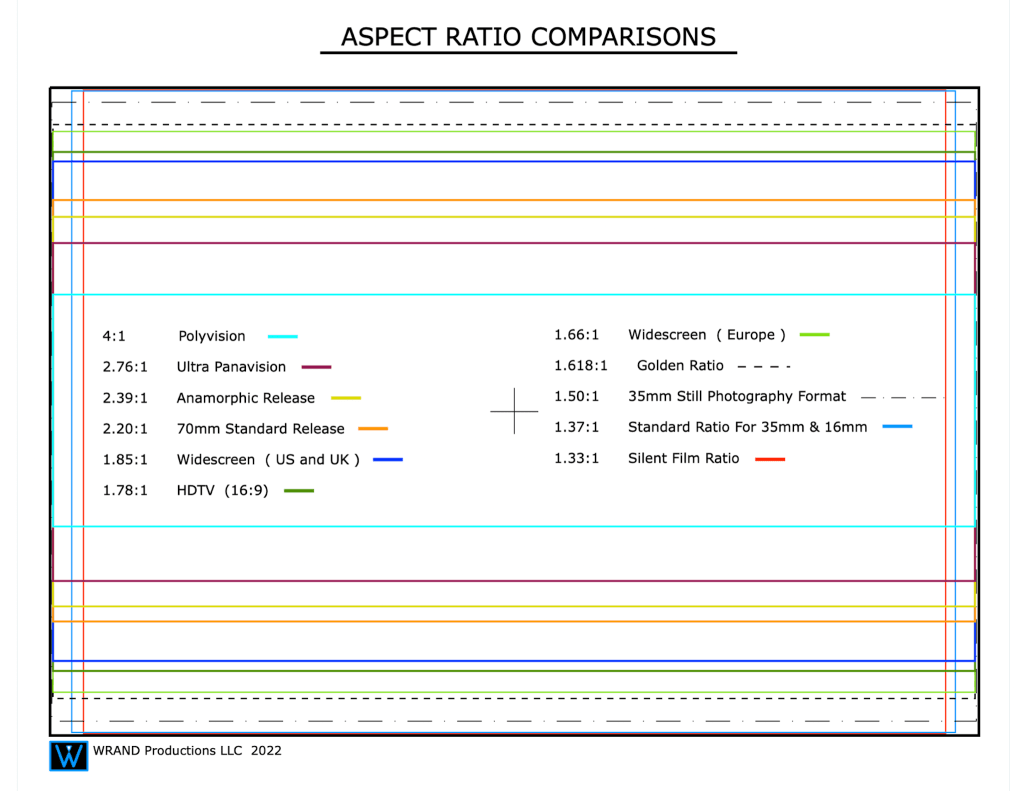
The first films, the silent ones, were shot with an aspect ratio of 1.33:1. The width of each image is 1.33 times the height.
The extreme projection aspect ratio up until now was a 4.1:1 format called Polyvision for the 1927 film, Napoleon, which was done by lining up three projectors and interlocking three 1:33 ratio film prints.
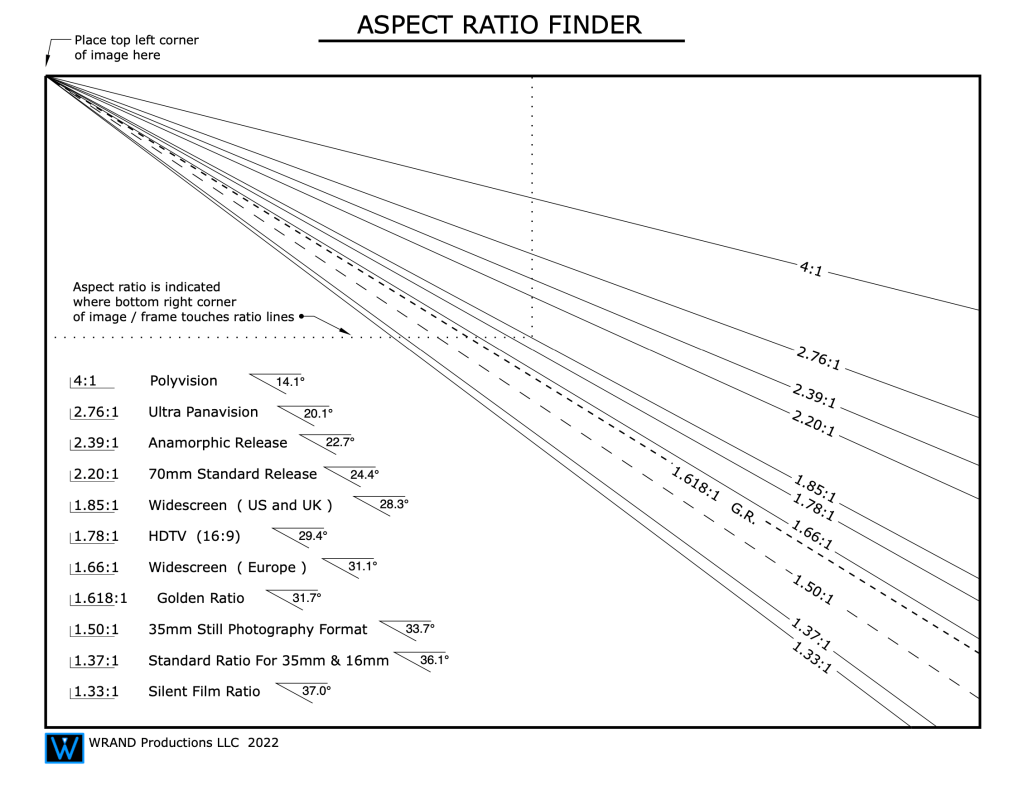
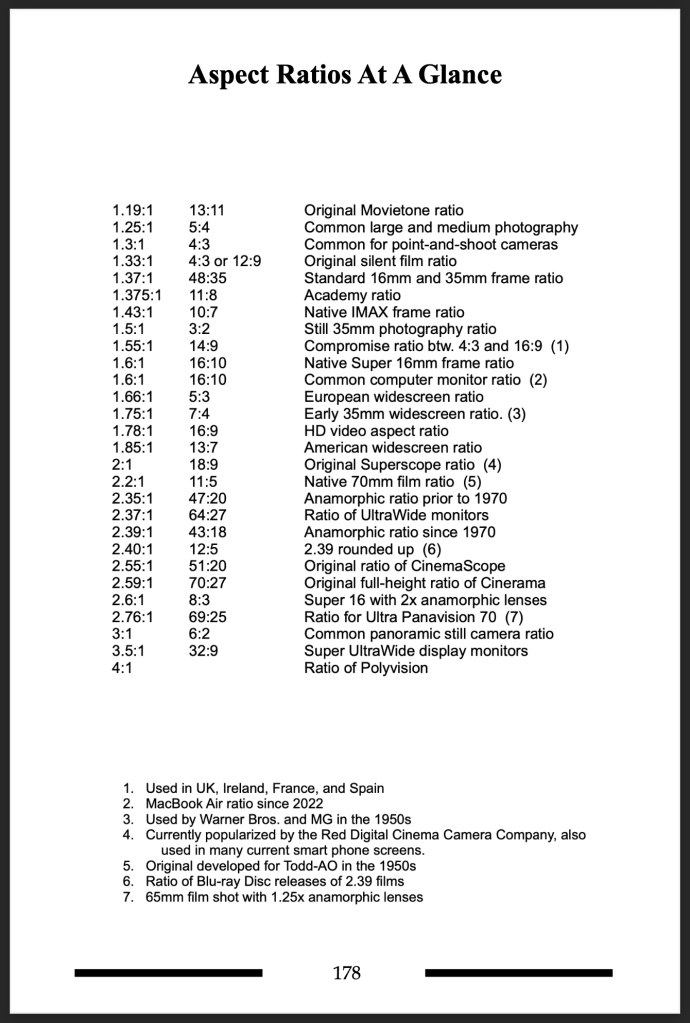
Here is a chart for determining the aspect ratio of an image.
Once television became a competitor to the movie theaters for audience eyeballs, the studios began to experiment with shooting films in wider formats to create a visual experience that TV couldn’t match because of the fixed 1.35:1 television screen size.
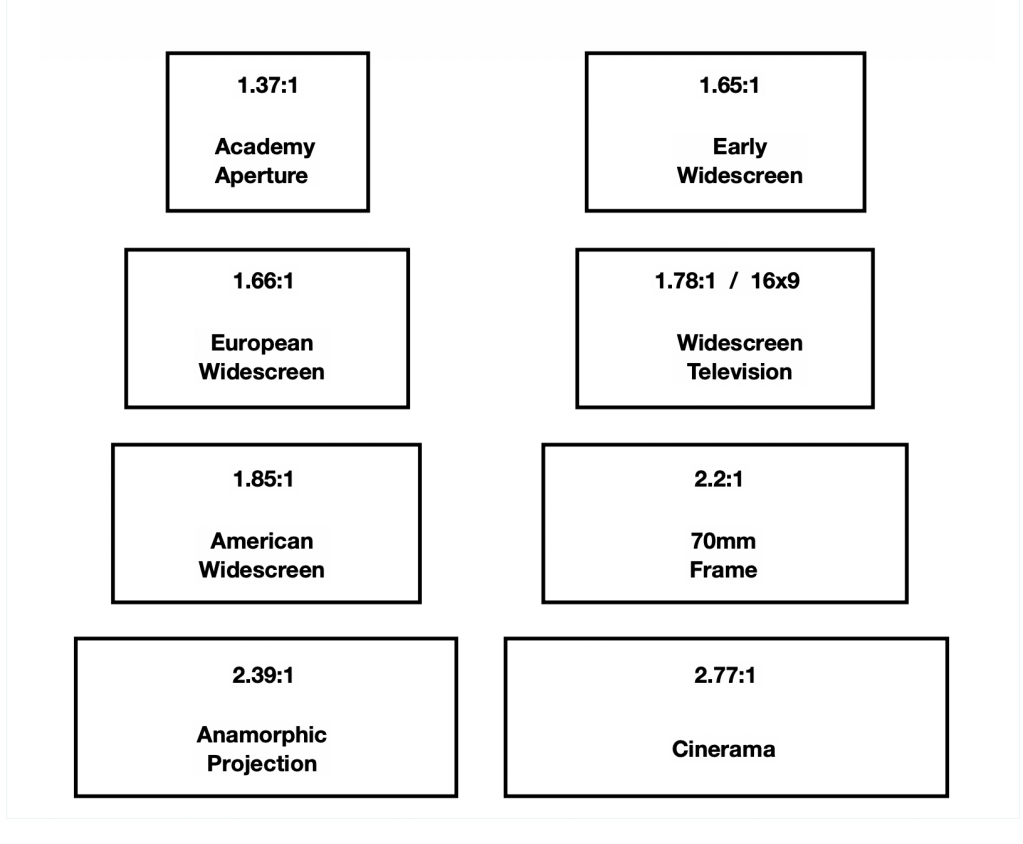
As filmmakers became tired of seeing their films shot in widescreen cropped for viewing on TVs, a compromise was made by changing the old 1:37 aspect ratio to 1.78. This opened up the standard screen width and changed the way even television shows were shot from the mid 1980’s.
Notice that some formats are referred to by different style or raio callout. The 1.78 format is also described as 16×9. Thus the typical smart phone screen ratio is known as 9×16 because of it’s being typically viewed as a vertical rather than horizontal image.
The best video explanation of film stock differences and aspect ratios was done by Ryan Coogler for Kodak as he talked about the different aspect ratios he used for shooting his film “Sinners”. He talks about a number of new projection systems that I didn’t know about.
Here is a video of Autumn Durald Arkapaw, the cinematographer and first woman to win the Best Cinematography Oscar, explaining how she shot the film in two different aspect ratios; IMAX and Ultra Panvision 65.
The latest story to excite below-the-line crew members in Los Angeles is the news that Ben Affleck and Matt Damon have made a deal with Netflix for their new film, The Rip. The contract includes a stipulation that provides for a bonus to the entire crew of the production if the show performs well on the streaming platform when it is released.
This one-time bonus would be in addition to the salaries which crew members were paid during the production.
Affleck told an interviewer at the Toronto Sun, “We wanted to codify a model that included 1,200 people on the crew, as well as the cast, because we firmly believe that when everyone is investing themselves, that makes it likelier that you’re going to have something that people connect to more.”
“How this business survives and thrives going forward, we believe, is going to be fundamentally related to the fact that (filmmaking) really is a collaborative art form, so (we are) seeking to incentivize all of those folks into making the best movie possible.”
Wether this idea can be a part of other contracts at other production companies and what it’s outcome for the crew will be remains to be seen.
The idea is a revolutionary first for large-scale Hollywood studio productions, but it’s an idea that isn’t a new one. The idea had been suggested to major studio executives 40 years ago by British producer Sir David Puttnam, and it didn’t go over well.
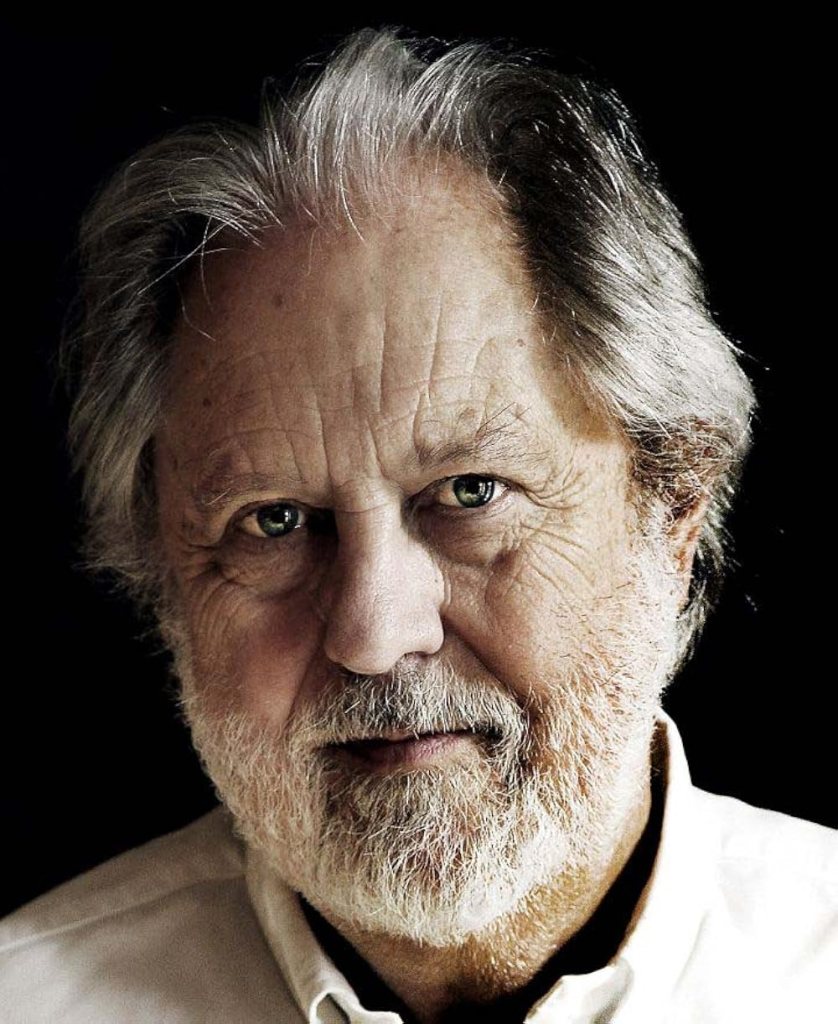
Sir David Puttnam – Photo by Alex Westcott/TODAY
In 1985, I was a Fellow in the Directing Program at the American Film Institute. AFI was a choice place to be and it was a heady experience, especially at that time. It was a time before the internet, or DVDs with director and producer commentaries, or an endless variety of interviews and how-tos by professional filmmakers.
It’s a place where major directors and producers will show up to screen and talk about their latest productions with the school’s community. We had visits from David Lean, Steven Spielberg, John Hughes, and others . Nearly every week there was another Hollywood luminary who none of us would have met in person if not for the AFI program.
One week it was announced that the guest artist would be Oscar winning Producer David Puttnam. And, he would be guest lecturing not just for the day but for the entire week. He would be screening his new film, The Killing Fields, which was nominated for five Oscars.
Also that week, he screened three of his other films; Midnight Express, Chariots Of Fire, and Local Hero. It was a whole week of master film classes by the man who had produced them. I wish they had been recorded.
Sir David was incredibly cordial, approachable, and even self-deprecating at times. He told us that when he was producing his first film, in an effort to prove he was on top of the goings-on of the production, he would go over the budget expenditures for each week. One week he caught a suspicious cost difference and called the line producer into his office.
The line producer looked confused when Puttnam pointed to the line item listed as Focus Puller. “How would this same equipment cost a different amount every week?” he asked. He said his moment of satifaction at having rooted out financial irresponsibility quickly turned to embarrasement when the man told him that the ‘Focus Puller’ was the title of a crew position, not a piece of equipment.
He was as generous with information as he was with his time. As we watched the films he would interject stories about the production challenges they had faced, both comical and daunting. He would examine a production from nuts to bolts and would barter with a director over, for instance, how many animals they actually needed in the background for a believable scene.
Very down to earth in his presentation style, he entertained us with stories of his current meetings with studio leadership. He was being courted at the time by a studio to take over as head of the operation. They were as surprised by his attitudes toward the current Hollywood system as he was by the studios’ expectations and business plans.
They showed him various options for homes in Los Angeles, all with huge properties and large pools and they told him about the options he could have as a company car. He said he didn’t want a house with a pool and that the cars they were suggesting were ridiculously large.
He had already ruffled feather among a number of studio heads and other producers with some of his comments about the Hollywood system, which he considered to be a “me-too” attitude, as he thought that the system seemed to be content with just copying other people’s successful films.
“You can’t do creative work in an environment like that”, he told an interviewer from TimeMagazine. In one communication to Columbia’s corporate owners, Coca Cola, he said, “The medium is too powerful […] to be left solely to the tyranny of the box office”.
He also pointed out his disgust at huge actor salaries. A New York Times article stated later, “What surprised and dismayed him most about Hollywood was the amateurishness.”
Once he was installed as the new studio head at Columbia, he made it clear that he wanted to make films he would be proud of. “I would be shattered if I could not look with pride at Columbia’s pictures. That would not be true of 75% of films made in Hollywood today”, he said. The New York Times also reported that he was “enough of a realist to want to make entertaining movies, and enough of an idealist to want his films to have social value.”
He wasn’t afraid to point out mistakes that he felt had been made in what were considered audience favorites. A writer for The Hollywood Reporter in 2016 wrote that “He had slammed the ending of the blockbuster E.T. The Extra Terrestrial because he thought the alien should have stayed dead.”
On some days he would express his ideas for revitalizing the entire studio production process including changing the pay structure that was in place in Hollywood. He wanted to move some of the profits down to the people who actually made the films. He had talked to a number of individuals about a possible system where a crew member could benefit from the film’s actual profits, choosing between taking a full salary or partial salary and points on the film’s box office.He said they looked at him as if he was mad.
Sir David would take over at Columbia Pictures in September of 1986. He would stay on as head of the studio for just 13 months. After his tenure, when asked about by a writer at The Hollywood Reporter, he said “Looking back, I was a good movie producer who made the mistake of being persuaded I could run a studio. I hated almost every day of it.”
On the last day of the week that he spent with us at AFI, he didn’t rush off as you would have expected of most people of his stature. When the lecture ended, he stuck around for small-talk. A group of us lined up to say goodbye and offer our thanks for the one-of-a-kind week of instruction and advice.
I hung out toward the back, not sure of what I’d say as a proper thank you. I approached him and he displayed a big smile and held out his hand. I thanked him and then, in a prescient, self-interested moment, I blurted out my unexpected question.
“Is it true?” I asked him. “Is the industry as hard on relationships as some say it is?”
His smile faded a little and he looked at me with a kind of empathy. “Yes”, he said. “It definitely can be.”
I was listening to the radio, looking out at the clouds and remembering the weather reports that David Lynch used to do each morning on NPR from his house on Mulholland Drive here in Los Angeles. It was at about that moment that I heard the announcement that he had passed away.
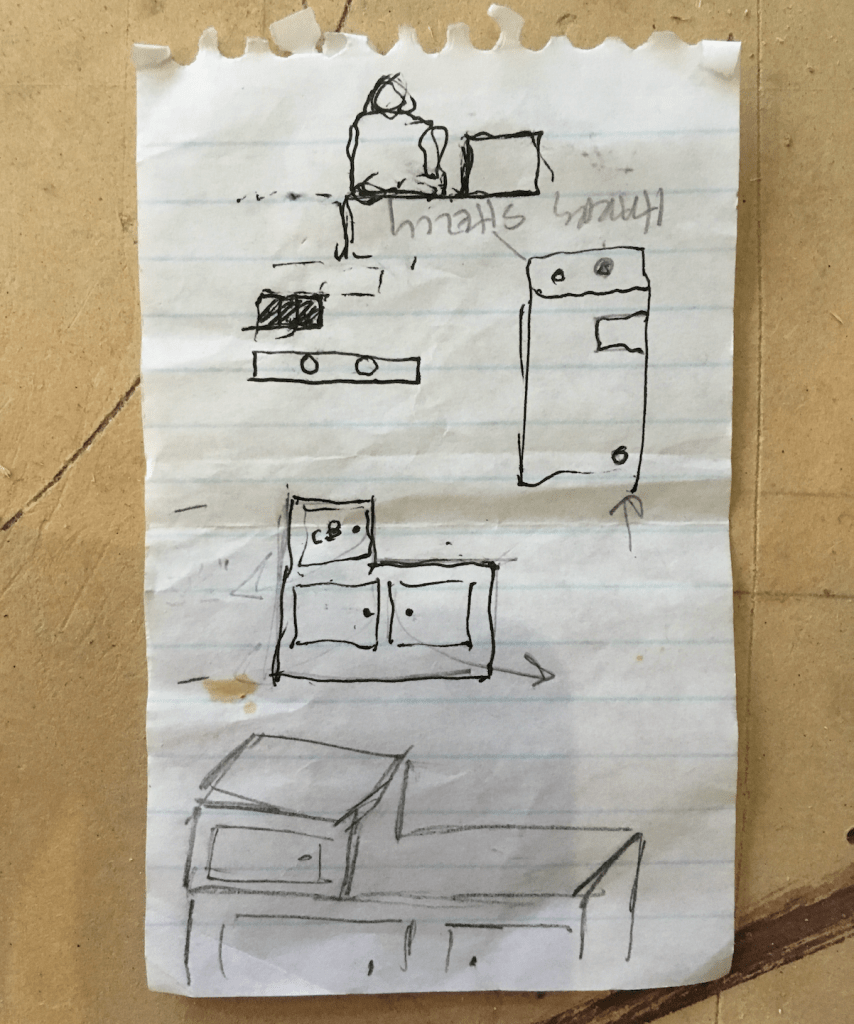
I’d been flipping through photos on my phone the day before when I found a shot of a crumpled piece of notepad paper. On it was a small sketch in black ink and pencil with some cryptic notes.
Years ago when I was working on a show on the Paramount Studios lot, I was walking through the mill when I saw a friend who waved me over to his work bench. He pulled a piece of paper from his tool bag and smoothed it out on the table.
I looked at it and squinted. “What is it?”, I asked him.
Sketch for set dressing by David Lynch
“It’s a sketch from David Lynch, he wants me to build it for a scene.” He described the conversation that had happened just a few minutes before. Lynch had come down from his office and searched him out, and conspiratorially explained to him what he needed for the scene the next day.
The sketch was of a small wooden storage unit that would fit between the front bucket seats of a van. He had explained to him in careful detail exactly what the unit had to do and the practical parts that were required to work in the scene.
“Where’s the construction drawing?”, I asked him, looking around at the plan bench. “This is it”, he said. When the Transportation Department delivered the van to the lot, he would measure the interior to see what size the box needed to be. Lynch trusted that he understood what it was he wanted and would follow through.
Suddenly everything I had heard about David from his early days at The American Film Institute was making sense. A common frustration for directors, particularly ones who are artists, is to have a last-minute idea and know that the normal steps you have to take through a film company hierarchy don’t always produce results as quickly as you want them to.
Instead of going to the Production Designer with his request, which would then get passed to an Art Director, who would then get a Set Designer to measure the vehicle, model the box for approval and then create a construction drawing, Lynch made a quick sketch and went directly to the guy who he knew would end up building it. Voila. Complex process streamlined.
In 1970, Lynch applied to The American Film Institute Conservatory by submitting a short film he had made and was offered the opportunity to attend as well as the money to make a short film he had planned for some time whose cost to produce was beyond his means.
He received a call from Tony Vellani, the director of the school, who offered him a place at the Conservatory and $7,200 to make the film.
At AFI, Lynch started work on a film called Gardenback, but was so frustrated in the process by what he felt were constant interference’s that he left at the beginning of his second year.
Vellani and others of the school administration felt that he was one of their best students and convinced him to come back by promising that he could finish his film without any more interference. He abandoned Gardenback and started on another film that would become the feature-length film, Eraserhead.
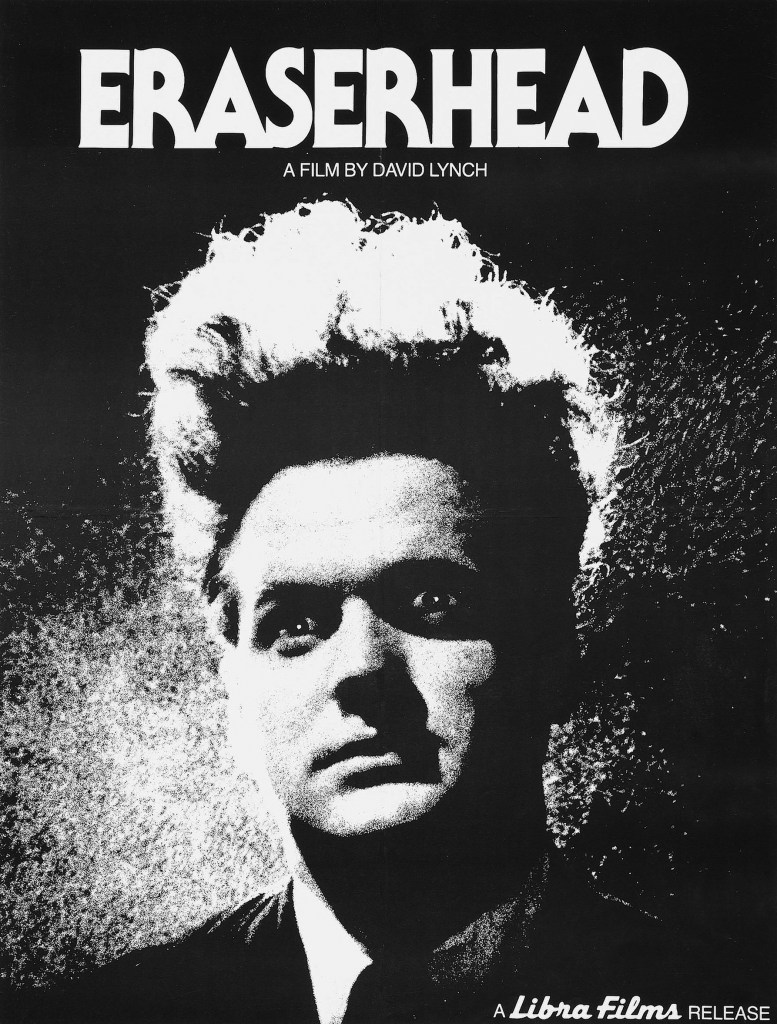
The poster for Eraserhead – Libra Films International 1977
Initially the concept for the film was opposed by several of the AFI administrators who felt that it veered too far from the typical Hollywood narrative film, but they finally relented when the dean, Frank Daniel, threatened to resign if they vetoed it. The story is said to be inspired by Lynches own fear of fatherhood and his experiences living in a crime-ridden neighborhood in Philadelphia while going to college. Shot over a period of nearly four years, the surreal horror film was initially panned by most critics but became a midnight movie cult favorite along with films like The Rocky Horror Picture Show.
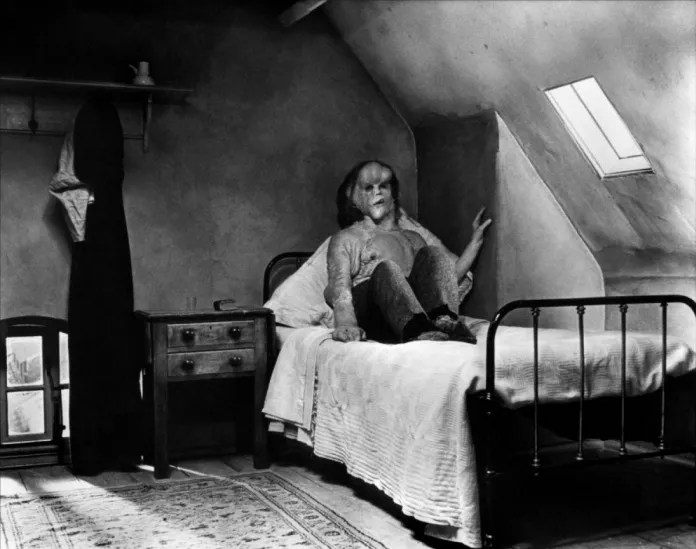
I knew the film led to his being tapped by Mel Brooks to direct The Elephant Man which was one of my favorites but I didn’t see it until years after Elephant Man had been released. At first I was shocked by how different they were in tone from each other but later I started to appreciate the mind that had imagined it and began to see threads of commonality.
Still from The Elephant Man – Paramount Pictures 1980
Vellani would often talk about Lynch when I was a Directing Fellow at AFI in the mid 1980s. He once told me that he considered David to be the most naturally gifted filmmaker he had ever met.
I had always heard that David didn’t like to talk about his films too much and brushed aside questions that required him to explain endings or motivations, which made me wonder how he had dealt with the AFI critique sessions.
The typical sequence of film projects at The American Institute Conservatory was that Directing Fellows made three films the first year. On the completion date the film is screened before the entire school for critique.
At the end of the screening, The director, writer and producer were seated at the front of the room with Tony Vellani who gave the director an intense look and asked, “What is the premise?” Your response was supposed to be a three or four word answer in the pattern of, “Blank leads to blank“, as in “Betrayal leads to tragedy”, condensing the dramatic structure of the story into as few words as possible. The film was judged primarily on how successfully you had fulfilled the goal of matching the final film to its premise.
Knowing of Lynch’s reported distaste for being pinned down on story points, I wondered how he maneuvered through this process when his film was critiqued at the school.
Vellani said that he had gone to Mexico and Davids invitation to visit him at the Churubusco Studios in Mexico City while he was shooting Dune. He described how he was trailed by an army of people. Producers, Art Directors, and ADs. He said he looked uncomfortable and distracted by this entourage and it reminded him of the early 70s at AFI when David was there shooting Eraserhead. They had taken over some stables near the Doheny Mansion in Beverly Hills where the conservatory was originally located and turned them into their stage space.
Tony had brought a group of AFI dignitaries and financial supporters to view the students in the process of making their films and he arrived with these guests, unannounced, to watch David shoot a scene. After a few knocks on the ‘stage’ door, it opened slightly and Lynch stuck his head out, surprised to see the group.
Vellani explained the reason for their visit and introduced the visitors. He said David listened politely and then said simply, “Sorry, it’s a closed set”, and shut the door.
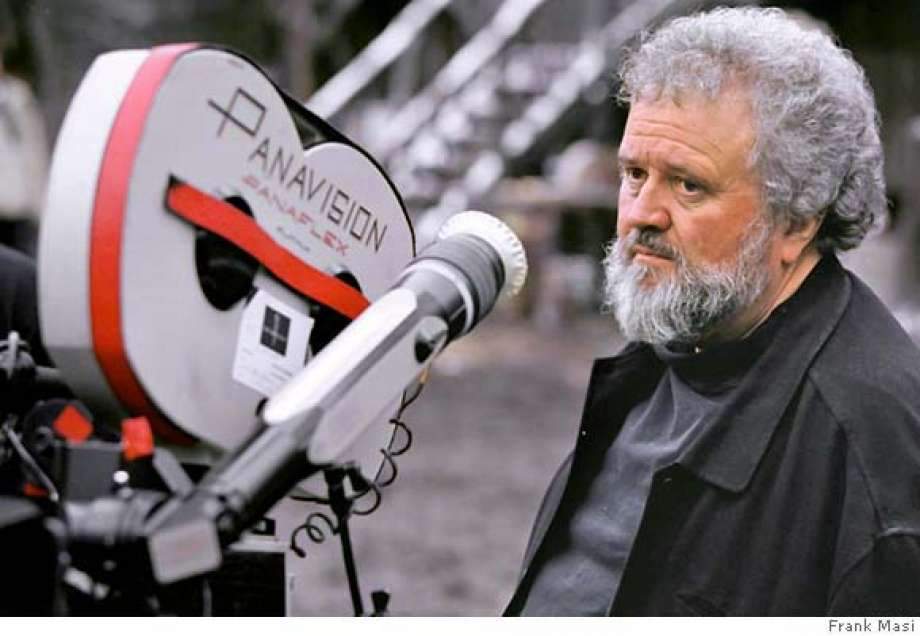
Allen Daviau, the five-time Academy Award-nominated cinematographer of films such as E.T. The Extra-Terrestrial, Empire Of The Sun, Avalon, Bugsy, and The Color Purple, passed away on Wednesday from complications of COVID-19. In 2007 he was given a Lifetime Achievement award by the American Society Of Cinematographers.
His professional film career began in the 1960s where he started out shooting documentaries, music videos and working as a still photographer. He met a young Steven Spielberg in 1967 and helped him shoot his short film, Amblin’. Years later Spielberg was in pre-production for ET when he saw a reel of a TV movie Allen had shot and hired him immediately.
Whenever I saw him, Allen was always personable and kind but it would be a mistake to take him for a pushover. He and a number of others were frustrated when they were denied membership to the cinematographer’ union. Universal had tried to sign him to a contract but the union was a closed-shop in all but name at that time and refused to allow it. Daviau and a number of other cinematographers including Caleb Deschanel filed suit to join the union and were finally admitted.
I only got to work on one picture with Allen, A feature called The Astronaut’s Wife, production designed by Jan Roelfs. He was outgoing and approachable, always eager to talk shop. There are times when you work with individuals that you hold in such professional esteem that the initial interactions are awkward but that was never the case with Allen. I didn’t get to ask him all of the questions I had buzzing in my head about his other films. I refrained from ‘interrogating’ him the way I had once done to Werner Herzog when I ran into him on the backlot at Warner Bros Studios in an embarrassing ‘fan-boy’ moment.
I never got to ask him about some of the shots in Empire Of The Sun that I had analyzed but I did learn two things: he didn’t like multi-camera shoots and he didn’t particularly like translites. “They’re too sharp”, he told me. Unlike the traditional handpainted backings, they had a crisp photo-quality that defied being able to create a realistic depth-of-field. Even the painted backings often had black or white bobbinet stretched in front of them to create an atmospheric softening effect. It’s ironic that now, years later, a number of companies will custom print backings to create different degrees of softness to simulate an out-of-focus image due to depth-of-field.
The multi-camera shoots were something he accepted as necessary at times but he felt that they diluted the quality of the lighting. He felt that being able to concentrate on just one composition at a time resulted in a superior product. There were lighting effects that became impossible to do effectively if you had to take other camera positions into account. He was as technically adept as he was artistic and relied on both his eye and his light meter. He knew that the audience will only see what you let them see. And being able to shoot with a single camera allows you to get away with tricks that are harder to pull off when you have to light for multiple angles at once.
A camera-lover, he told me as part of his endowment to UCLA, each year he would buy a top-of-the-line Leica and leave it unopened in its original packaging.
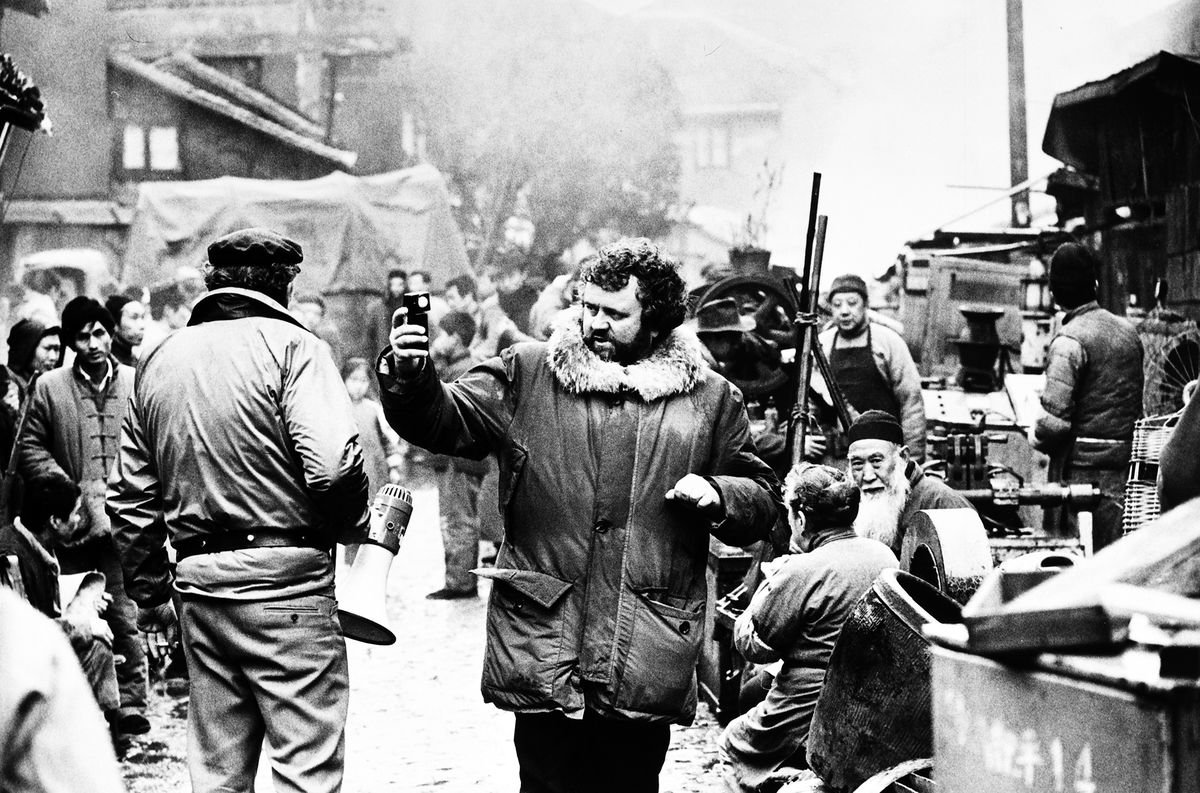
When he was in Shanghai on Empire, they were unable to get dailies until a week later and playback technology was a long way off. He had to rely on his light meter and his experience with the film stock to know if he had a proper exposure.
One thing I learned from him is, there are times when you have to let the details go. We were doing pick-up shots and only had a few days to recreate several parts of the sets from the main shoot. Recreating a portion of the main characters’ apartment was complicated by the fact that the backing we had used outside the huge glass window wall was unavailable.
We found a cityscape backing that was close, but overall the values and details didn’t come close enough to really match the original. I hoped that the shot would be tight enough that the DOF would hide the mismatch, but was dismayed when the director asked for a wider shot. With so many elements to consider, the backing issue was the last thing on most people’s mind . Allan was behind the camera, lining up the shot and I finally called out to him, “But Allen, the backing.” He just looked over at me and raised his hands. He could have just ignored me, or been dismissive or irritated. He just gave a little smile and said, “It’s OK, it’ll be fine.” And it was.
There is an excellent interview with Allen in the 1992 documentary film, Visions Of Light, about the art of cinematography.
An article at PC Magazine.com last November talked about how real-time rendering is changing the movies, mainly in terms of how it affects the workflow and the time involved in creating animated films. Because of the advances in processor speeds and the continuing evolution of software programming, animators are beginning to be able to animate in real time. The giant rendering farms of the Far East may soon be a thing of the past.
Creating renders, at least for me, is a tedious affair that ends up eating hours of time while processing images, and renders ( pun intended ) my computer a slave to the rendering engine, useless for working on anything else.
The new wave in rendering software is for real-time execution with full motion and lighting effects as well as physical atmospheric effects like water, fog, etc.
While not cheap, there are a number of real-time, full motion options that cut the normal still-image render time from hours to seconds.
LumenRT
The least expensive option I’m aware of is LumenRT. This is a real-time rendering engine designed for use with Sketchup, but is currently being developed for use with other modeling software. Unlike the other programs I’ll discuss, there is a calculation process involved that does take more time but the advantage of this is that you can output what is called a LiveCube, which is an executable file you can send to anyone that they can navigate in and explore the model without the need for any software. Pretty neat. The downside is that once this is done, if you make any changes you need to recompute everything.
The program boast very accurate lighting and reflection effects and this affects the render speed. The company’s site advises that you may experience slower processing speeds if your model exceeds 40,000 square feet or 500,000 polys.
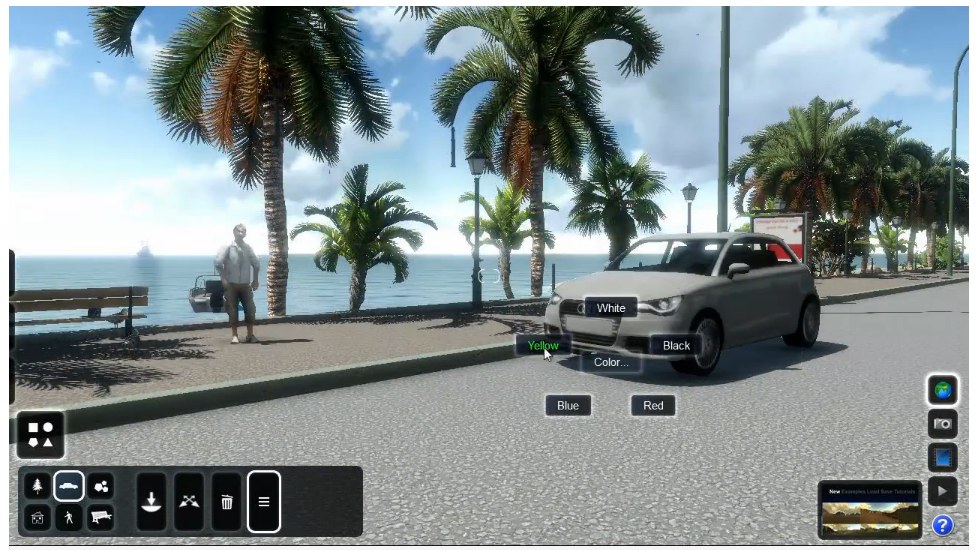
The next option is a program called Lumion, which was designed based on the object-oriented analysis approach of Quest 3D, a virtual reality program designed for 3D fly-throughs and simulations.
Lumion’s interface
Lumion is a true real-time rendering engine that can import nearly any 3D model. Instead of using ray-tracing technology like most other renderers, it uses a system more like those found in gaming systems to simulate light effects. This would seem to suggest that the specular effects and reflections are not accurate but a viewing of several sample videos of the product seems to suggest otherwise. Because of the way the program operates, objects in the background are rendered at lesser resolutions meaning it can handle models with millions of polys without bogging down.
The program is touted as having a short learning curve and is able to generate full motion renders in a fraction of the time it once took to do them in programs like Maya.
Lumion isn’t cheap by any means. The price of the basic program is about $1,900 with the pro version running about $3,700. There is a free version, which is limited and there is a trial version as well. It also runs only on the Windows operating system. Check out the amazing promo videos below and read the reviews here and here.
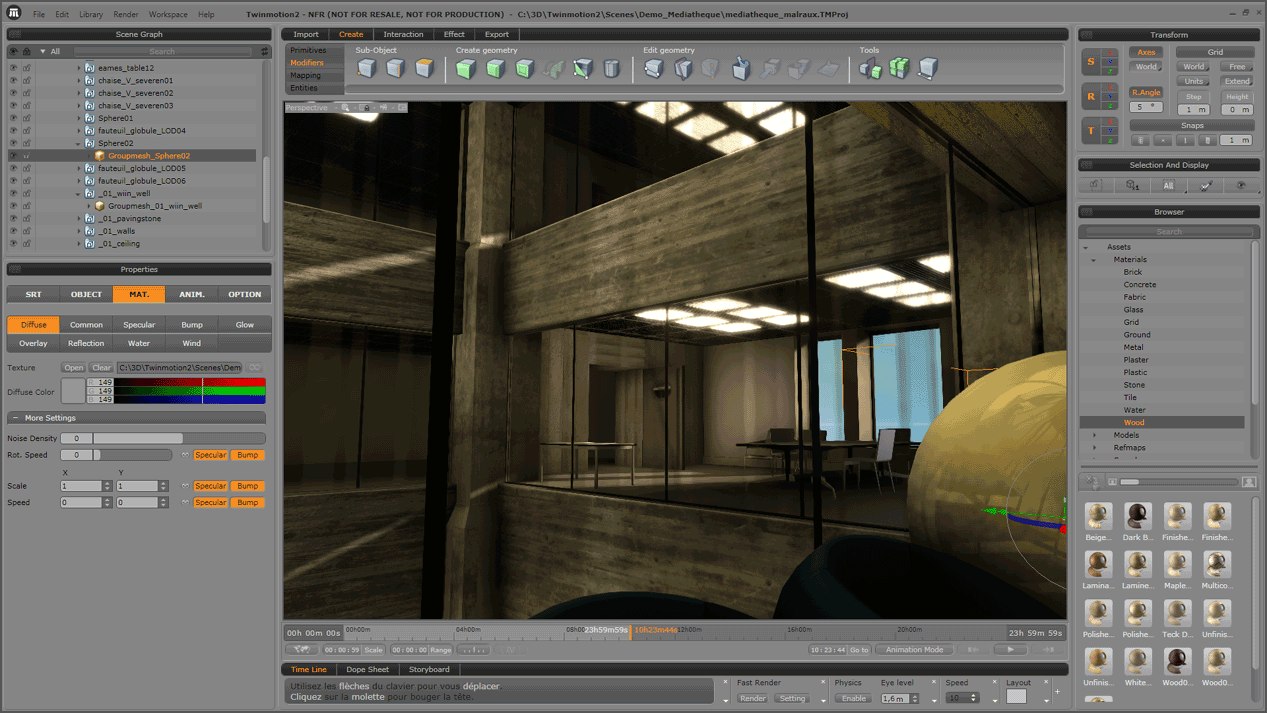
Twinmotion 2 bills itself as “the render killer”. It was developed by an architectural film as an in-house application but was made available to the public. Like Lumion it is capable of handling huge models because of its Level Of Detail technology that renders distant objects with less detail and increases the poly count as you move closer to them.
Twinmotion 2 interface
Twinmotion seems to have more accurate geo-locating controls as well as sun controls, but Lumion is constantly changing so that may no longer be the case. Twinmotion does create excellent renders as seen below in this side-by-side comparison of a render to actual film of the location.
At $2900, Twinmotion 2 is in the same range as Lumion. Plus, there is a $850 annual subscription fee, similar to Revit. It’s hardly a purchase one could take lightly.
So what does this mean for the Art Department? Do we need full-motion renders? Considering that renders are becoming more and more common at each step of the design process, creating full-motion renders that can be done in a fraction of the time of traditional renders might become the norm.
Maybe that’s not such a bad thing. Maybe they could provide a good transistion step into the pre-viz process. Or maybe they’ll bring some of the pre-viz work back into the Art Department.
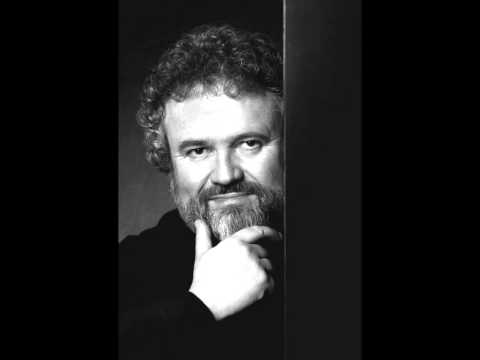 Allen Daviau, the five-time Academy Award-nominated cinematographer of films such as E.T. The Extra-Terrestrial, Empire Of The Sun, Avalon, Bugsy, and The Color Purple, passed away on Wednesday from complications of COVID-19. In 2007 he was given a Lifetime Achievement award by the American Society Of Cinematographers.
 The Designer's Assistant