It can be tricky to identify or specify a particular wood if you’re not very knowledgable about working with it. There are hundreds of different species available and even though a small number of those are in common usage in the construction trade, narrowing it down to the ideal look you want can be frustrating.
For many years a Production Designer was able to just hand a Scenic Painter a photograph and the artist would “grain” the surface to match any kind of wood they wanted. With the loss of painters who are trained in “graining”, it has become more common to find a laminated material which matches their choice or to use actual wood veneer that matches the reference.
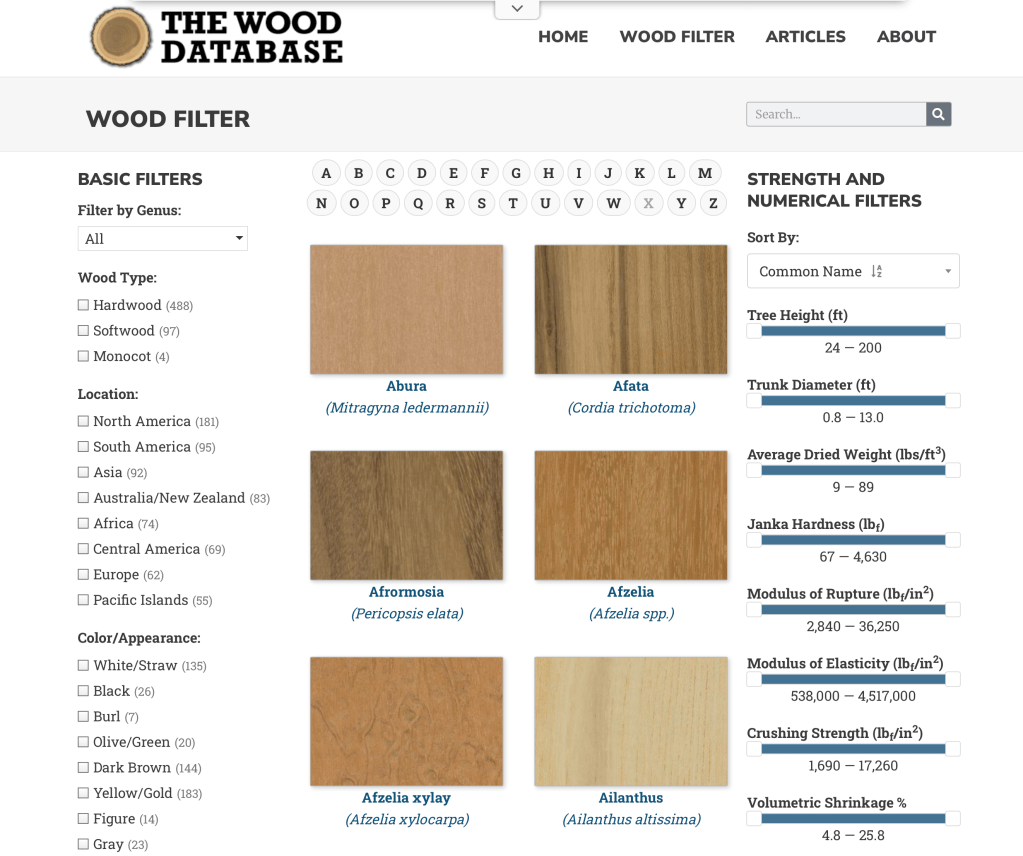
One website that I’ve found recently is a very good starting point to locate a match to a reference photo you might have or select a wood species based on your preferences of shade, color, or grain.
The Wood Database was created by Eric Meier in 2007 and now includes images and data for over 600 different wood species. You can search by name, type, location, appearance, and several other catagories.
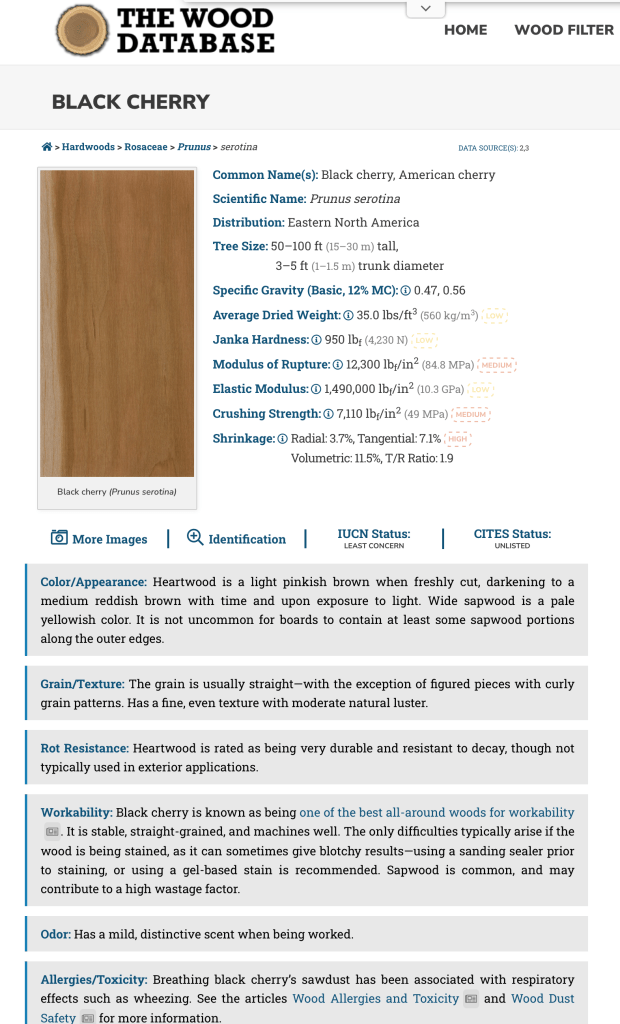
Each species entry has a color photo of the wood showing grain pattern (depending on the cut orientation) as well as the scientific data as to hardness and shrinkage rates.
The information is also available in hardback book form, which can be ordered from the site, which features the data on over 350 wood types, including large color images of each species.
Another good reference is a book called What Wood Is That? by Herbert Edlin. The book explains basic wood characteristics and details 40 common wood types. It also includes 40 actual wood samples so that you can see a real-life sample of the types outlined.
The actual wood samples that are in What Wood Is That?
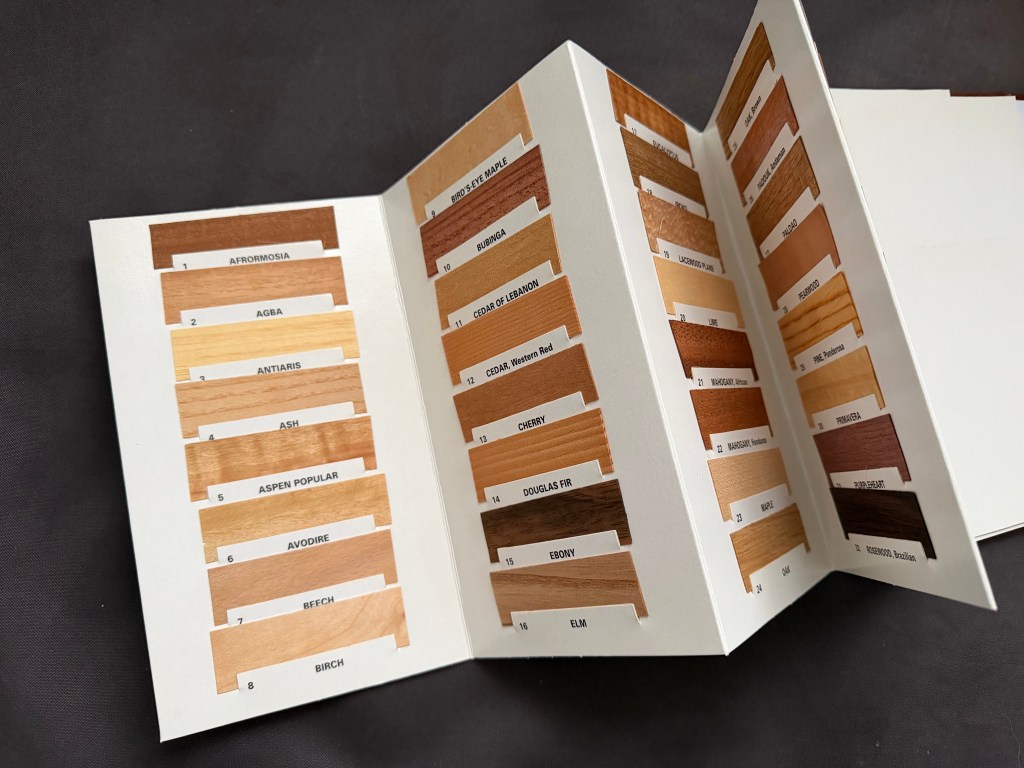
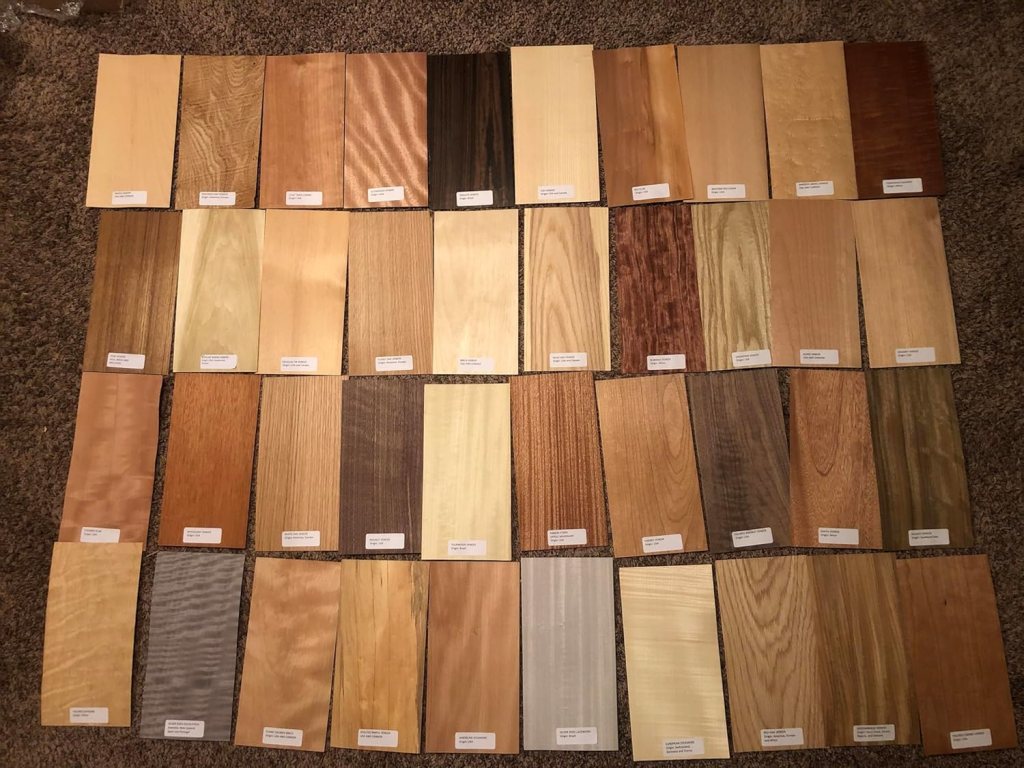
For larger wood samples to look at, I’d suggest getting a set of veneer samples like the ones below. You can find sets like the one below from various venders on Amazon. Be sure that you get a set that have labels attached for easy identification. With these, you have a piece large enough ( they are usually about 6″ x 12″) to be able to try different stains, finishes, or age to your liking.
One of the reasons that I wrote the Wrand Film Glossary was to record many of the obscure film and entertainment industry terms that get passes down orally but are never recorded.
Art department and set construction lingo is usually not included in the typical film glossary, and “Double dap” is one of those odd terms that you will hear used by Prop Makers* but have probably never had it explained.
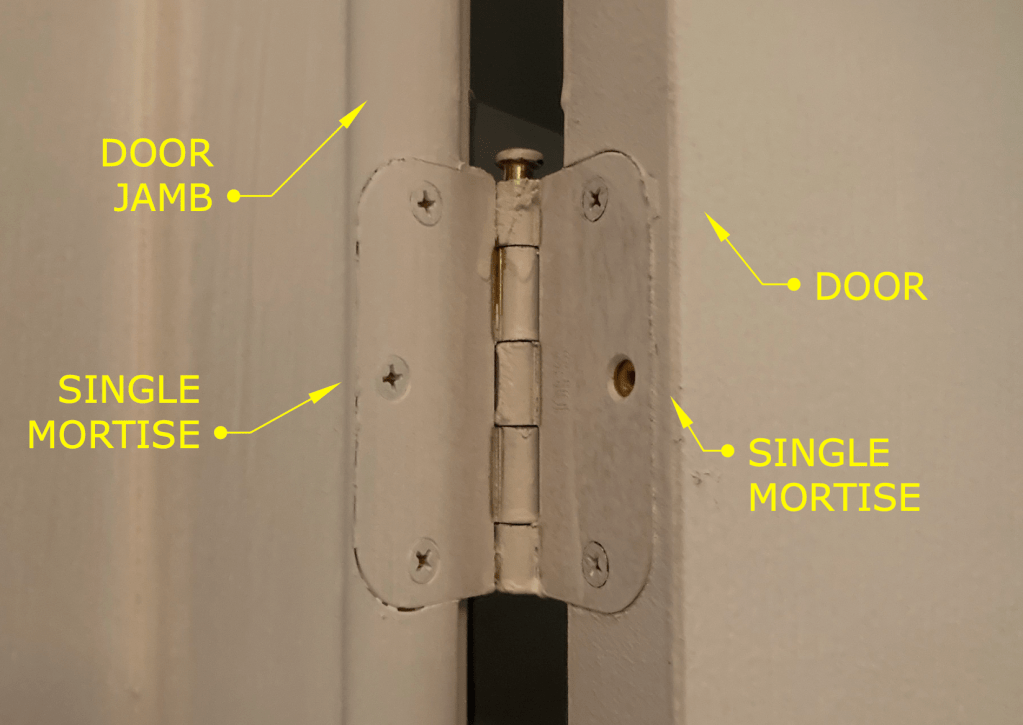
The term refers to how the hinges of a door on a stage set are to be installed. Normally the installation of hinges for a door involves creating mortises in the door stile and the jamb that match the thickness of the hinge leaves. That’s referred to as a “single dap” installation. (Note: this is specifically for doors in North America or the UK. Many Continental European doors are half-overlay and don’t use the type of leaf hinges that are standard here.)
Typical hinge installation – referred to as a Single Dap
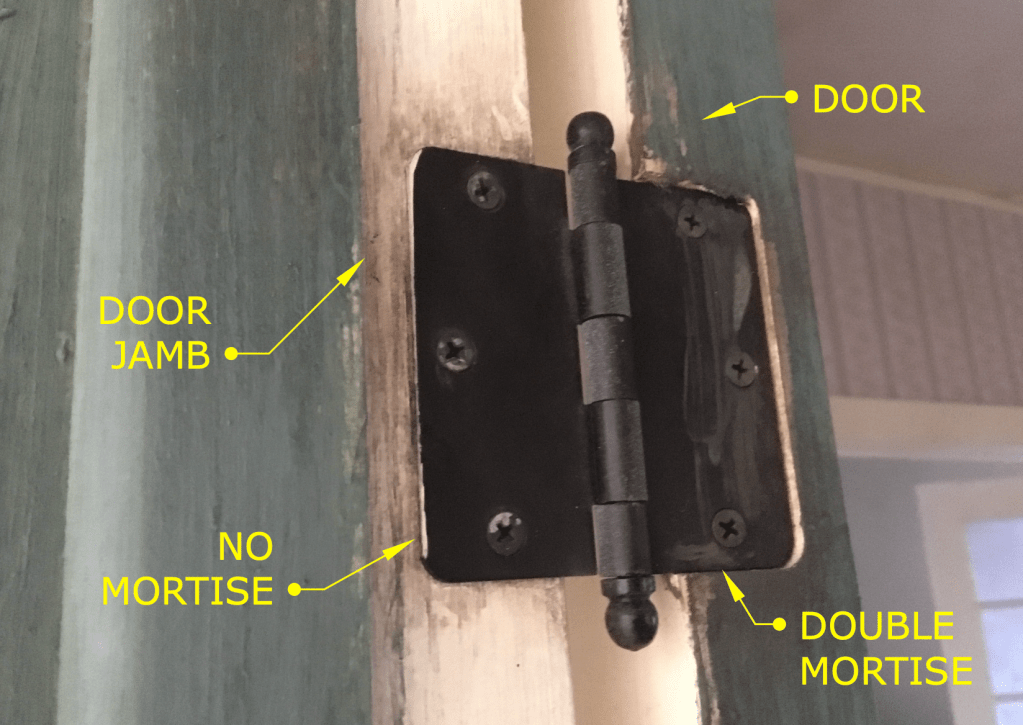
A “double dap” installation involves creating a mortise in the door which is twice as deep as usual and not making a mortise in the jamb, as shown below.
Example of a Double Dapped hinge
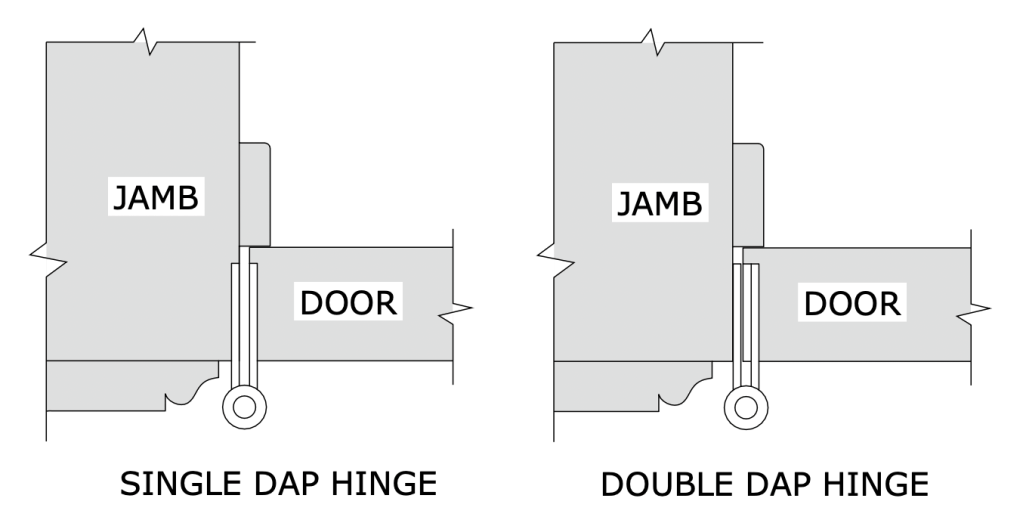
The diagram below is a side-by-side plan view showing both types of installation.
So what’s the purpose of this? Well, this is something that is more typical on sets for a broadcast show than on sets for a feature film.
One advantage is speed. We tend to build sets at a pretty brisk pace, sometimes building an entire set over a weekend. For example, if you have a set with six doors, that means you need to install 18 hinges, which means routing 32 mortises. With a double dap installation you cut that number in half.
Another advantage is if you are redressing a set and need to change out the door of an opening for a different door. With a standard installation, you will need to patch and fill and re-rout three mortises. Instead you just need to fill some screw holes.
This is also the case if you need to change the swing direction of a door at the last moment. (Good luck prying off and repositioning that door stop.)
Double dapping has fallen out of favor lately. Production Designers don’t like the look of it for one thing. (Along with Phillips head screws on a period hinge!) They tend to stick out particularly when the hinges are a contrasting color from the jamb or if the wood is painted a light color and the hinges have a dark laquer/black finish. In some instances this condition can either visually hide the extra mortise depth or accentuate it.
Also, notice the round corners on the hinges in the photos. Round corner hinges are a 20th century invention to speed up production. Once machinery, i.e. routers, was being used for mortising, it became a lot faster to create hinges with leaves that didn’t require squaring off the mortise corners as was necessary for period, square hinges. Round corner hinges come in 1/4″ and 5/8″ radius corners, so be aware of what radius size they are if you’re choosing hinges for a door that has already been mortised.
Note: Prop Maker is a designation for a union stage carpenter in Los Angeles to differentiate them from a ‘civilian’ carpenter. They are trained it building theatrical scenery of all types and historical periods and specialize in creating scenery for film productions. They are more similar to cabinet makers than a typical carpenter and are skilled in construction techniques and methods that would baffle most people outside the entertainment industry.
Jeesh, it’s been ten years since my last gift guide and I’m getting it out a little late this year, but some of the same items are still here on the list, mainly the classic tools and books that never become obsolete, (like a lot of software programs do).
I don’t receive any money from these recommendations. These are books and tools that I own and use often.
My Must-Have Tools For Film Designers
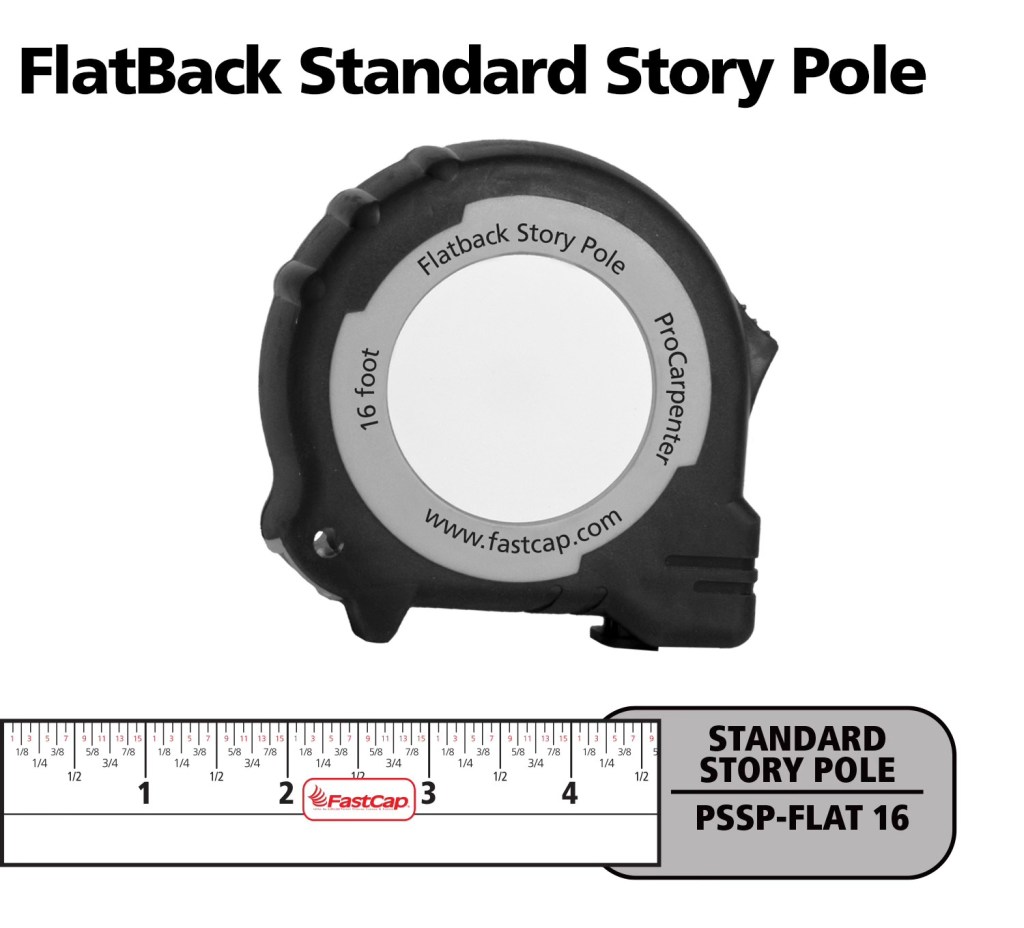
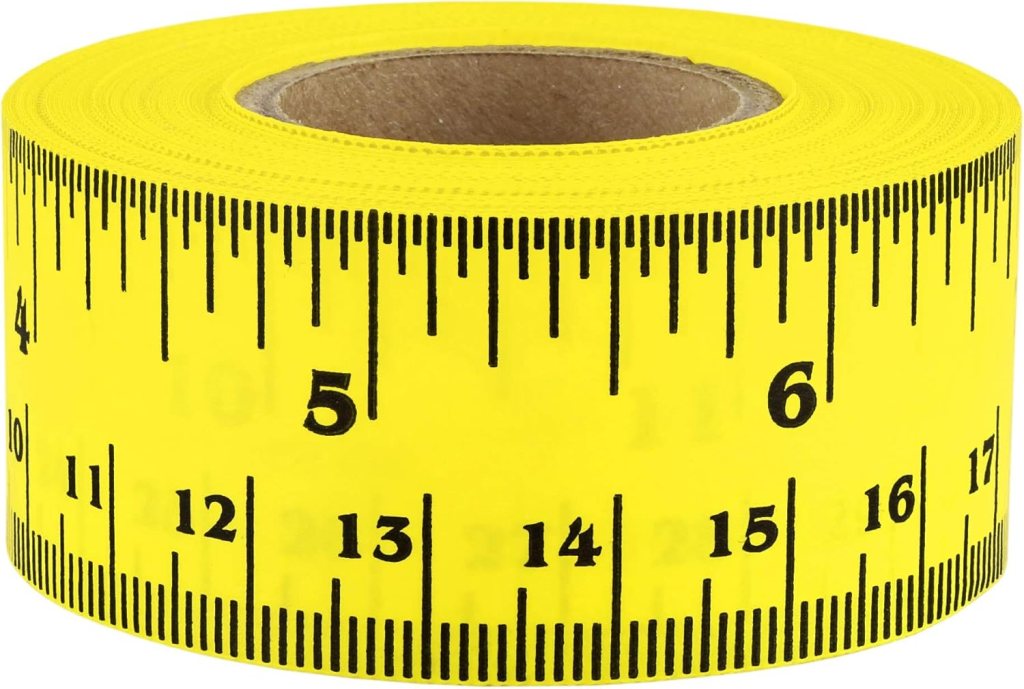
FastCap Flat Back Tape – You can not only measure round or curved surfaces but it has a blank area to write on for use as a story pole. – $10.00
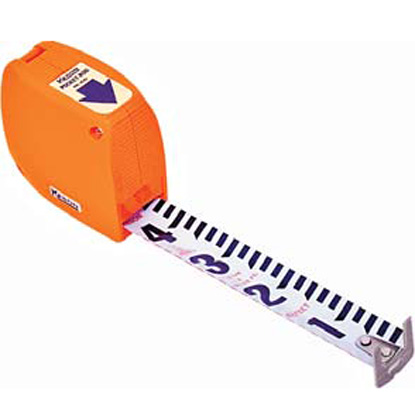
Keson Pocket Rod– These are so essential for site surveys that I have four of them. They come in Architect and Engineer models. – $20.00
6″ Digital Calipers – Like these, there are many manufactures. (Avoid any priced under $20.00.) – Must-have tool for doing photo scaling (see article) – about $24.00
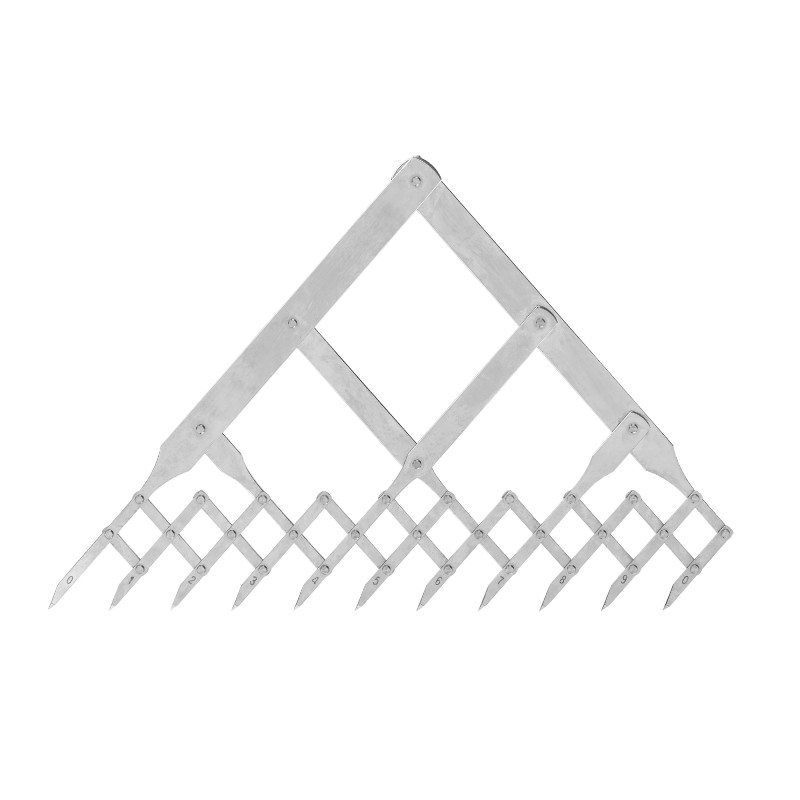
Equal Space Dividers – great for not only photo scaling but for designing in general. They run the gamut in price from these to these. $220 to $24.00
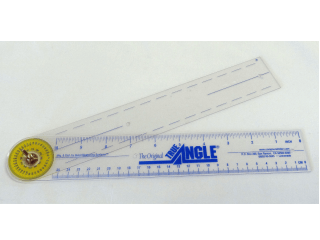
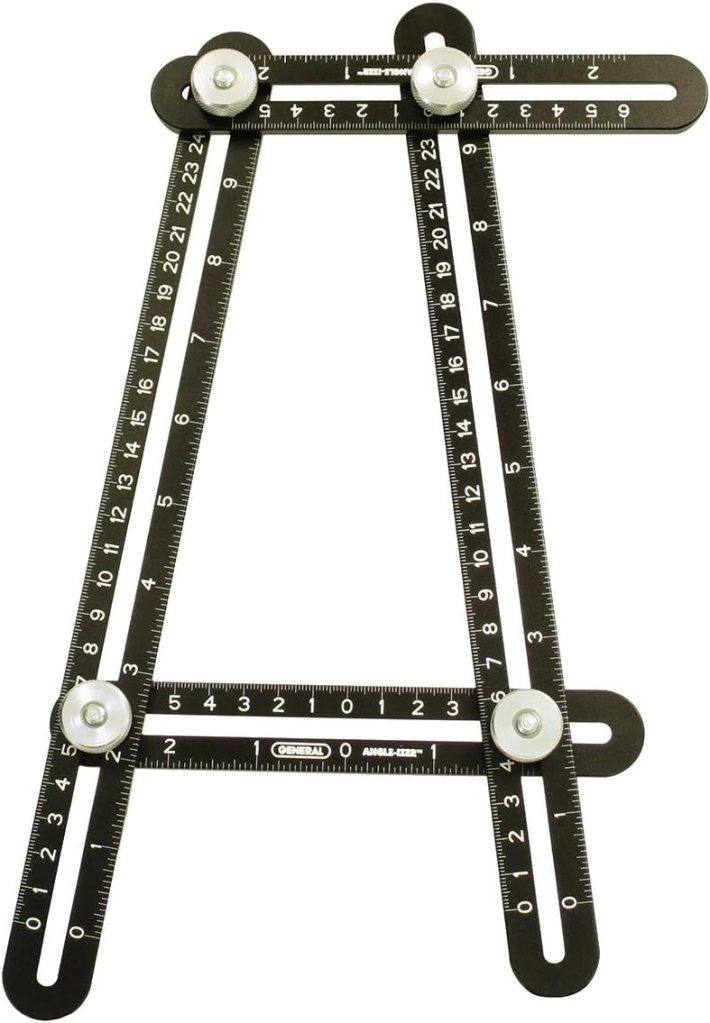
True Angle – Multi-use tool for measuring and transferring angles. lightweight. – 12″ -$16.00
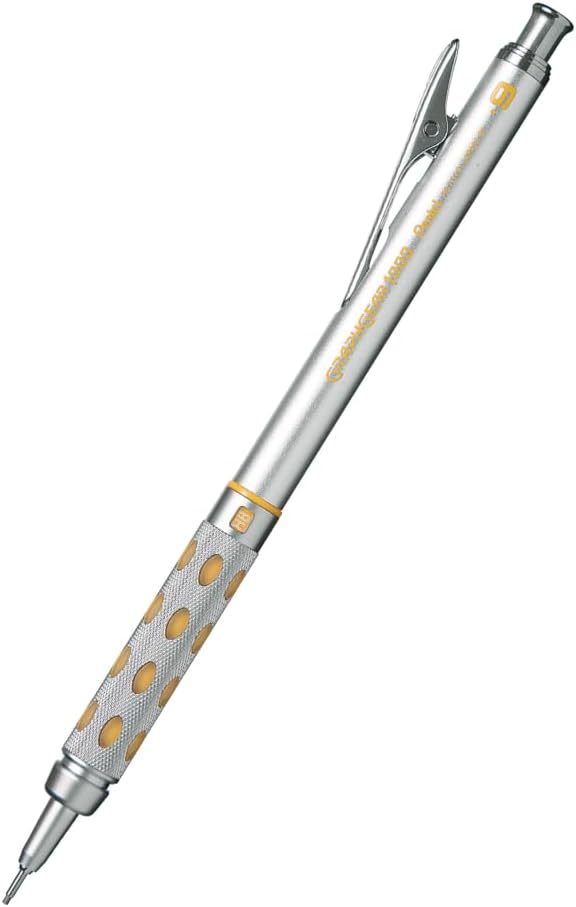
GraphGear 1000 – Mechanical pencils, my new favorite brand. These are great because the barrel sleeve retracts into the pencil to protect it. Comes in .3, .4, .5, .7, and .9mm leads. About $9.00
Compass – So many to choose from, (and a lot of crappy ones are in the mix). This one is a good all-around basic, practical compass that will last a while. $14.00
Still my favorite design and furniture book publisher. Here are my recommendations:
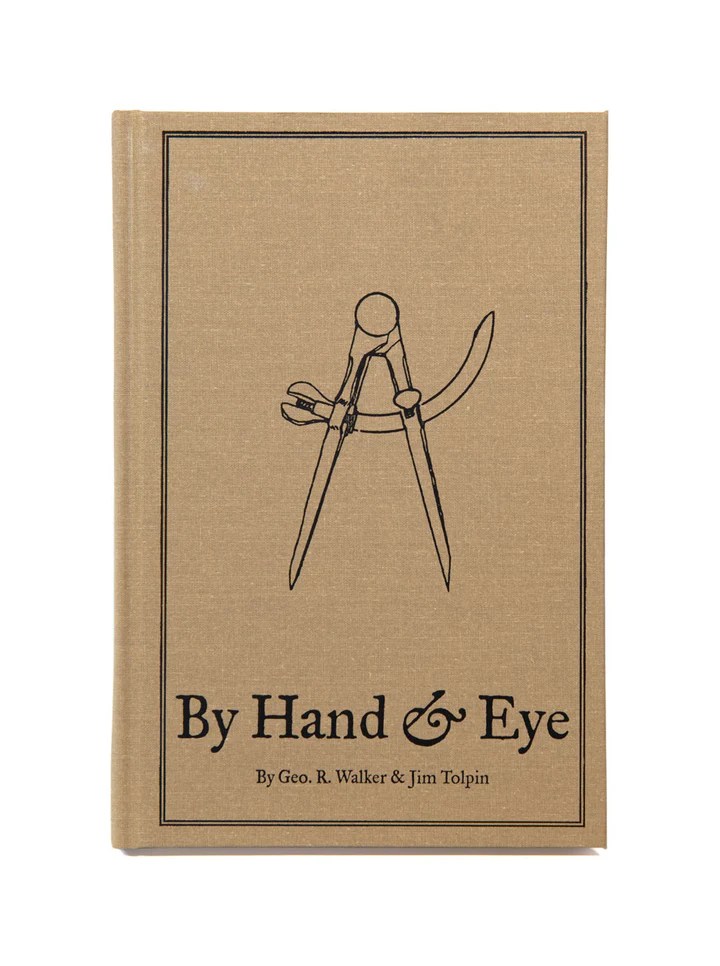
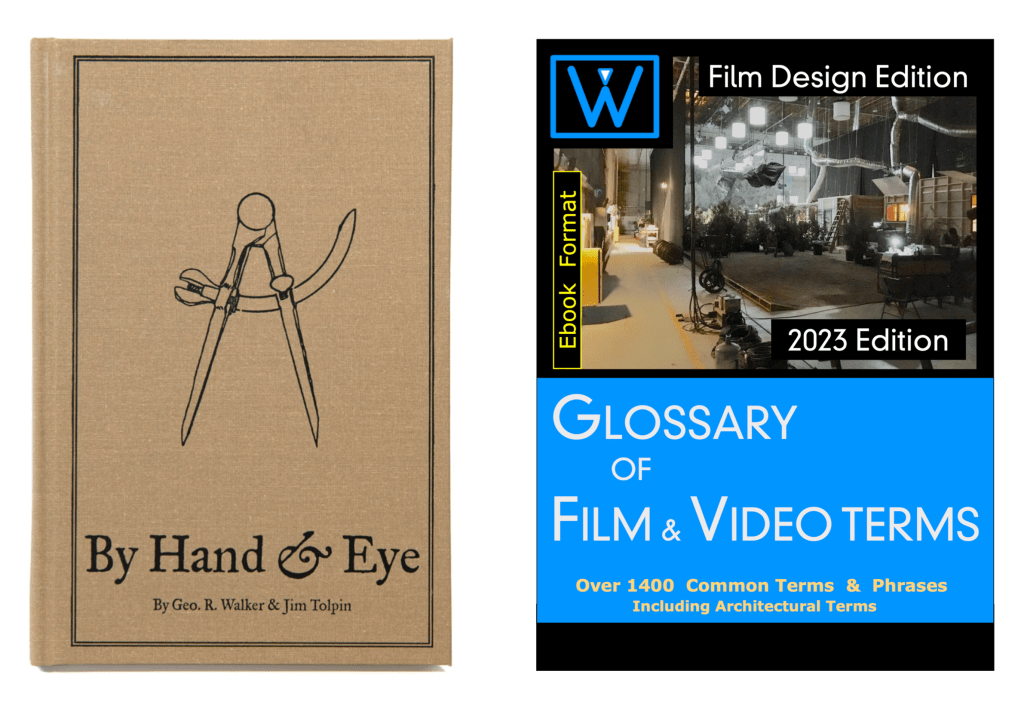
By Hand & Eye – $51.00. Another gem from Lost Art Press, this is probably one of the best design books written in the last 100 years. It outlines the world of design without a rule and using only dividers and proportional methods. I covered this in a previous post and always recommend it. Buy this and a good pair of second hand dividers from Ebay and you will completely change the way you think about design.
By Hound & Eye – $31.00. A companion workbook to By Hand & Eye.
A Field Guide To American Houses – Virginia Savage McAlester
Stair Builders Handbook – T.W. Love
Backstage Handbook – Paul Carter
American Cinematographers Manual – ASC Press
The VES Handbook of Visual Effects – VES Society
Designer Drafting For The Entertainment World – Patricia Woodbridge
The Classical Orders Of Architecture – Robert Chitham
Illustrated Cabinet Making – Bill Hylton
Styles Of Ornament – Alexander Speltz
McKay’s Building Construction – W.B. McKay
Neufert – Architects’ Data – Granada Publishing
Geometry Of Design – Kimberly Elam
Really, Really Last Minute Gifts
When you realize you’ve really screwed up and forgotten someone and have no time to run to the store, much less order anything, you can always gift a good app.
Log onto the Apple or Android store and gift your so-important-you-forgot-about-them friend one of these apps and your reputation will be saved:
Hardware and fasteners are usually a conundrum for most people. Unless you grew up with a dad who liked to fix things or had a preternatural attraction to hardware stores (ok, guilty as charged), you are probably at some point confused about specifying or discussing specifics when it comes to connection thingies.
I’m always on the lookout for ways to simplify the explanations and it gets harder as more and more types of fasteners get added to the possibilities pile.
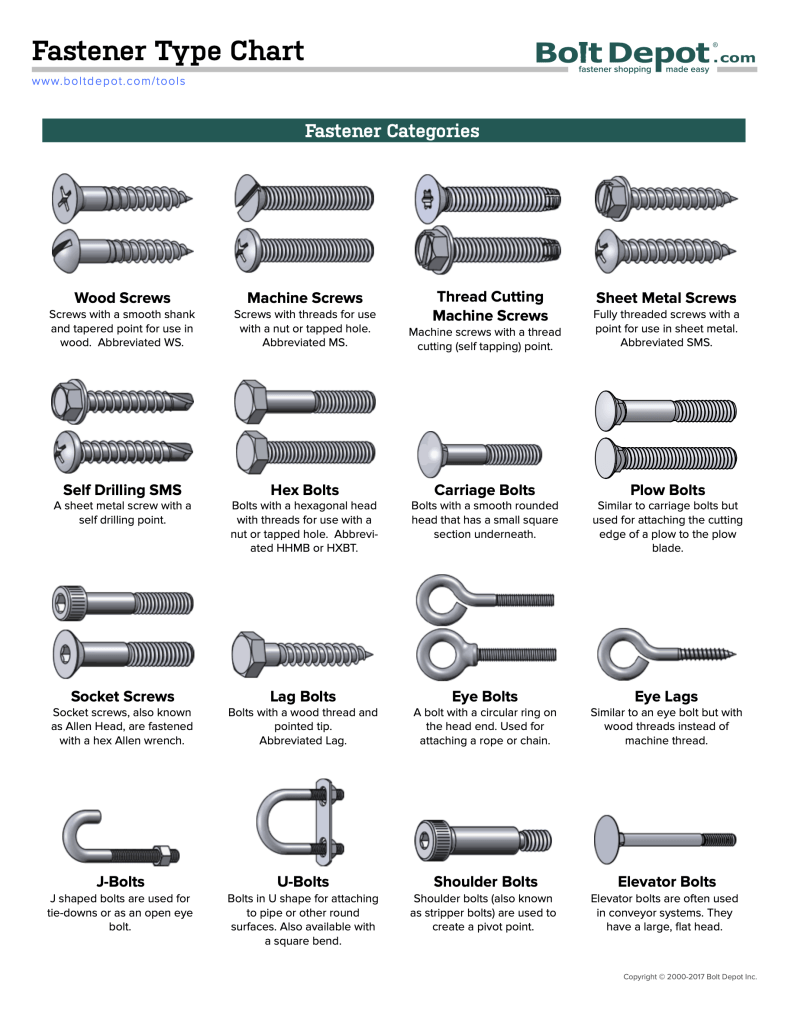
If you really want to just go down the rabbit hole of fastener options, all you have to do is dive into the online catalogue at McMaster-Carr, purveyor of all things industrial.
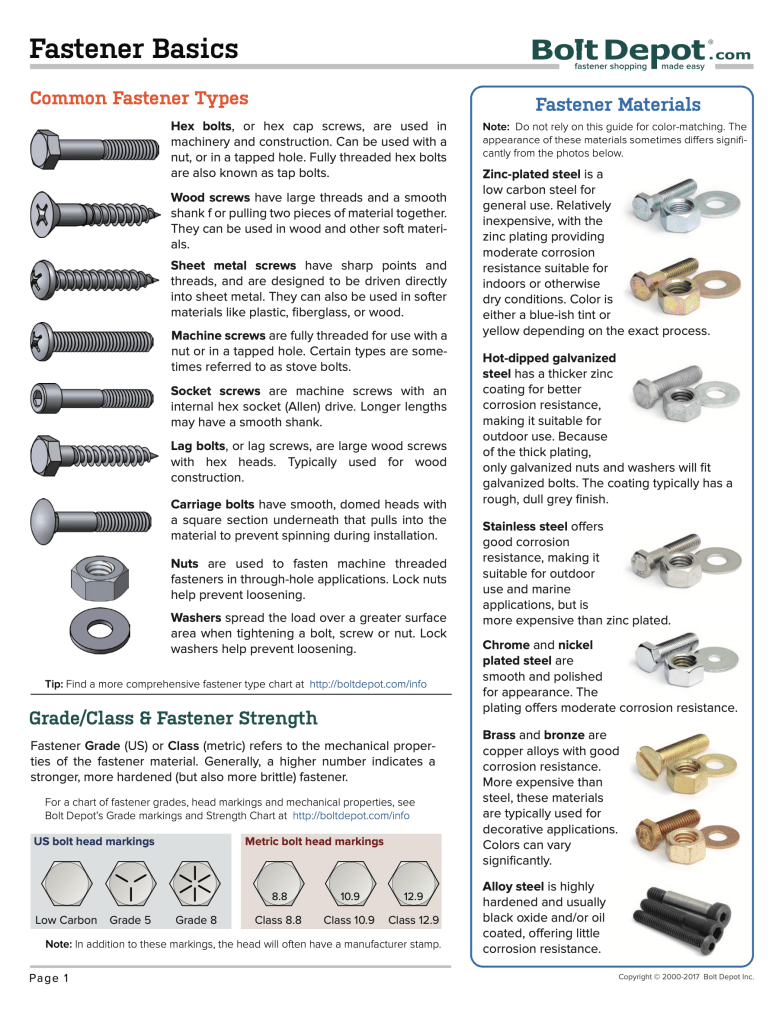
But if you just want a simple, easy-to-understand diagram, go over to BoltDepot.com. It’s a family-owned hardware company in Massachusetts and specializes in fasteners.
They’ve put together a 32 page PDF of basic fastener terminology that includes full-size print out of fasteners so you can see the exact size you’re looking for, which will alleviate a trip to a Home Depot to wander through the haphazard hard department, trying to find someone to help you figure out what you need (don’t waste your time).
You will also have a lot better time getting some personalized customer service at Bolt Depot than you will from the other giant hardware suppliers.
Until now, no one has created a class that explains cameras to designers.
You’ll not only learn the technical information that will help you understand the mechanic of cameras and optics, but you’ll learn how they capture your scenery and how they can affect your design decisions.
Image: Warner Bros Studios
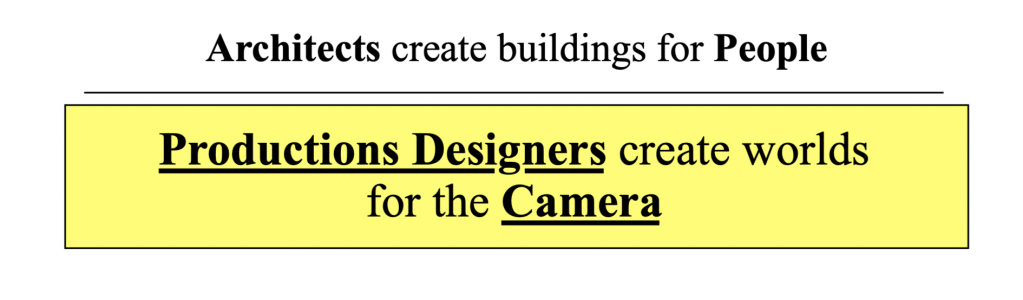
As a film designer you must understand how cameras capture and record images, because that’s how the audience sees and experiences your work.
Few if any film design schools include optics as part of the curriculum leaving film designers with a huge disadvantage when working with the cinematographer on a new project. The information in this course will help you create effective and believable sets that help the camera tell the film’s visual story as successfully as possible.
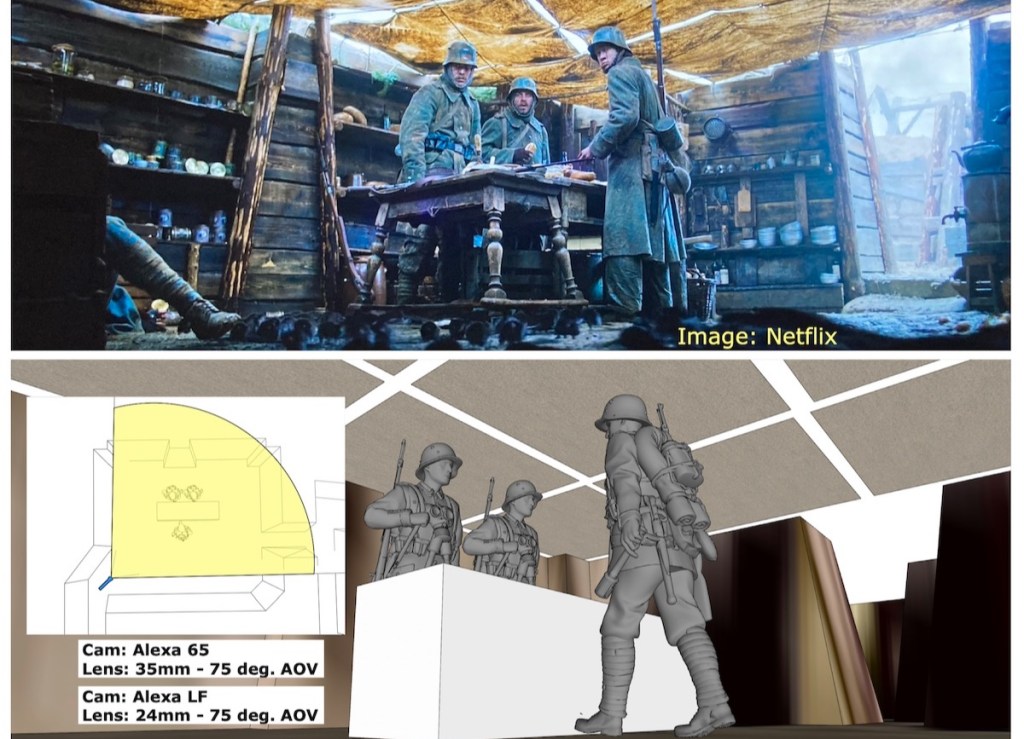
Image: Netflix
With this course, you will be able to discuss the camera requirements for your sets with the cinematographer and visual effects supervisor and not be excluded from important decisions that affect your designs. It will further your knowledge for a successful career in the Art Department as a set designer, art director, or production designer.
What you’ll learn in this course:
Cameras – Film vs. Digital
Lenses – spherical vs. anamorphic, prime vs. zoom
Specialty lenses – lenses and attachments that solve tricky shooting issues
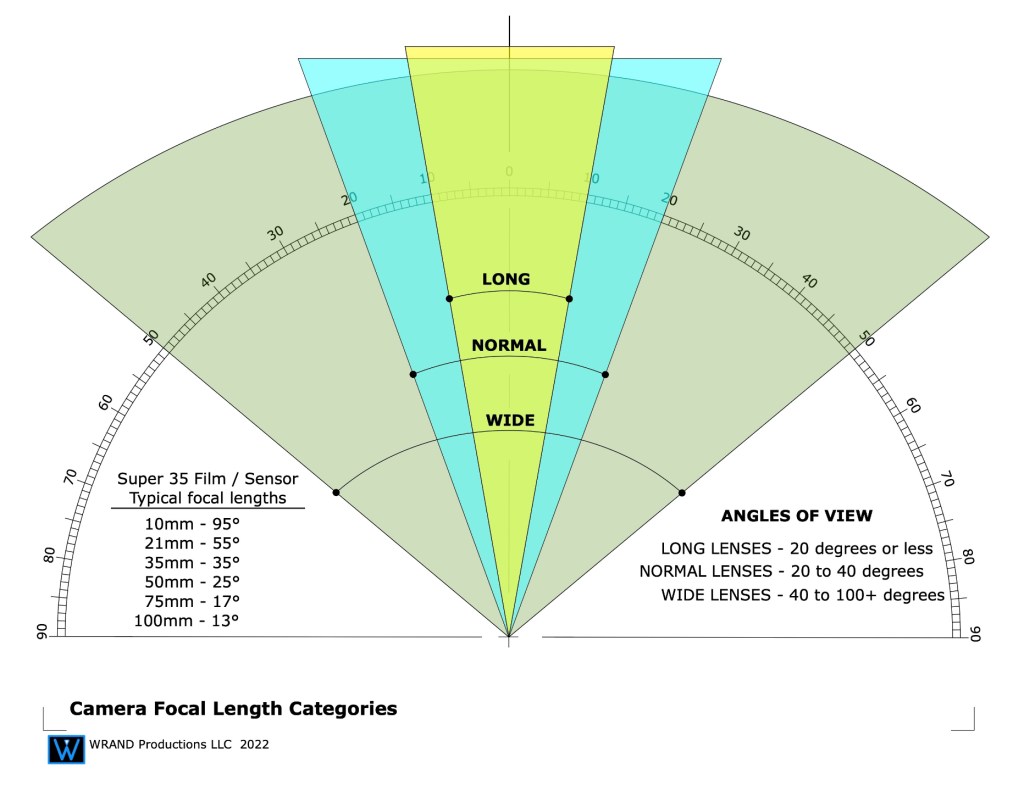
Understanding focal lengths
Understanding depth-of-field
Aperture settings – F-stops vs. T-stops
Dynamic range – over and under exposure comparisons
Lighting – color temperature, typical lighting styles
The Inverse square law of lighting
The basics of optics for in-camera effects such as foreground miniatures and forced perspective sets.
Understanding color grading vs. color correction, and digital intermediates or D.I.’s
Why is resolution important? Understanding the race for more pixel depth.
User Manual – you’ll get a manual with both text and diagrams that explains the concepts of the course for later reference
You will also get access to the weekly Community Lounge where you can get questions answered and meet other members of the film community.
In addition, I’ve included a special section that analyzes a number of the shots from the new German film, “All Quiet On The West Front” (Im Westen Nichts Neues). which won Oscars for both Best Cinematography and Best Art Direction in 2023.
With 3D model recreations of some of the sets and locations, I’ll discuss why certain shots were difficult to get and how they achieved them. I’ll also discuss how physical locations and built sets can sometimes make shooting problematic and how careful pre-planning can avoid frustrating situations during production.
First of all, this is not a paid ad. I’m getting nothing out of doing this post other than making people aware that they may be missing a big opportunity to take advantage of an event where they can learn a lot about the state of current and upcoming technology that is created specifically for the entertainment industry.
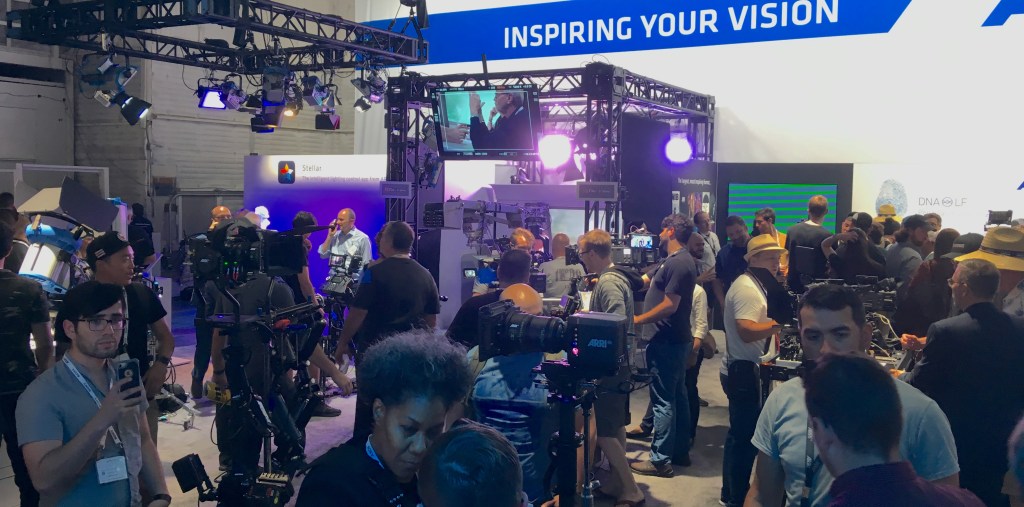
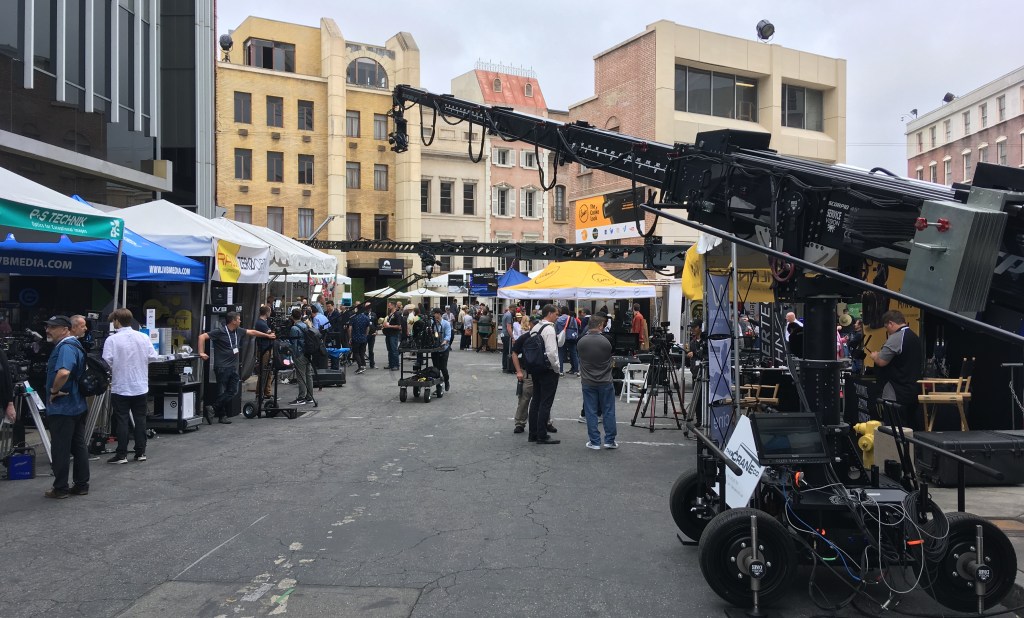
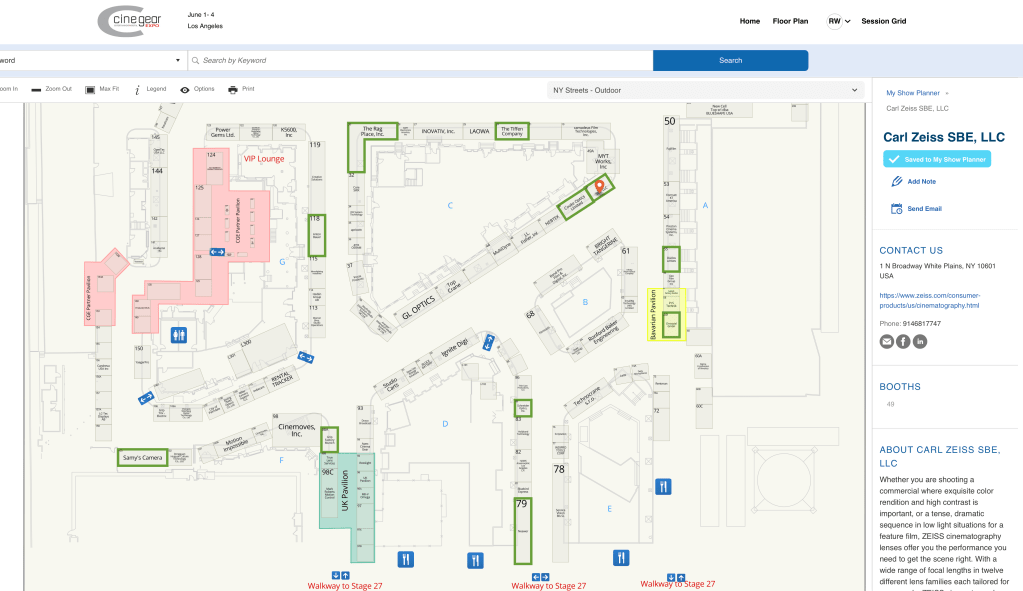
Cinegear is an annual expo that takes place in Los Angeles during the summer. This year it’s being held back at its usual spot on the Paramount Studios lot in Hollywood on June 1 – 4. (There was one in New York in March and there will be a slimmed down version in Atlanta in October). And, it’s free. Admission is now waived, you’ll just have to pay for parking in an adjacent structure.
Known mainly as a product expo for manufacturers and purveyors of cameras, lighting instruments and production equipment, the event is a perfect place for designers and art directors to find out about inventions and equipment that will affect their jobs now and in the future.
People who aren’t camera-savvy tend to be intimidated by the immense amount of hardware on display and assume that they have nothing to gain by spending a day looking at cameras and grip equipment.
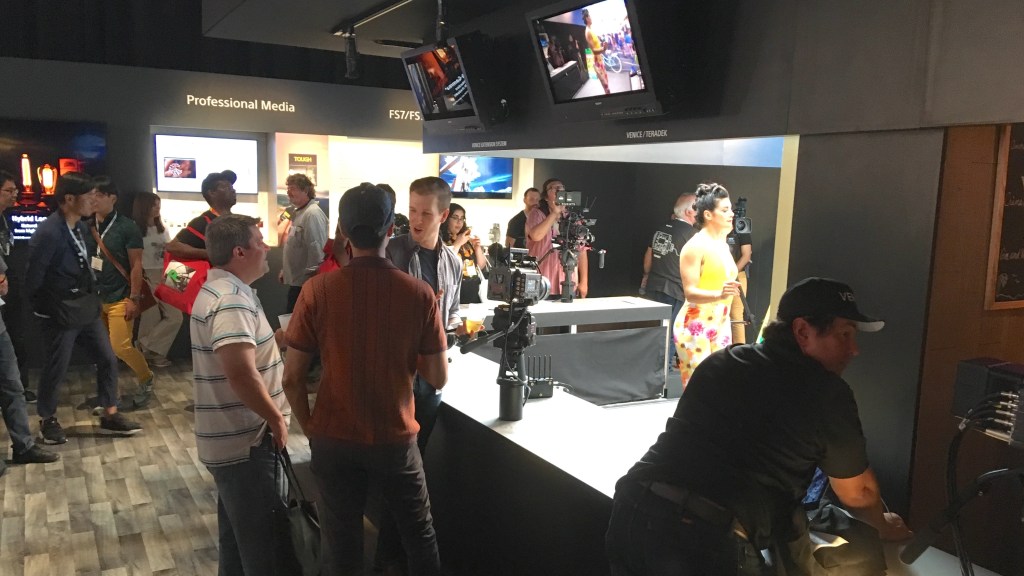
Yes, it’s geared toward professional camera crews, but they don’t make you take a test at the gate. The vendors are more than happy to answer any and all questions about their merchandise, even ones that you think might be simplistic. There are also hands-on exhibits and master classes available to anyone.
Where else can you go and see (and play with) every available cinema camera that’s on the market? My daughter loves checking out those $60,000 cameras that she can’t yet afford to rent.
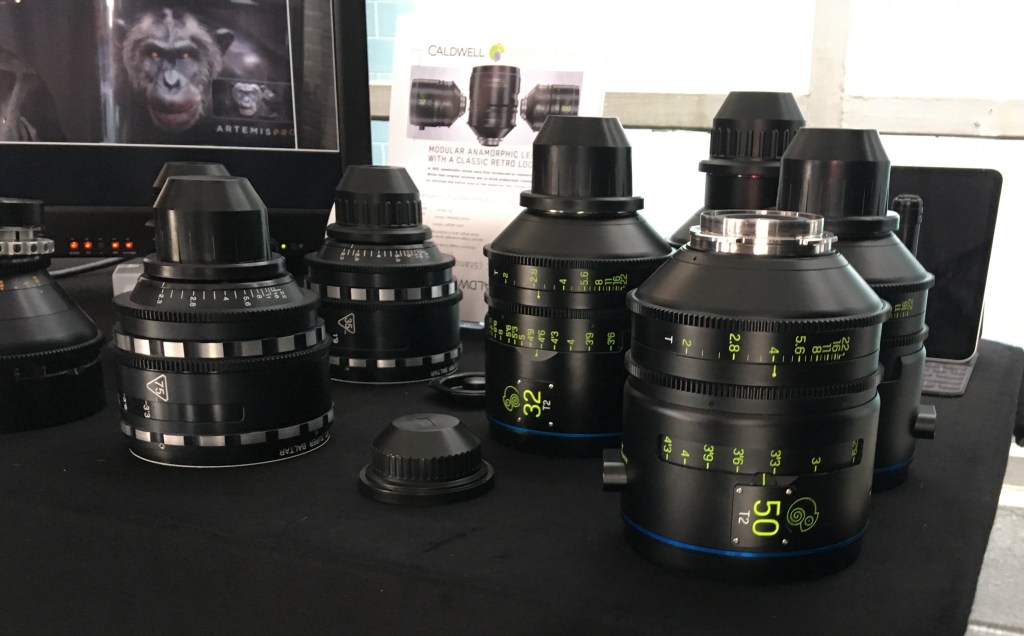
At the Panavision booth they’ll even put any vintage anamorphic lens you want on one of their cameras so you can see them in action.
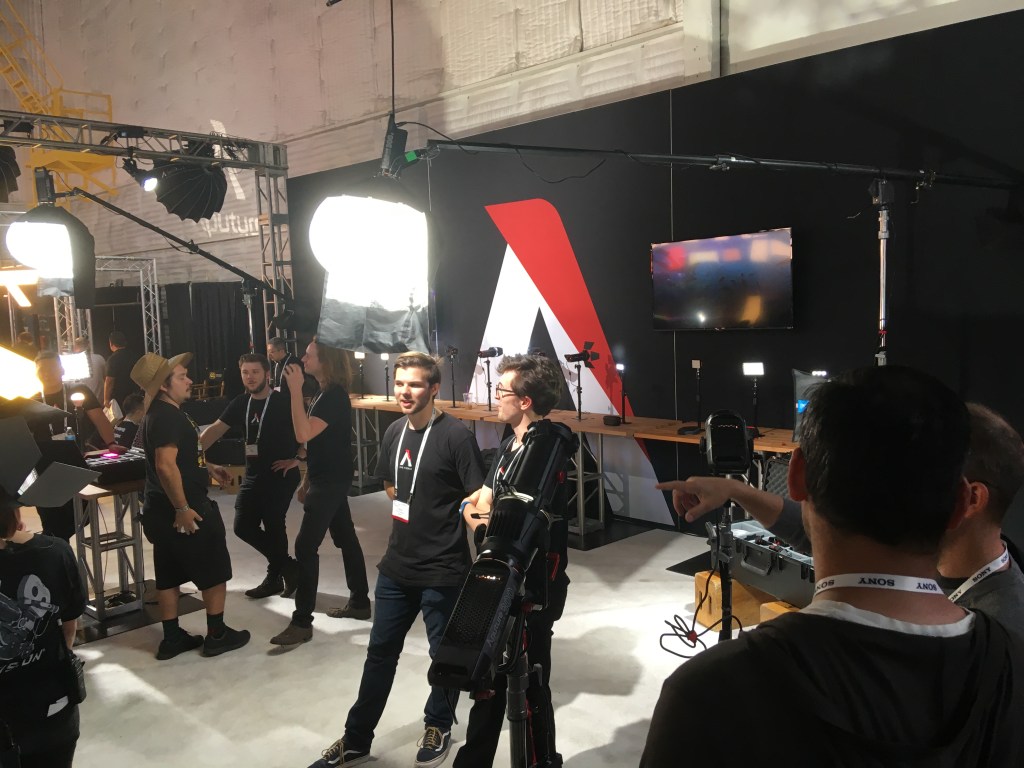
And it’s not just cameras that are on display. Vendors of new LED lighting instruments, LED wall systems, backings, pre-visualization systems, etc., are eager to show anyone involved in the business what the possibilities are. LED lighting instruments keep getting better, brighter, and smarter. The new Arri LED panels, for instance, are set up to mimic any color temperature or lighting effect.
You can see a map of the vendor sites on their webpage, and you can create your own map to track booths you want to visit ahead of time if a fear of being overwhelmed by the size of the venue (nearly 200 vendors) is a concern. Vendor booths fill 5 sound stages and the entire backlot area.
Master classes are usually held on the last day and attendance quotas fill up quickly, so be sure and make a reservation in advance.
If you do go, save time by registering beforehand and skip the long line at the gate:
This years’s show should be well-attended. It’s been 4 years since the last show at Paramount. Last year there was a much scaled-down version at the Los Angeles Convention Center which was disappointing to say the least.
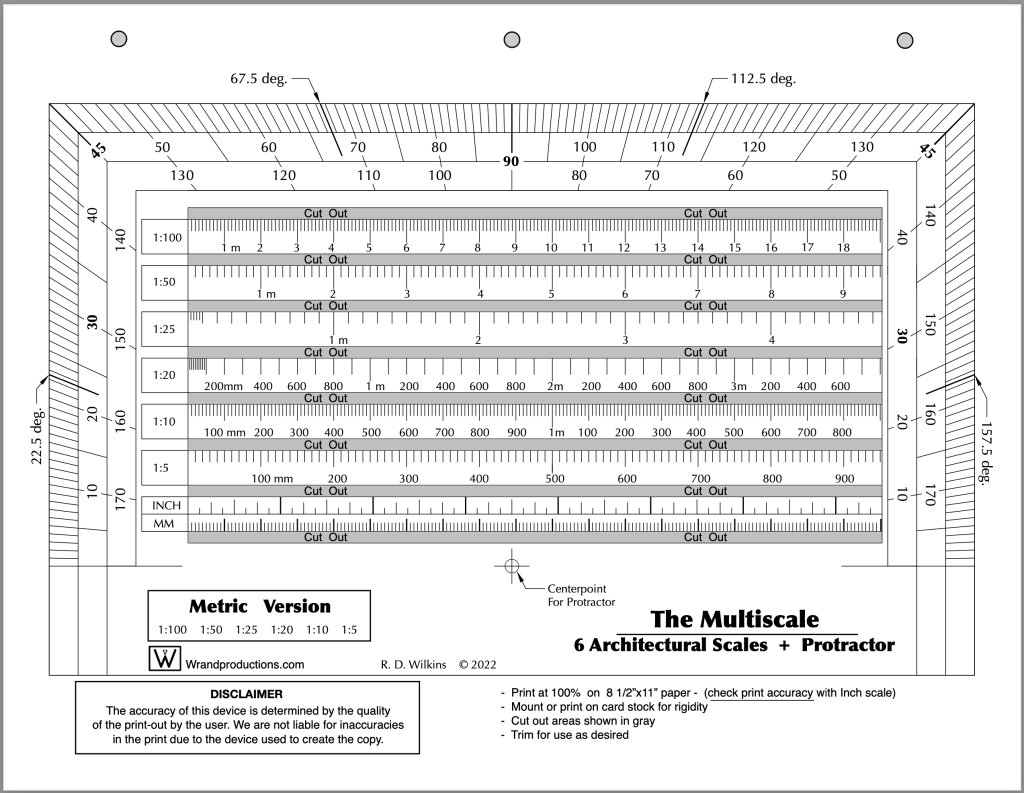
Last week I posted the Imperial version of a new tool I’ve updated recently. I promised I’d post the Metric version of the tool this week so here it is. You’ll find the Imperial version here if you missed the post.
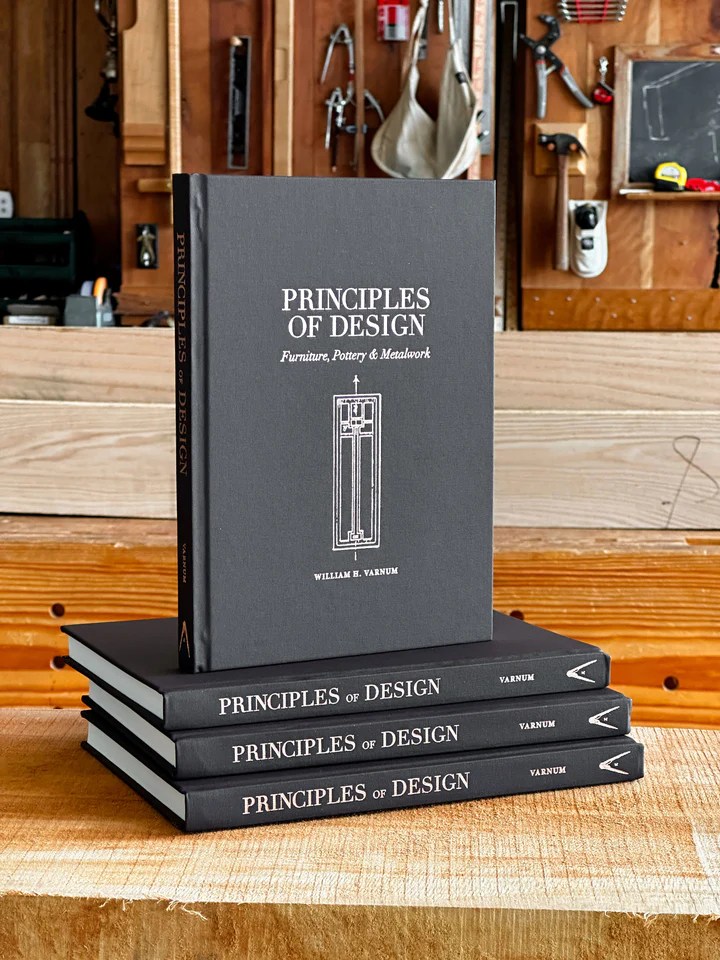
This is one of the design books on my Top Ten list. Authors Jim Tolpin and George R. Walker examine the role of proportion in design from ancient times to the present. While the emphasis is on furniture design, they show how much of the world is governed by simple proportions, noting how ratios such as 1:2; 3:5 and 4:5 were ubiquitous in the designs of pre-industrial artisans.
This is not a recipe book but a guide to a new way of looking at design through the eyes of centuries of artists.
Published by Lost Arts Press, this is just one of a whole line of fantastic books on design and hand woodworking that they offer.
You’ll receive a link after you purchase the course to download the PDF.
This new first edition is the only one of it’s kind; a film glossary created for film designers. Whether you are a novice or an industry professional, you’ll find useful information in this book that doesn’t exist in any other film glossary,. As well as nearly 1500 up-to-date terms on production, cameras, crew positions, post-production, legal aspects, stage equipment, and industry slang, there are hundreds of entries on architecture, hardware, set construction, and more.
The 2023 Ebook is due to be available in mid-December. Series purchasers will be the first to get the book when in becomes available and will receive a download link.
The 10-Week Course Description
This is the only time the series will be offered at this price and it will return to the normal price when the series begins on October 31.
This self-paced online series covers the fundamental skills that a Set Designer in the feature film and television industry here in Los Angeles are expected to have.
This is similar in difficulty to a one-semester graduate-level program at a university, but much of the material presented here is not covered at most colleges and is normally only available at the professional level. I’ve been developing this series for several years, basing it on classes I teach at the Art Directors Guild in Los Angeles.
Here is an outline of the material that will be covered in the series:
Week 1 – The Basics
Standard drafting conventions and symbols for set construction drawings. Set construction: typical flat construction techniques and variations.
Week 2 – Cameras & Optics
Understanding basic camera and lens terms: aspect ratios, focal length, depth of field, sensor sizes, exposure, stage lighting, using camera angle templates.
Scaling from photographs and artwork: calculating dimensions, understanding picture perspective and allowing for lens distortion.
Week 3 – Analyzing the Script / Reference Materials
How to break down a script for set design; using storyboards; techniques for estimating drawing time schedules.
References: using online, printed, and survey photo references; building a reference library on a budget.
Week 4 – Working Drawings
Step-by-step directions on creating proper construction drawings: plans and elevations; details, full-size details, and digital cut files; reflected ceilings and furniture plans; stage spotting plans, and director’s plans.
Week 5 – Door & Window Details
Diagrams and explanations of door and window construction and various adaptations for stage sets; creating accurate-looking period reconstructions; understanding, using, and sourcing hardware.
Week 6 – Stairways
The fundamentals of stair design: types of stairs, stair construction, how the choice of stair type affects design, and designing elliptical stairs.
Week 7 – Mouldings & Staff Elements
Understanding and using the Classical Orders of architecture; the proportions of mouldings based on style type; using a moulding catalog and creating built-up moulds.
Using plaster staff and compo elements in a set; designing with brick skins and textured surfaces.
Week 8 – Backings, Special Effects, & Visual Effects
Using painted and photo backings: The advantages and drawbacks of various types; creating custom backings; how to calculate correct placement distance from the set.
Special effects considerations: replicating fire, water, and wind effects; understanding legal requirements for special effects work on a sound stage; dealing with practical fireplaces.
Visual effects work: shooting with green or blue screens; using LED walls or volumes.
Week 9 – Backlots & Location Surveys
Shooting on studio backlots; shooting on location; proper surveying techniques; assembling a personal survey tool kit.
Week 10 – Physical Models
The advantages of physical study models; determining model scales; various model types and construction techniques.
Class Materials & Videos
Each week there will be tools, charts, and reference material to download as well as video instruction to help you do the exercises and create your portfolio drawings.
Along with the classes, you’ll have access to a private chat area that is only available to students of the series and alumnae who have taken courses previously. Here you’ll be able to meet other designers, discuss class material, get advice on your career, and exchange ideas and experiences from both the classes and real-world entertainment jobs.
Prerequisites:
– You must know how to draft. Drafting ability is essential to effectively completing the course and ending up with a set of professional quality working drawings. I’ll be offering a course on drafting later in 2022 to fulfill this prerequisite.
– Be familiar with CAD software – You are free to use any CAD software you are familiar with. Using software that you are still learning may make the lessons more challenging than you can handle. There is no standard drawing software in the entertainment industry as far as the Art Department is concerned. There are preferences among certain designers but one aspect of the job is a need to create files that can be used by many different other programs. 3D modeling won’t be required for any of the class projects but feel free to work that way if that is part of your usual design process.
There is a 14-day money-back guarantee from the time you begin the series if you change your mind. If you’re unsure about whether the series is right for you, you can schedule a free 15-minute discovery call to talk with me and I’ll be happy to answer any questions you might have.
A full-size triangular architects scale isn’t the handiest thing to carry around with you.
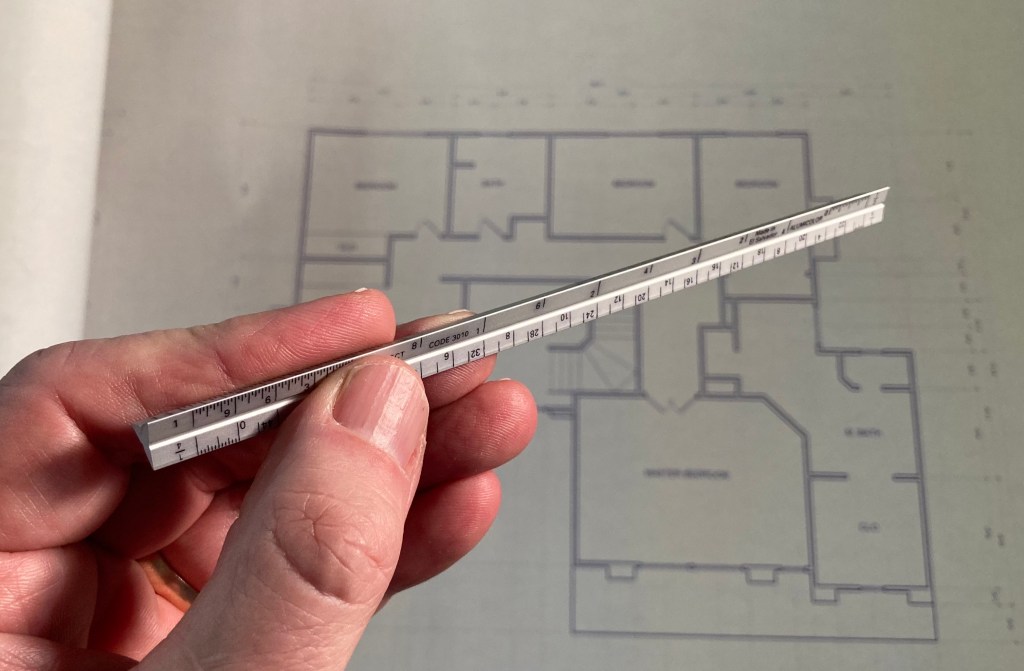
I have those miniature versions, the cute ones that are about 6″ long and require a magnifying glass to be sure you’re reading them correctly.
It hurts my eyes to try to read the numbers on these things
After I nearly poked a hole in my chest from having one of these in my pocket, I looked for an alternative that might lessen the chances of a trip to the emergency room after falling on one of these.
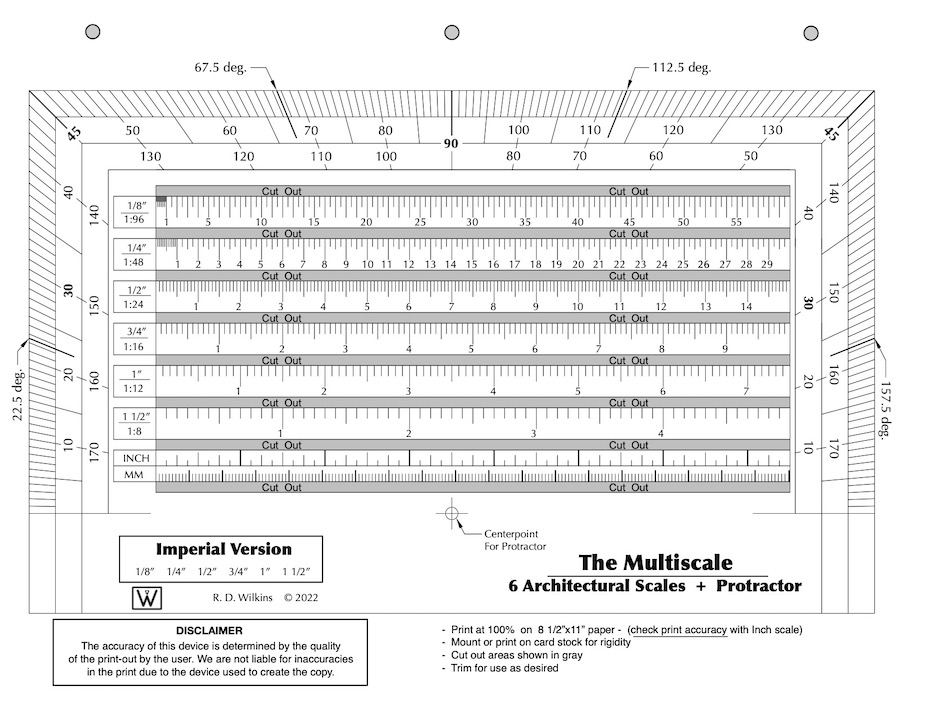
I found an 18th century drafting tool that was a combination scale and liked the concept. So, I updated and revised it to what you see here. It’s a combination of the six standard scales we use for set design and throws in a protractor as well.
A good thing about it is that it’s not engraved on brass or ivory and it fits in a binder or a book, or you can fold it up and put it in your pocket. But, it doesn’t work very well with a lot of folds in it. Best to leave it as flat as possible. Just be sure you print it out at 100%. Check it with the inch scale at the bottom against a known accurate ruler.
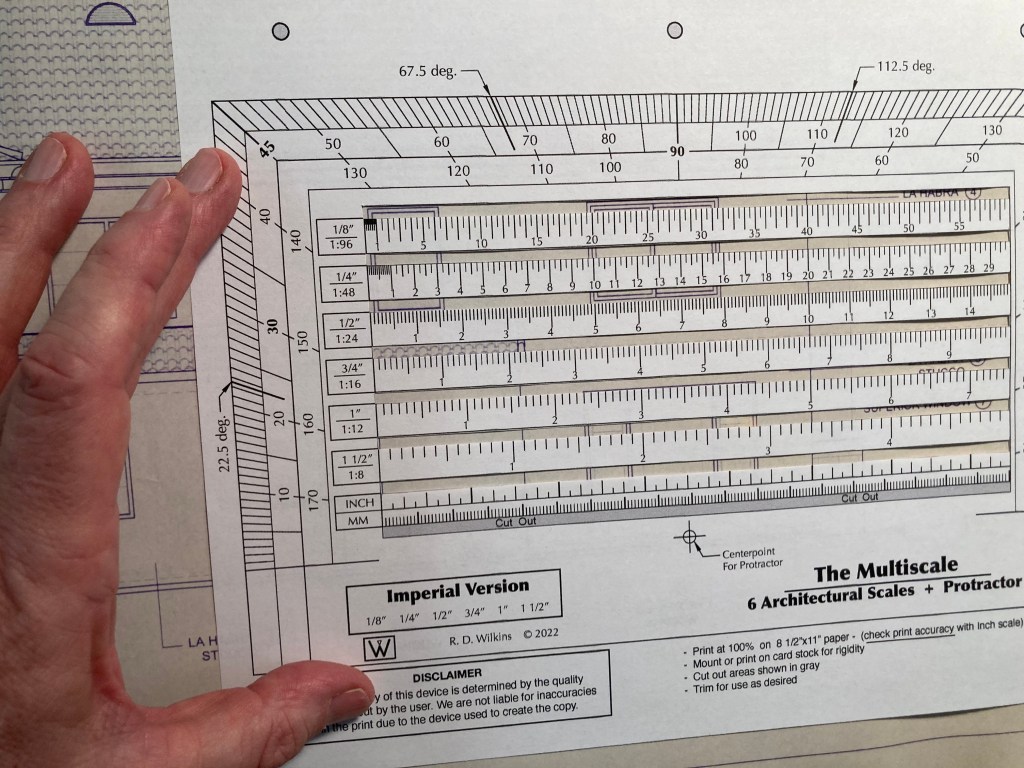
It’s better if you mound it to some thin card stock or manila folder material. Then cut out the little windows between the scales and you’re good to go. Heck, you can even have it printed on a transparency if you want.
Cut out the slots between the scales for use on drawings
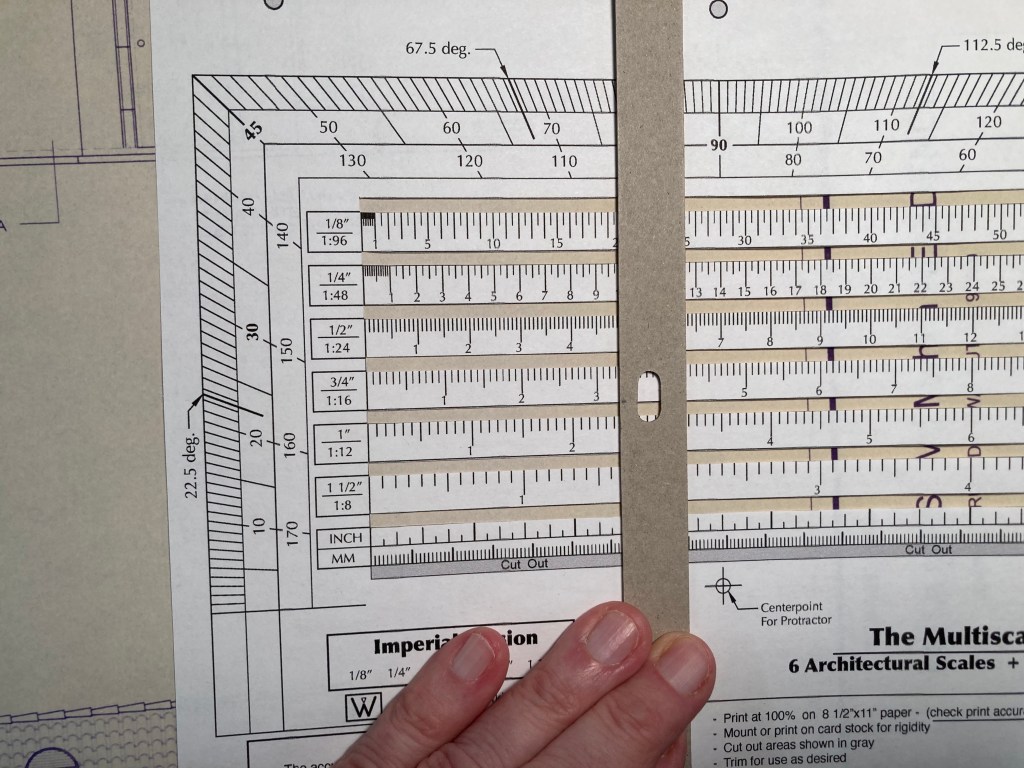
Lay a ruler or straight edge vertically on the scales and you have a direct-reading scale conversion calculator. Next week I’ll be posting the Metric version of this tool.
A straight edge aligned vertically will allow you to do quick scale conversions.
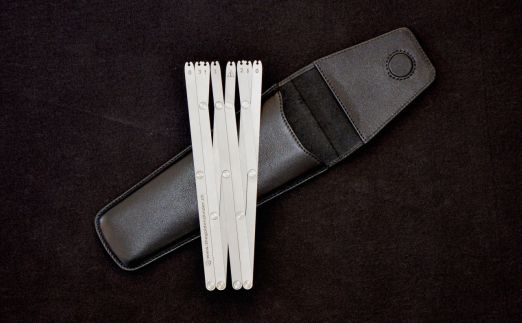
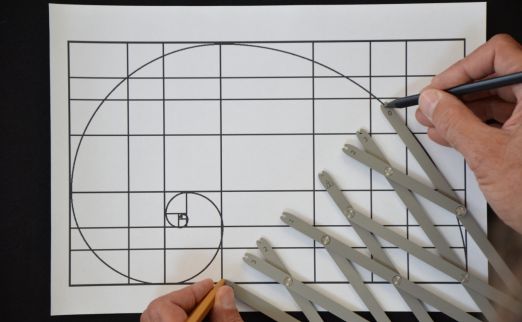
I love well-made tools, especially dividers. So when I got an email from Robert Lèvy in Switzerland describing a new set of dividers based on the Golden Proportion, I was very interested. He was kind enough to send me one of his tools on loan to examine and try out. The dividers are everything I would expect in a tool; beautiful, easy to use and very well made.
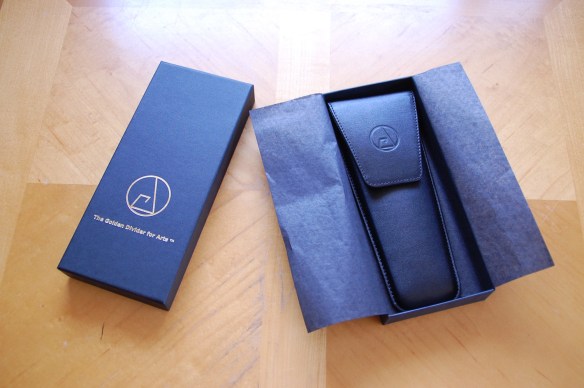
The packaging is as well thought out as the tool itself. It comes in a black box stamped with the logo and name in gold. Inside, in black tissue, is a very nice calfskin case which is also stamped with the logo. The leather (real) and the stitching are very good. Unlike a lot of faux leather cases you see today, this one, of real leather, is well constructed both inside and out. The top flap is held closed by two magnets, both stitched into the leather, and the inside of the case is lined with a soft microfiber fabric. On the back of the case is a leather loop for attaching it to a belt.
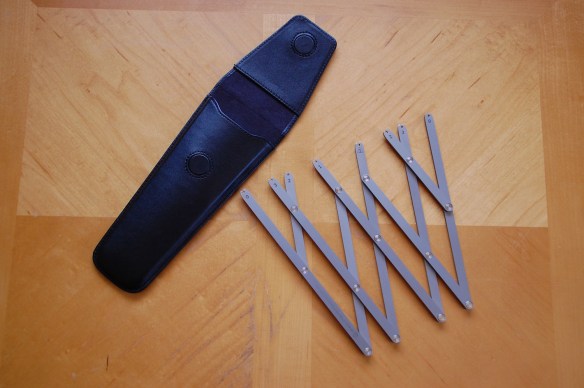
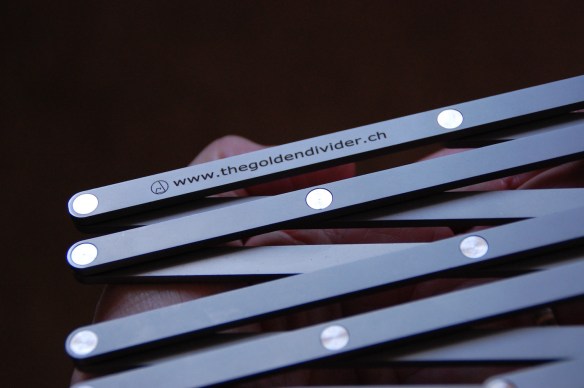
The tool itself is excellent in every way. Laser cut from 316L stainless steel, it holds up to oil from hands. The lettering is laser engraved and the arms of the dividers are connected with permanent flush rivets. Rivets are usually the weak point of dividers as they are either set too tight or they quickly loosen up after some use. These rivets are not only well engineered but they are set at a perfect tension. The arms move easily but stay where you want them so gravity won’t pull them to a wider setting during use.
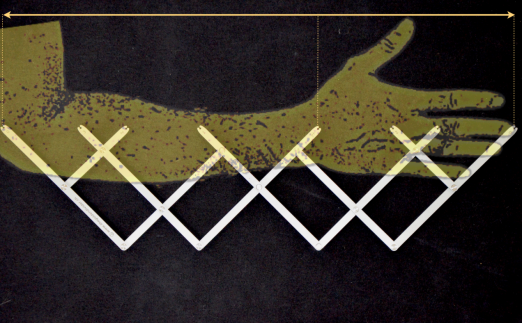
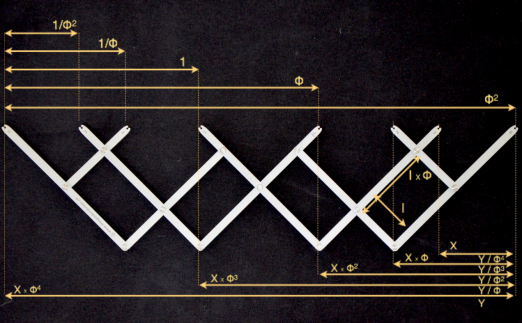
One of the great thing about these dividers compared to others based on the Golden Proportion is that this tool’s 8 arms give you multiple proportions at once, not just a single one making it possible to lay out the primary, secondary and tertiary lines for a drawing. Drawing a volute is actually easy, and explaining a relationship between a cubit and a handbreadth and showing the golden proportion relationship of body parts is simple with these dividers.
Photo: GDA
Photo: GDA
Rather than go into a long-winded article on Golden Proportion, go to Robert’s website. You’ll learn everything you need plus get more information on his device, which by the way took the Silver Medal at the Geneva International Exhibition of Inventions this year.
The dividers are now at an introductory price of 295 CHF, or about $298 US. This is a very good price for a tool of this quality. Buy one while you can. Very well made specialty tools like this won’t be available forever.
Here is a video on using the tool to lay out regulating lines.





 The Designer's Assistant