Why You Need Full Size Details

On construction drawings they are noted as an FSD, an abbreviation for Full Size Detail. You need them to visually describe exactly how something is to be built, whether it’s a built-up moulding profile or a complicated mechanical detail.

Here is an example of a typical situation where an FSD is needed. Note the red arrow pointing to a detail bubble that reads, ” FSD – 8A”. This is noting a sub-detail of a window detail labeled as #8.
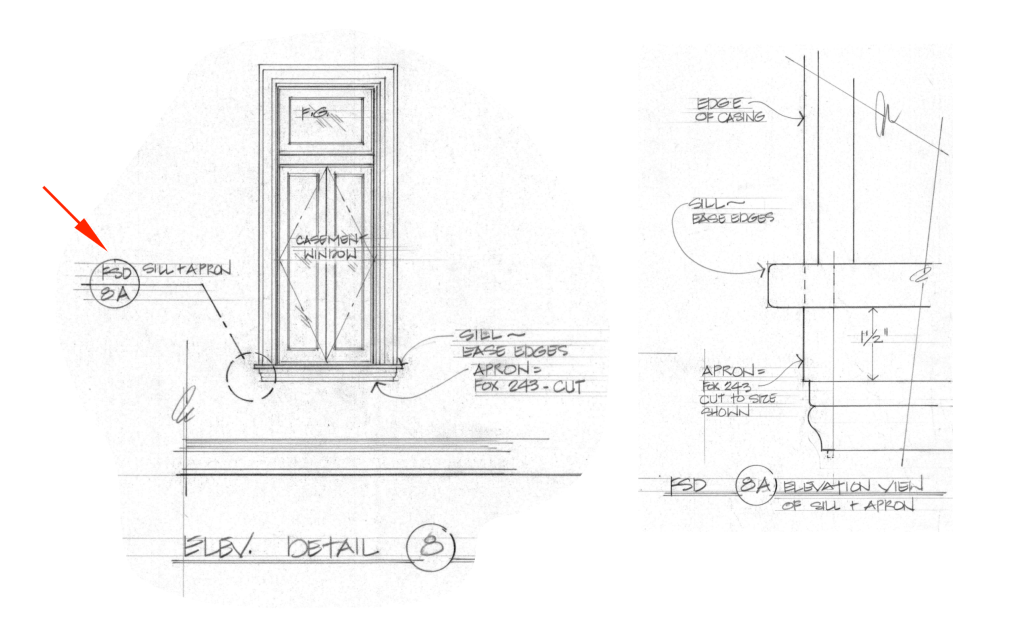
Detail drawing by Dawn Snyder

The detail calls out a window sill apron mould with the moulding profile number and a note that the moulding is “cut”. This means that rather than being used as-is, the moulding needs to be altered in some way. This level of detail is impossible to read on the elevation which is drawn at 3/4″= 1′-0″.

The FSD beside it shows how the moulding is to be placed in relation to the other window parts as well as shows that the plinth of the moulding profile is to be cut down to 1 1/2″. Unless you don’t care how the window ends up looking, you need to include FSD drawings if you have specific details in mind.

Here is another FSD through a window jamb. This drawing shows the jamb thickness, sash thicknesses and widths, the moulding profiles, architrave, and panel moulds. An FSD is needed for this complicated level of period details.
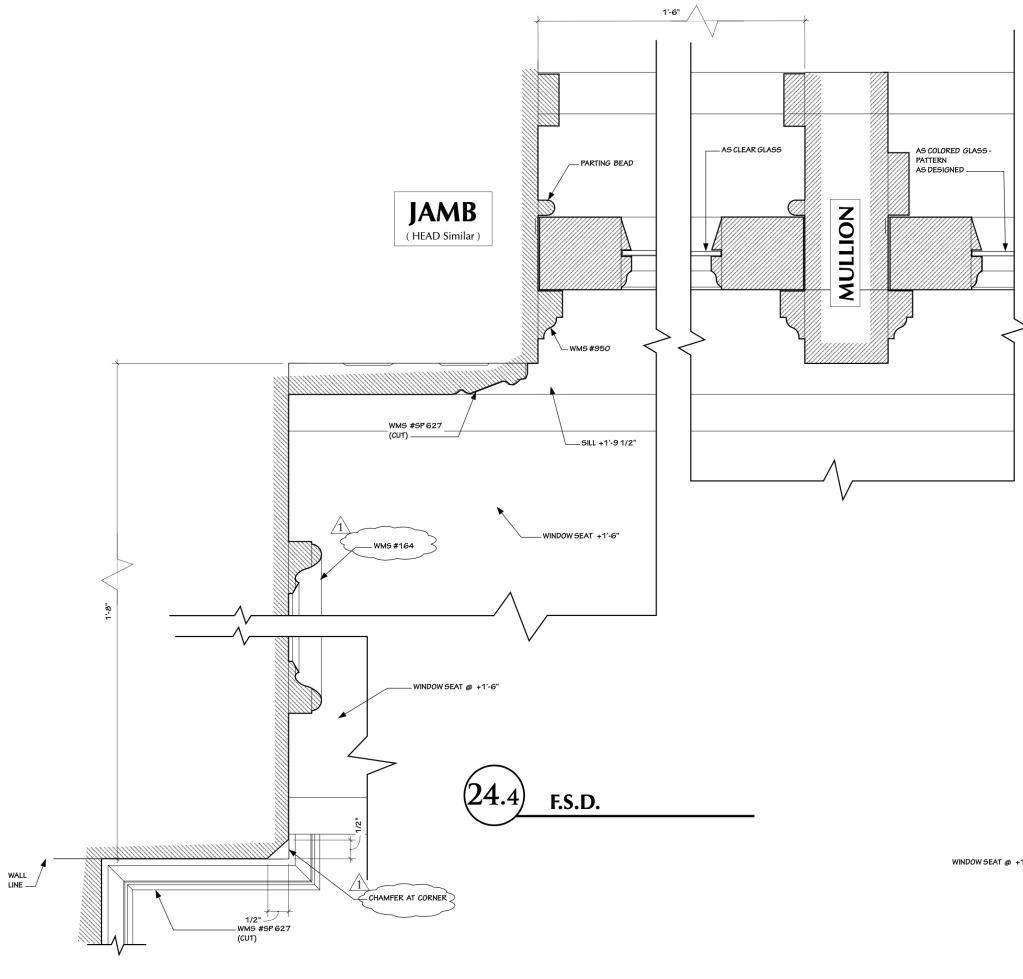
FSD Window detail – R D Wilkins

Below is an FSD of a vertical section through a platform riser. Here you can see notes as to materials, fasteners, and electrical lighting effects. Again, it’s impossible to communicate this level of detail in a smaller scale of drawing. You may encounter some situations where you can get by with a half-scale or half full-size drawings, but these aren’t recommended if a full size detail is possible.
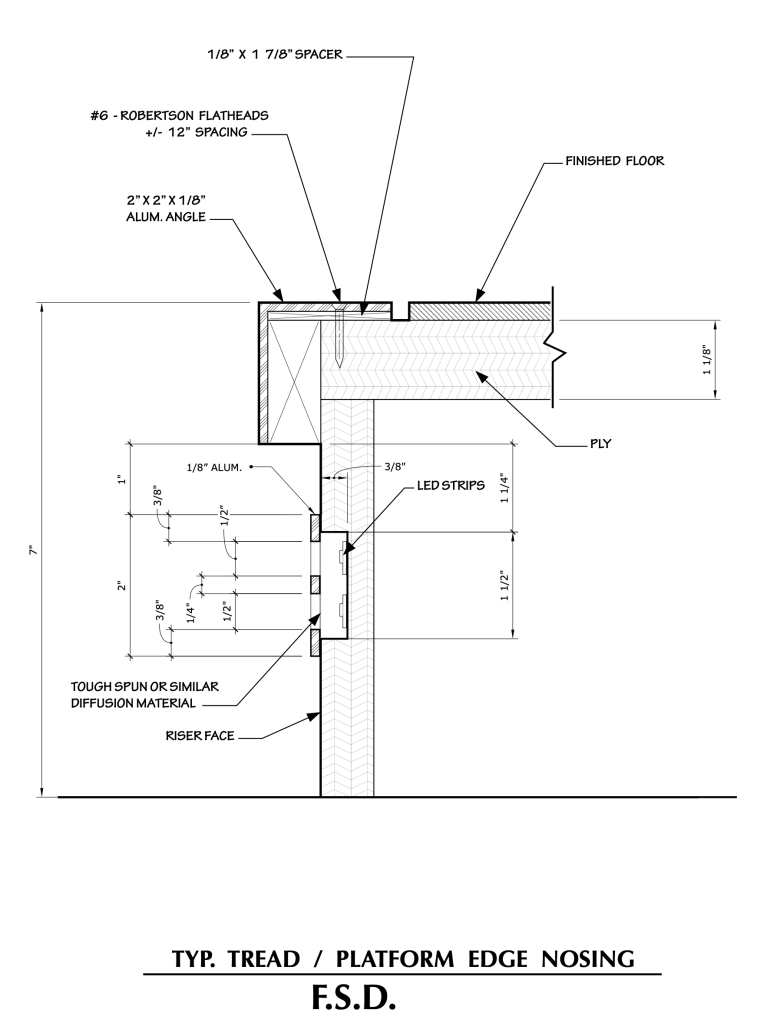
FSD platforn detail – R D Wilkins

A note on dimensioning: You’ll notice that in the section through the window jamb that there are few dimensions. Only the distances where the drawing contains a ‘broken’ wall line are dimensioned. This is traditional, as the prints were originally made as a direct contact print and the set designer was sure that the prop makers could scale from the drawing and get correct measurements. This was the point of a full-size, as you’ll see below.

Once CAD became the standard, and you couldn’t be sure that the print was made at 100%, and people began to work from prints that were smaller than intended, there was more assurance in completely dimensioning even an FSD. This is for the Art Director on a show to make a call on.

Shop Drawings & Story Sticks

There’s nothing new about the concept of full size drawings. It’s a technique that’s thousands of years old.
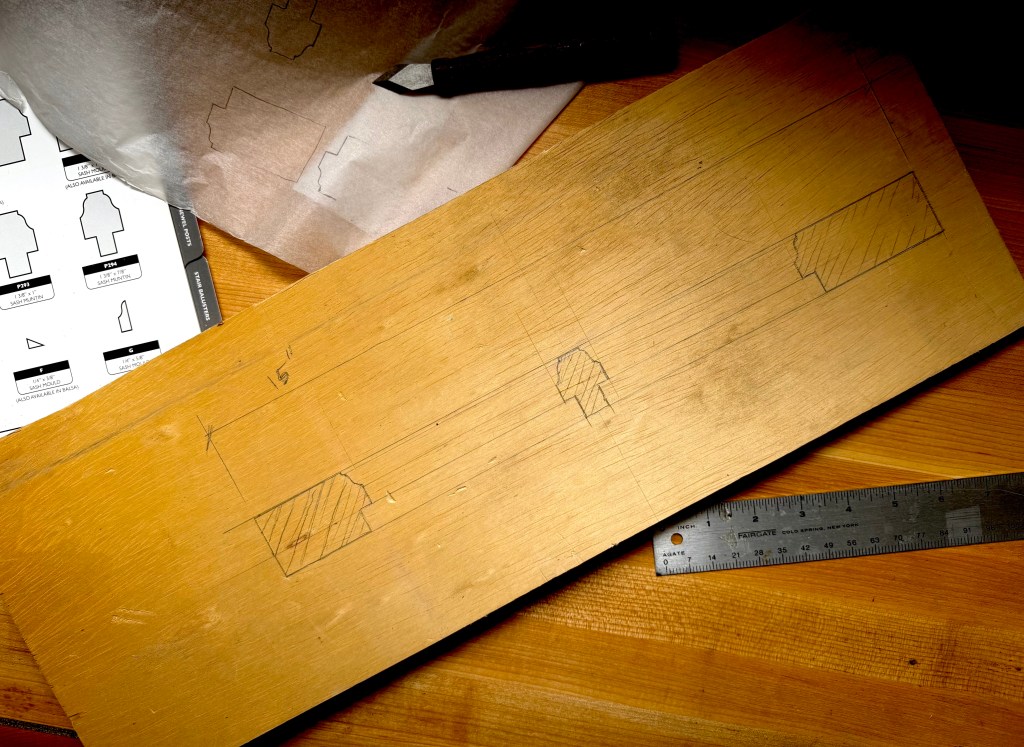
A shop drawing for a small window sash, drawn in pencil on a scrap board.

When I was a prop maker, we were trained to create shop drawings for things like mouldings, windows, and doors. On television shows there is not often time to do full size details of every set element and it often fell to us to create a shop drawing to ensure accuracy when laying out the pieces for a built object, especially a window. Nothing sucks as bad as inserting window sash into a frame and finding out the meeting rails are off by a quarter inch.

In the best case, a full size section has been drawn and you can either pull dimensions off the drawing or glue one to a piece of door skin to cut a template out on a bandsaw.

Traditionally jointers, carpenters, and stone carvers created their own story sticks or setting-out rods to be sure that their cuts were accurate, or full size patterns to check the true size of their work piece.
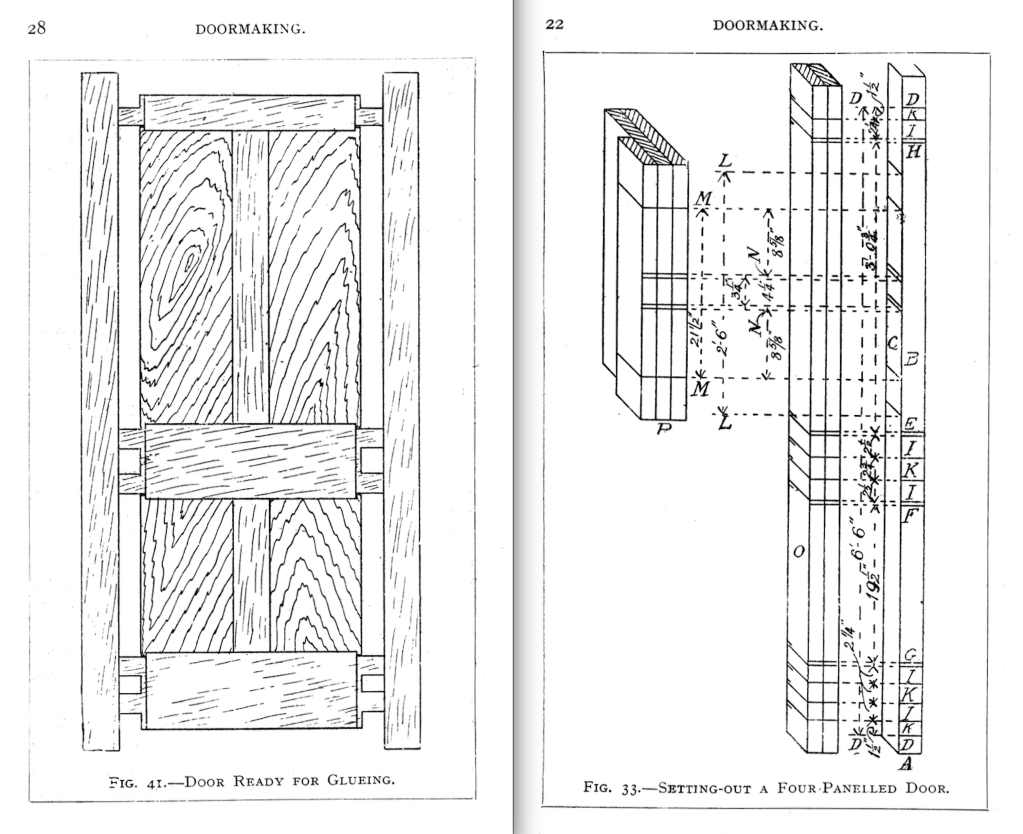
An example of a Setting-out rod for a 4-panel door. This is from a reprint of an excellent little book called Doormaking & Windowmaking from Lost Art Press.

In traditional Japanese house construction, the master carpenter would lay out all the major dimensions for a house on a master story rod called a Kensao. This was like a blueprint on a stick and would be referred to for all questions about construction measurements or additions to the structure. When the house was completed, the rod was kept in the eaves under the roof of the building.
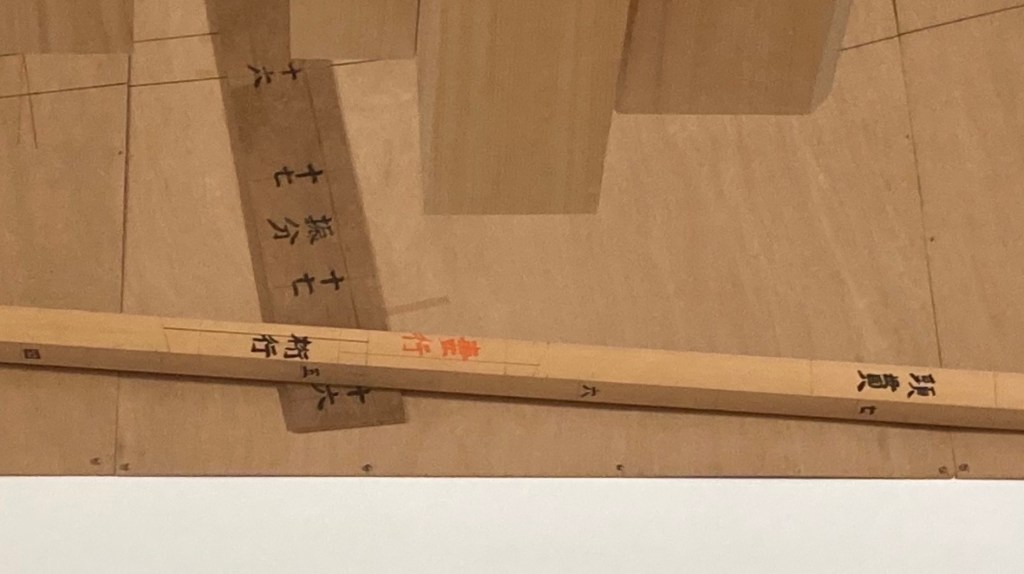
A kensao which was part of the collection of the Masters Of Carpentry exhibit at the Japanese House in Los Angeles.

In the Middle Ages and the Gothic period, stone building details were laid out in full size on a tracing floor, a floor that had a smooth layer of plaster applied to it on which the details were laid out with a large compass and straight edges that the stonemasons referred to for each separate element to make sure that they would fit together.
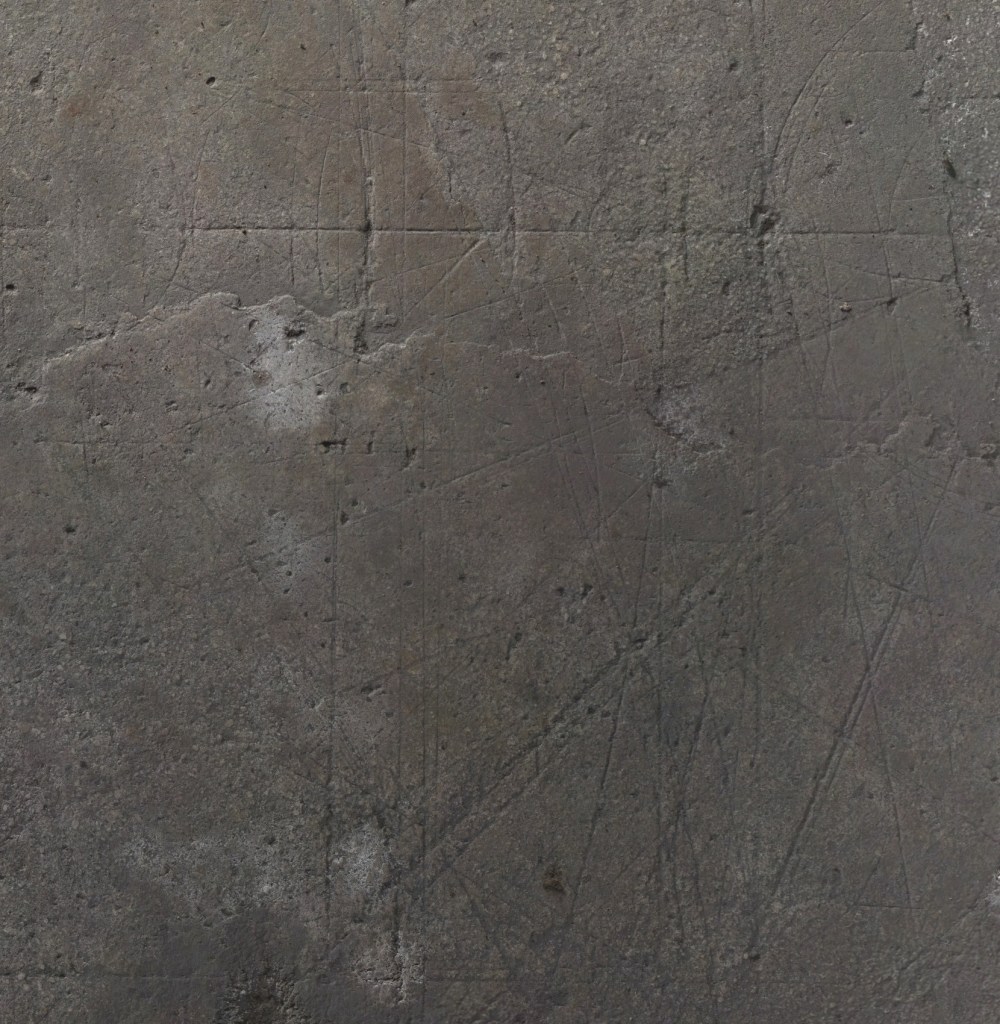
remaining images from a tracing floor

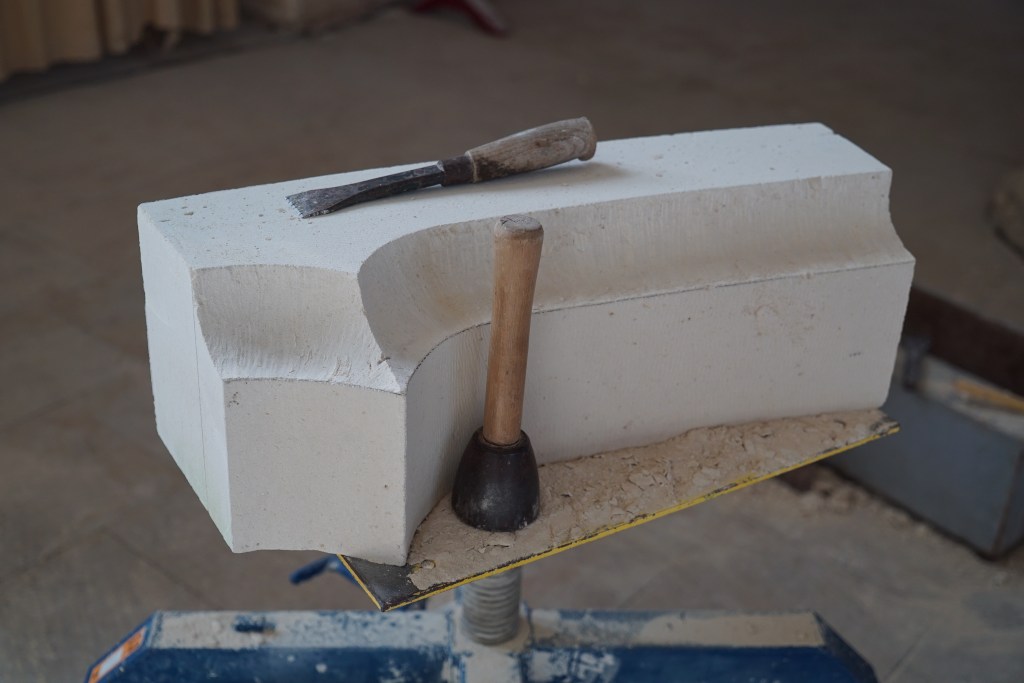
I was able to watch some stonemasons in France repair the windows of a medieval church and saw their modern day version of the original process. The design was drawn out full size on thin plywood sheets. This pattern was transferred to separate patterns on thin plastic which were then used to trace the outline onto the stone itself.
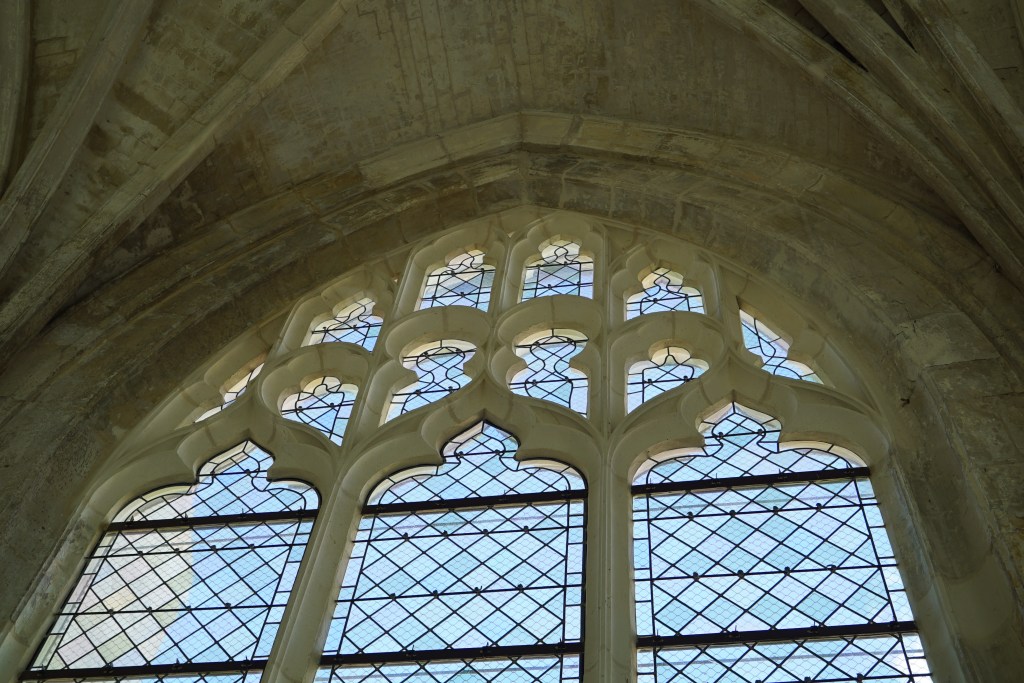
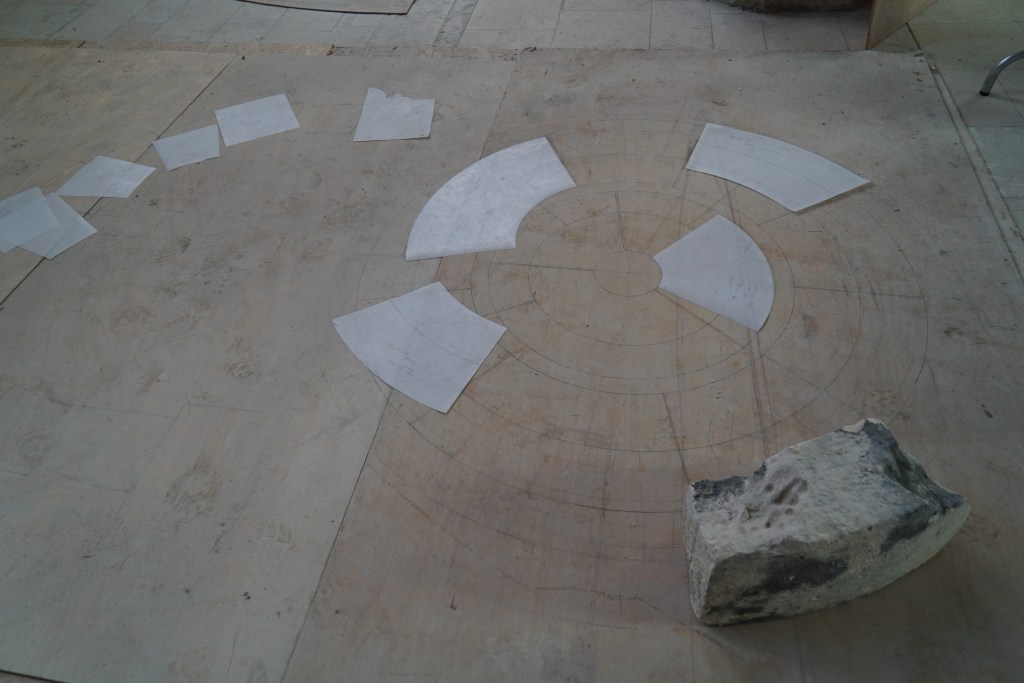
newly replaced tracery
full size detail on plywood with individual stone patterns in plastic
Individual stone tracery section in progress

Production Designer Sarah Knowles recently told me about a new exhibition at The Met in New York City. Entitled Gothic by Design: The Dawn of Architectural Draftsmanship, the show includes over 90 original pieces that span from the 13th to the 16th century. On now though July 19.

Many of these pieces were meant to be presentation artwork to show the sponsor what the final building would look like, but there are several construction drawings in the gallery show.
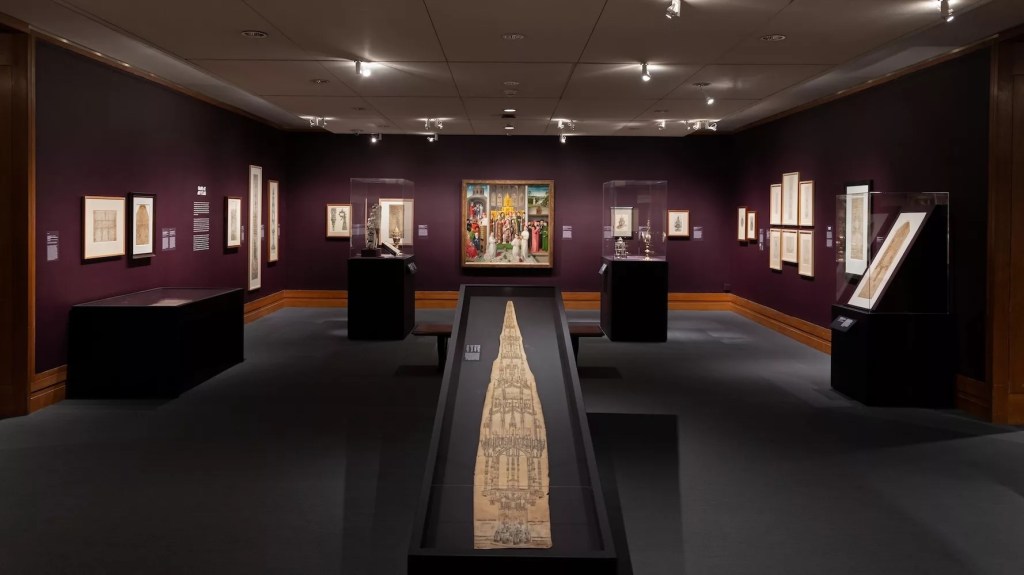
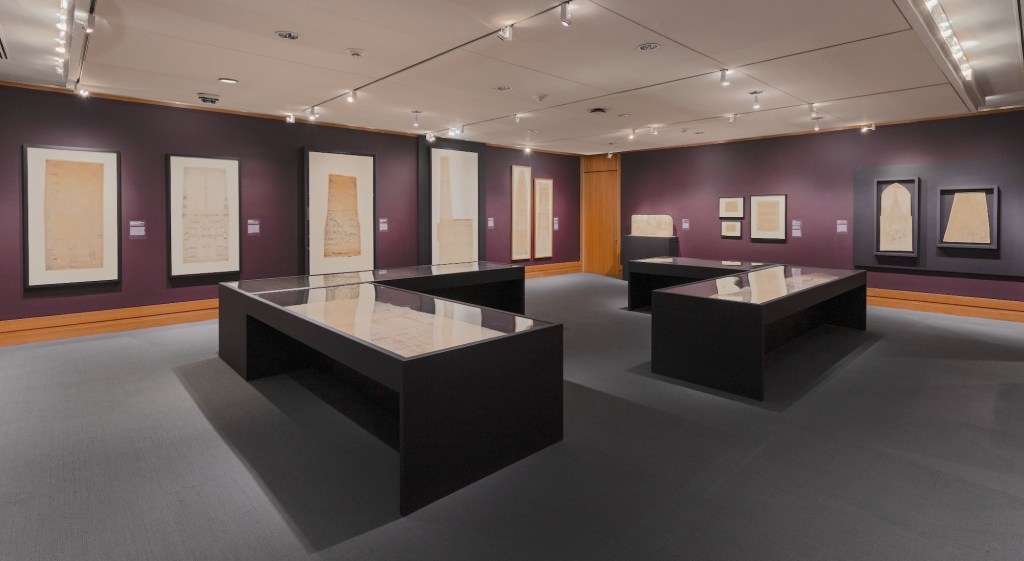
The Met – Gothic By Design Exhibit. Photo: Metropolitan Museum Of Art New York

One of the drawings s a plan and developed stair stringer for the Saint Stephens Cathedral in Vienna. The stairs are shown in a painting by artist Rudolf von Alt in 1841.
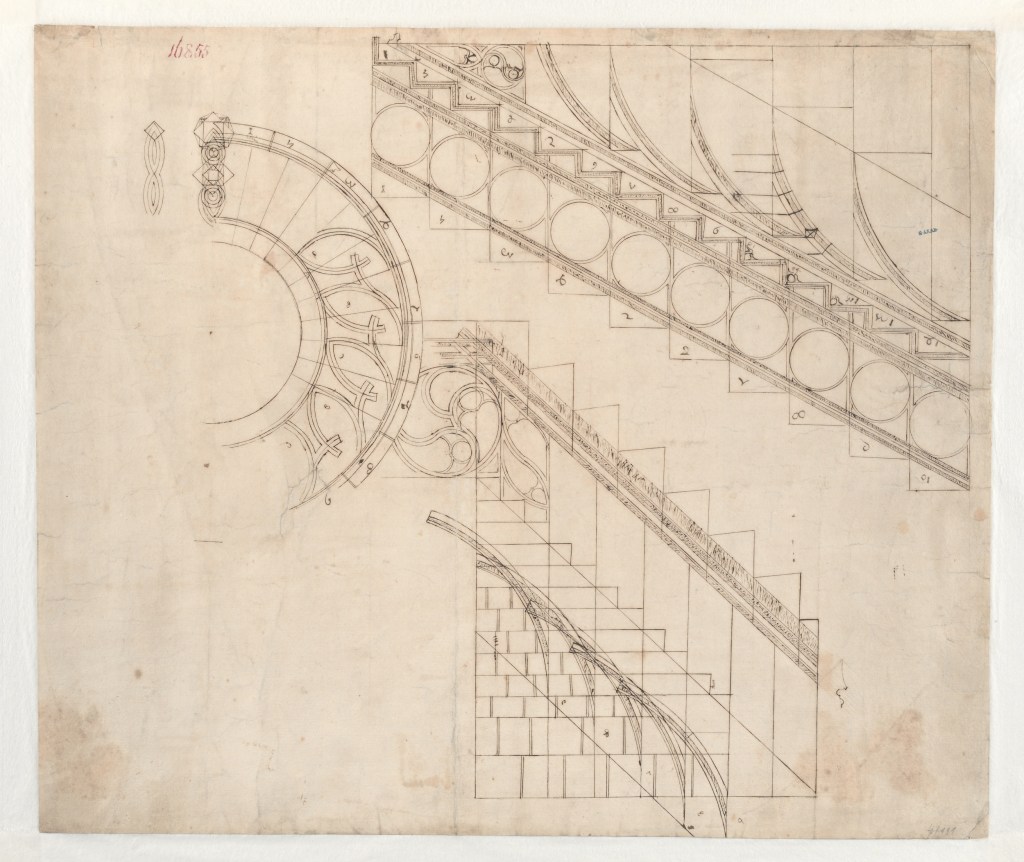
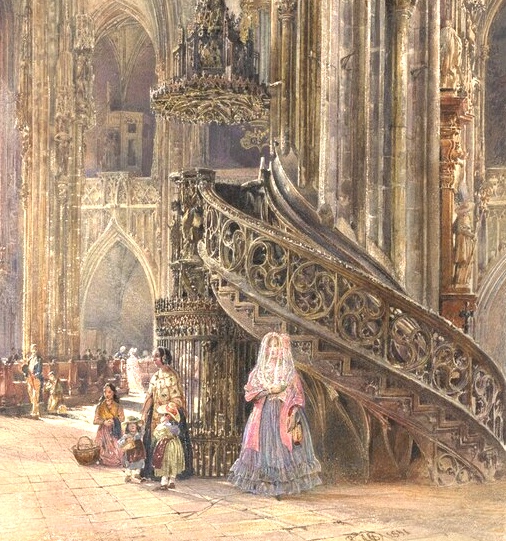
Drawing by Anton Pilgram, 1515. Photo: Metropolitan Museum Of Art, New York
The staircase is shown in a painting by Anton von Alt from 1841

The one full-size detail is of a vaulting detail from the Chapel of Saint Catherine in Vienna.

Similar to the plastic sheet patterns that the French stonemasons use today, the stonemasons of the period would make a pattern on paper for each of the stone sections.

One drawing in the collection is of the entire vault pattern with each of the pieces numbered.
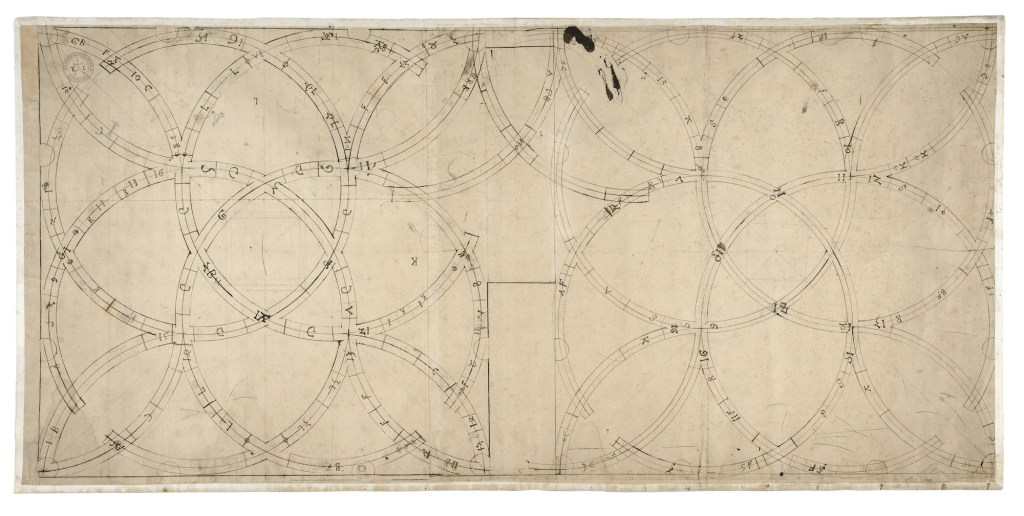
A drawing of a vaulting plan for the Chapel of Saint Catherine in Vienna. Photo Metropolitan Museum Of Art

If you are interested in learning more about set drawings and construction, this class on Set Construction offers detailed information about set construction, videos of basic flat and scenery construction, and 3D models of standard scenery pieces that will work in most 3D modeling programs.

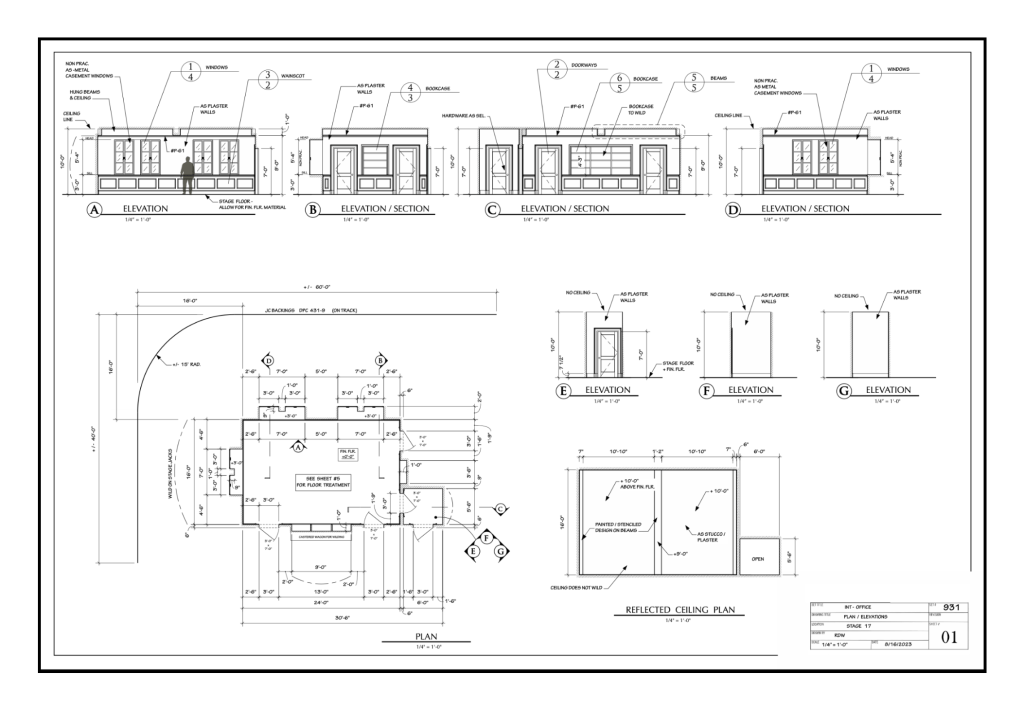
The class includes a full set of drawings for a typical set, including 3/4″ details and FSDs.
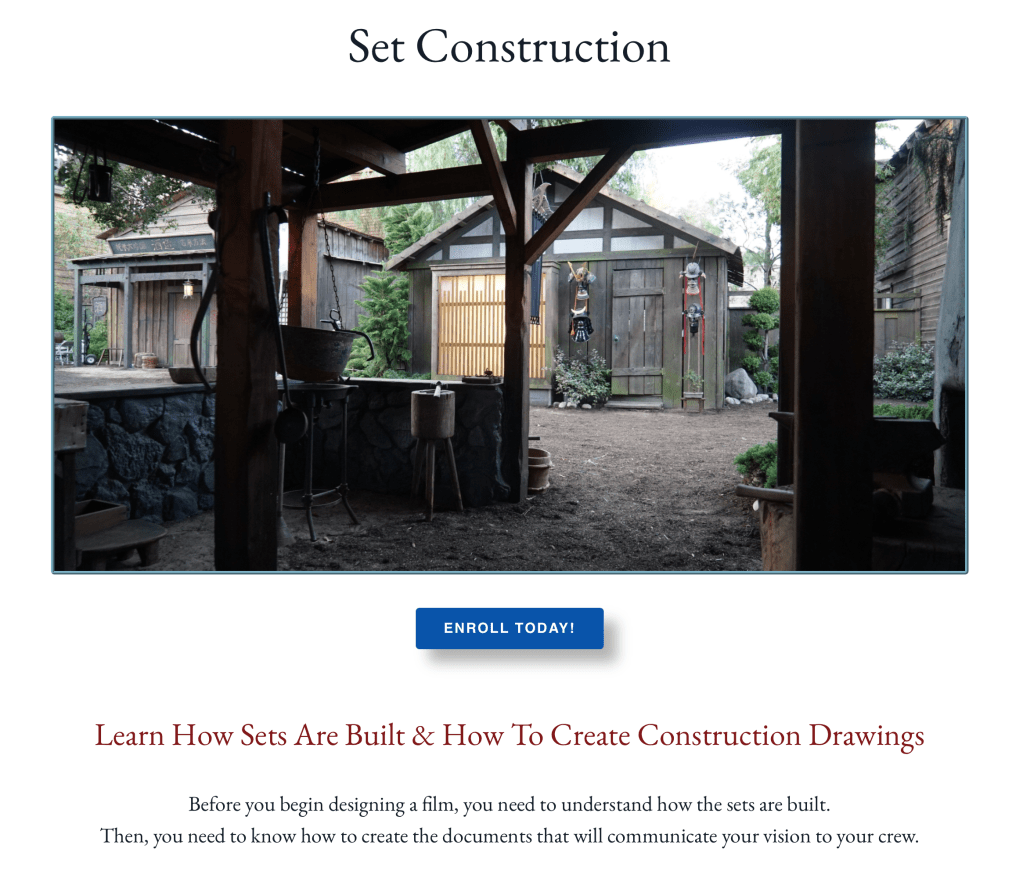
A full set of seven sheets of drawings is part of the course.

Art Department Masterclass – 2026 Sessions – April 30 Application Deadline

The Art Department Master Class is an international training program that has held over 10 training sessions in Lithuania, Italy, and Iceland. The one-week programs are led by film industry professionals from various countries who are leaders in film design in Art Departments around the world.

Production Designer K.K. Barrett giving a lecture on the design for the film Marie Antoinette at an ADM event. Photo: Andrius Paulavičius

Its creators, Ieva Buzinskaite and Domante Urmonaite realized that there was a lack of training available for people who had chosen a career in the Art Department of films and saw it as an opportunity for creating a world-wide community.

“We are committed to fostering an inclusive and supportive environment that encourages dialogue, generosity of knowledge, and long-term creative sustainability within the art department community.

Many of our participants and experts return again and again. They support the project, speak about it with warmth, and help shape what it becomes next. We’ve also been lucky to grow alongside partners who believe in the same values and continue to support us year after year.

At its core, this project is not just a job for us. It’s a long-term commitment to maintaining creativity, curiosity, and motivation in an industry that can easily exhaust all three. We want people to leave the Art Department Masterclass feeling re-energized, connected, and reminded of why they chose this path in the first place.

There is, of course, a lot of work happening behind the scenes – but that’s nothing new for anyone who has ever worked in an art department. And just like on set, we believe the best results come from care, collaboration, and a shared belief in what we’re making together.”

The 6-day sessions for 2026 are:

World Building – June 12 to 17 in Turin, Italy

Digital Post-Production – November 5 to 10 in Vilnius, Lithuania

The sessions are limited to 20 participants each and are meant for individuals worldwide who have at least 5 years of experience in art departments in the film industry.

The price of the sessions is €650 per session, which includes tuition, accomodation and lunch. The price is kept low through the generous government co-funding from the European Union Creative Europe program.

For more information on the sessions and to apply, go to this link.

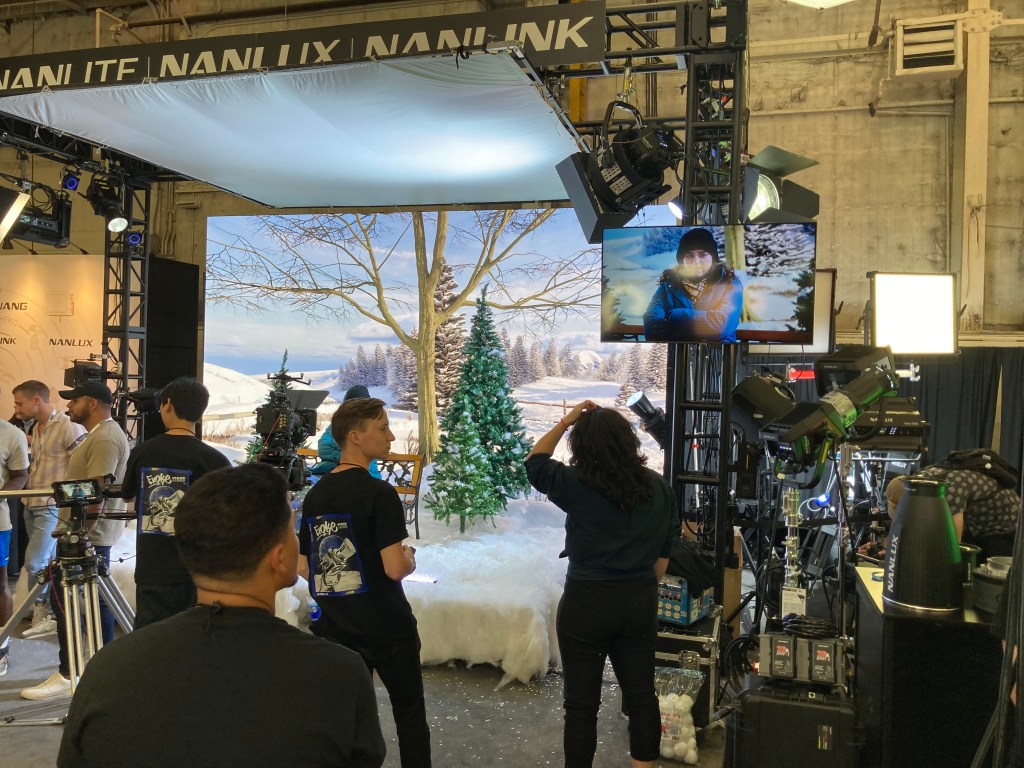
Why You Should Go To The Cine Gear Expo – Tickets Free Until May 27

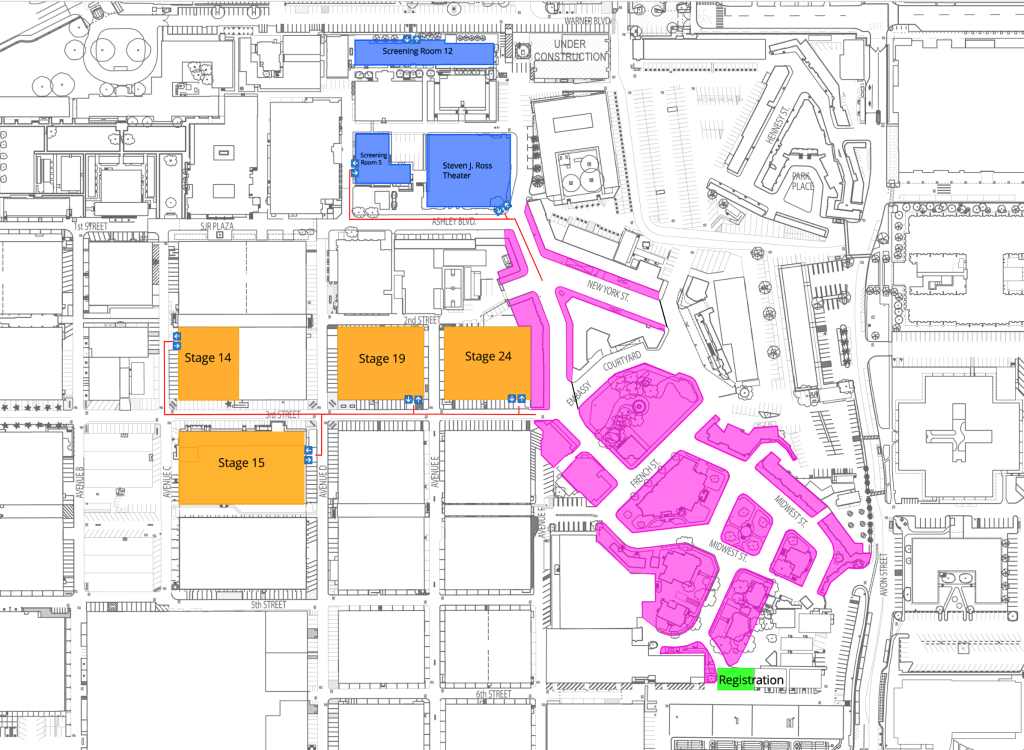
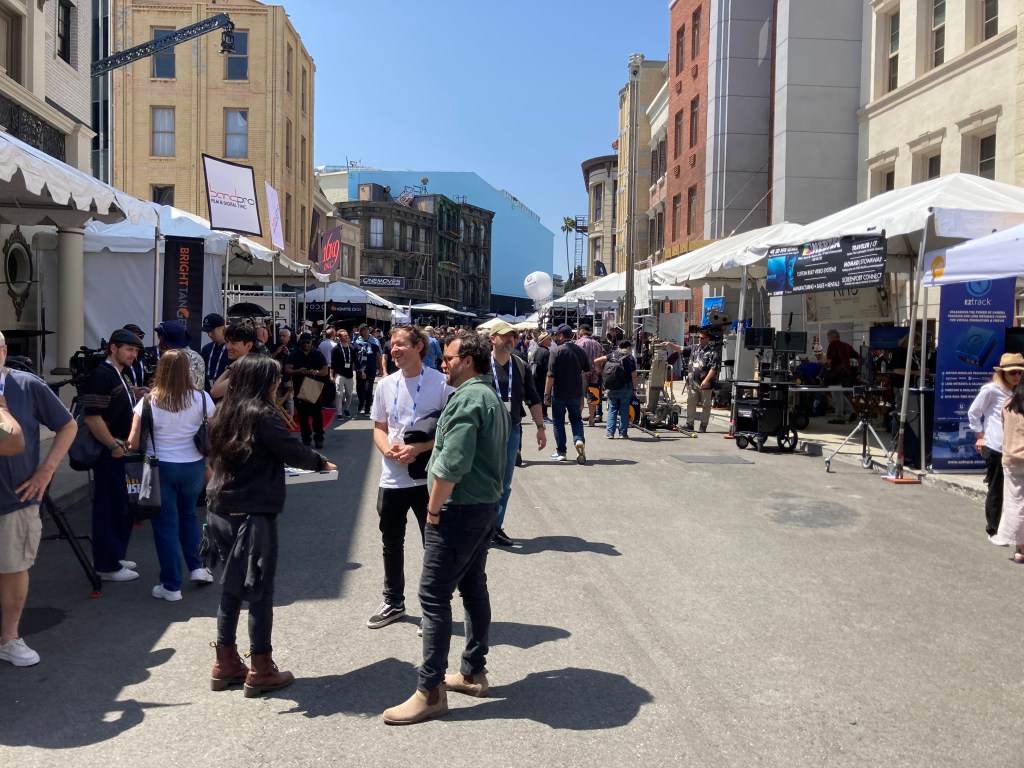
The Cine Gear Expo will be held at Warner Bros Studios from June 7th to the 9th this year after a long run in past years at Paramount Studios.

The event has finally returned to its pre-pandemic size and has been a must-attend event for cinematographers, gaffers, and technicians in the entertainment industry for some time.

This year’s event will feature exhibits, demonstrations, and presentations by over 250 vendors as well as special seminars and master classes. The exhibition area will fill most of the Warner Studios backlot area as well as stages 14, 15, 19, and 24.

The Reasons You Should Go

Maybe you’re not that interested in camera or lighting equipment, so you’re wondering why you should bother attending. You may not be excited right now by the latest in what the new technology has to offer but you should be, because it affects your job whether you want to believe it or not.

The technological leaps that have been made in the last few years in LED lighting and new digital camera sensors alone have transformed filmmaking and, by proximity, the way stage sets are perceived, shot, and expected to perform.

You ignore camera and lighting technology at your own career’s peril.

There are hundreds of vendors there who are very eager to help you understand what their products are and how they work. You really shouldn’t be intimidated if you aren’t familiar with the basics, they are there to educate you in the new ways of making ‘pictures’.

Think of it as a free weekend film class where the ‘instructors’ are eager to answer any questions you might have. Think of the times you’ve been curious or baffled by the terms a DP is tossing around and being afraid to admit that you have no idea what they’re talking about.

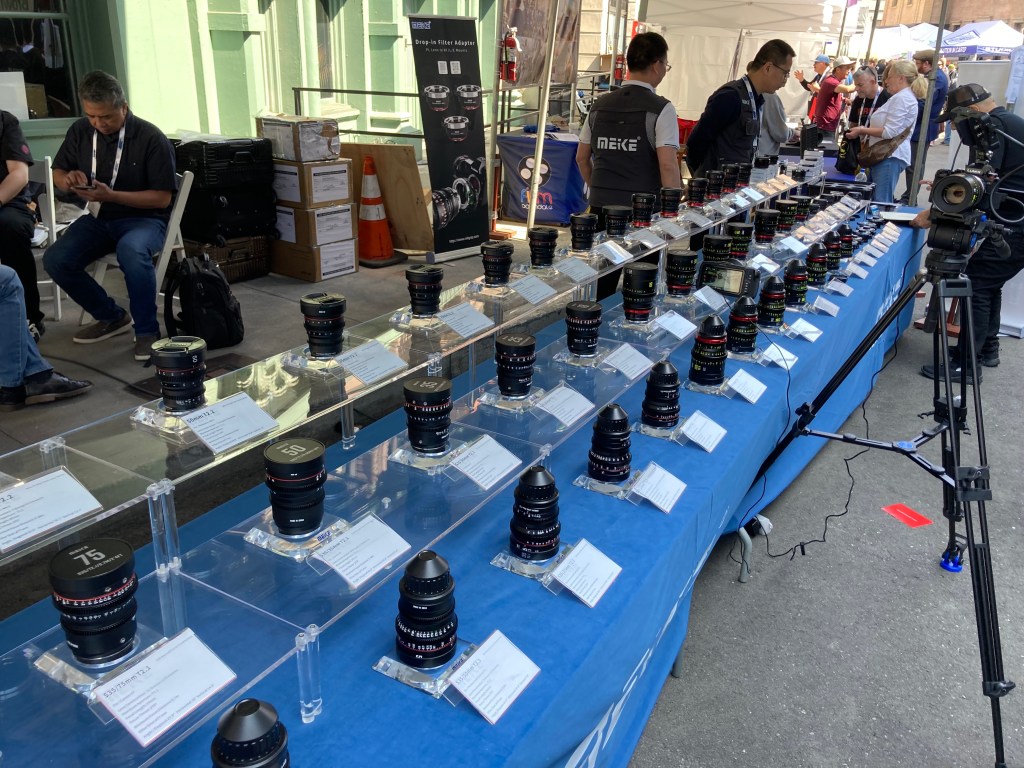
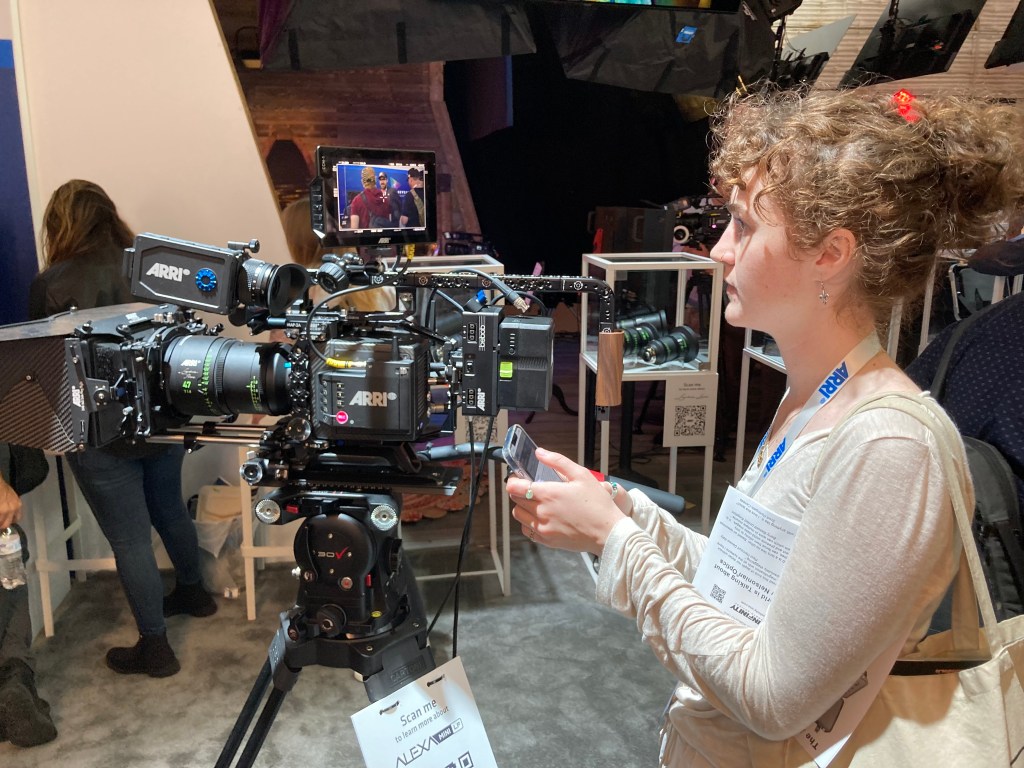
At the expo, you’ll not only get to see the latest cameras up close, but you can operate them too. The next time you want to play with a new Arri or Sony, it’ll cost you $800 or more in daily rental fees, plus insurance. Here you can see them all, in one place, and talk to people who are experts in everything about them. You will never see so many cameras and lenses in one place anywhere else.

You’ll also see the latest in lighting, new LED volumes, digital screens, cranes, and specialty equipment.

Register for free here.

If you can’t make the Los Angeles show, there are expos in Atlanta in the Fall and in New York in early 2025, But LA is by far the largest show.