
Last Minute Holiday Gifts For Set Designers

Beware. This is what happens when you give a set designer a crappy holiday gift. source: Awkwardfamilyphotos.com

Beware. This is what happens when you give a set designer a crappy holiday gift. source: Awkwardfamilyphotos.com

So, it’s just 12 days until Hanukkah and 13 until Christmas and you still haven’t gotten that special set designer in your life a gift. You could just give up in defeat and buy them that same aged cheddar cheese sampler you got them last year, ( which they carefully hid underneath your car seat and is the reason it smells like mold inside ) or you can get them something decent like one of the the items on the list below. At this point you’re probably going to have to resort to hideously expensive 2nd day air shipping, but who’s fault is that??

Best Value  –  Spike GPS device for smartphones and tablets – $299
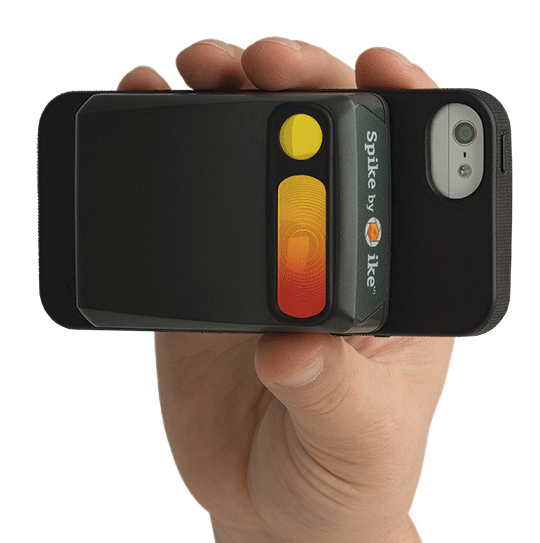
The Spike GPS device for smartphones and tablets

The Spike GPS device for smartphones and tablets

That may sound like a lot of money but that’s 50% off the introductory price of $619. I got one of these during their Kickstarter program in 2013 and have been thrilled with it. This device does everything my $500 Bushnell rangefinder does and a lot more. Take a photo of a building up to 200 meters away and then take measurements off the screen, even after you’re back at the office, even weeks later. Easily get accurate heights, door and window sizes, measure billboards, estimate square footage. You can instantly send the photo to someone else with the measurements, GPS coordinates and square footage. Soon to come are the capability to turn your shots into a Sketchup model and point cloud scanning of irregular shapes. For iOS and Android devices.

This offer is only good until December 23 with the offer code FRIENDSOFIKE14.

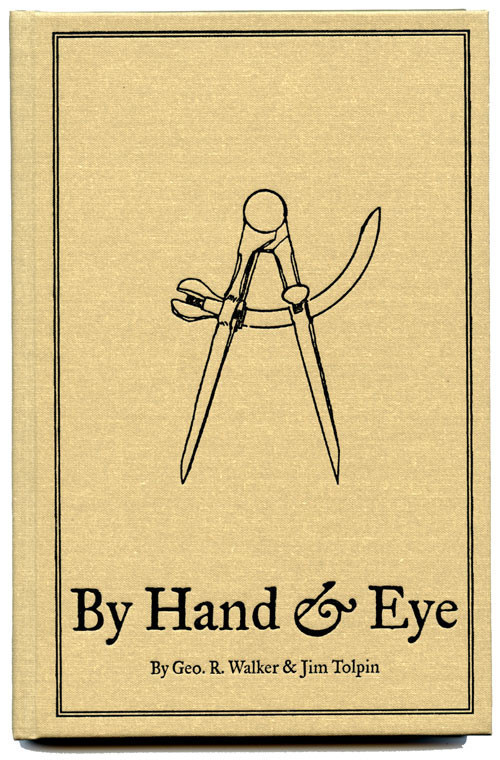
By Hand & Eye – $16.00
BHAE_scan_cover_500_1024x1024

Another gem from Lost Art Press, this is probably one of the best design books written in the last 100 years. It outlines the world of design without a rule and using only dividers and proportional methods. I covered this in a previous post and always recommend it. It’s so popular that it’s currently out of print and only a digital version is available. Buy them this and a good pair of second hand dividers from Ebay and you will completely change the way they think about design.

Drafting Apron – $25.95

apron1

Harkens back to the days of graphite dust, arm protectors and a time when you didn’t have to worry about hours of work disappearing from a computer failure. Hide a box of Tombow pencils in the pocket and watch them weep with joy.


WE Wood Watches – $75 to $150

we wood watches

WE Wood watches are beautiful analogue timepieces made from a number of hardwoods and use precision movements. Each one is absolutely unique due to it’s wood case.They’ll have something nice to look at while they’re waiting for their render to finish or that endless production meeting to come to an end.

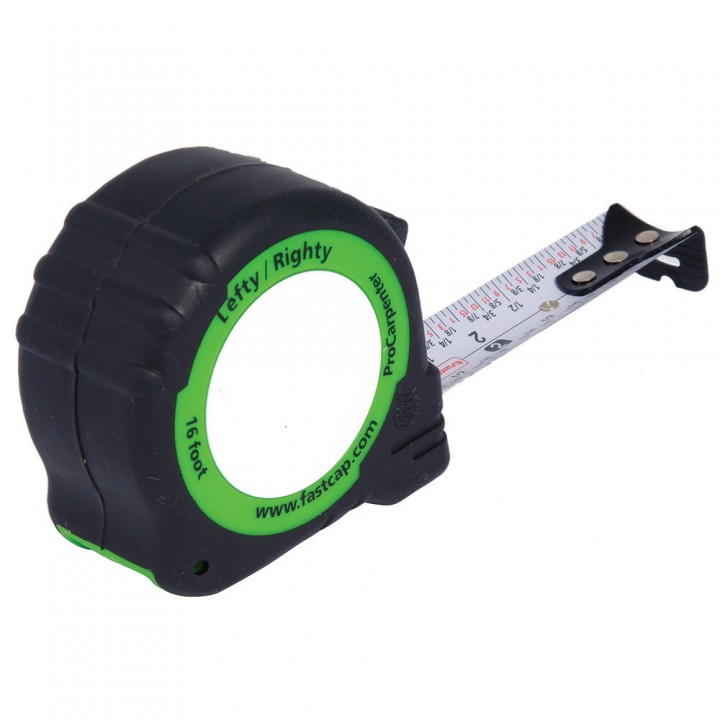
FastCap ProCarpenter Lefty/Righty Tape Measure – $8.99
29855-01-1000

Most measuring mistakes that occur while doing a survey come from misreading numbers upside down when you’re measuring from right to left. This tape solves that problem by having the numbers read correctly no matter which way you hold it. The same company also makes the Flatback tape which works like a flexible story pole, making it possible to easily measure round objects. You need this.


 Magna Tip – $2.49
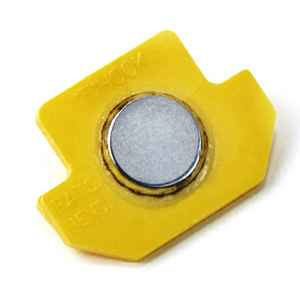
MagnaTip

This little guy will save you when you’re surveying alone and have a metal surface to stick it to. It attaches to the end of most 1″ wide tape measure and becomes a third hand. Especially good if you’re trying to measure something overhead. A great stocking stuffer.


Tape Tip – $4.95
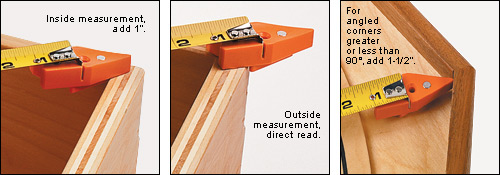
Tape tip

Another little device that’s a lifesaver when you’re trying to measure inside corners. Attaches to the ends of most tapes. Inexpensive enough you can buy one for your whole art department.

GripTip – $3.00 for two
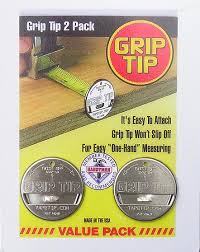
Unknown

OK, you’re saying, enough with the survey stuff. But this little gadget will save you someday when you’re trying to measure that stone or brick wall and the end of your tape keeps slipping off. The serrated edge will bite into just about anything and stop the cursing fast! At $3.00 for two, you can afford to have several in your kit.

Smartphone Projector – $27
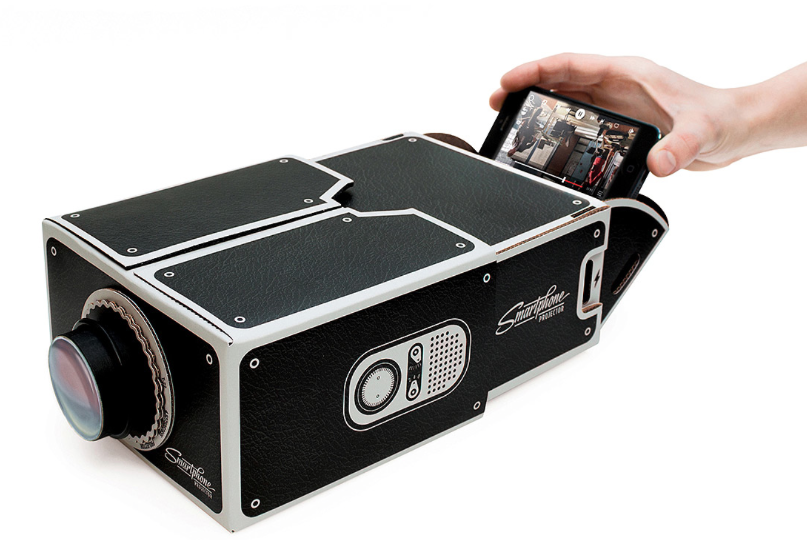
smartphone projector

For the gadget lover, this is a low-tech projector option that works with palm-size smart phones, not the phablets. Made from cardboard, the device works with simple lens physics as the image and light from the phone is projected by way of a convex lens onto any white surface up to 6 feet away. You’ll need a dark room though, it won’t work in a brightly lit space. A great way to share when you don’t happen to have a 27″ monitor in your bag.

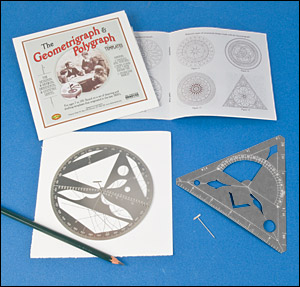
Geometrigraph – $14.95
Geometrigraph set

First manufactured in the late 1800s, these two stainless-steel templates were designed to make it possible to create curved, parallel or perpendicular lines as well as circles, angles and a range of polygons from 3-sided to 20-sided. By using the inset shapes of various curvatures with the circles and polygons, you can create an unlimited variety of ornamental designs.  All this can be done without using any other drawing instruments; all that is needed is paper, a pin, and a sharp pencil or fine-tip ballpoint pen. Two nickel-plated steel T-head anchor pins are included.  The templates are suitable for designers of inlay in wood, graphic artists, quilters, sign-makers, innovative youngsters, etc. The set comes with a 16-page instruction booklet explaining the various uses as well as showing numerous examples of typical designs. Remember the Spirograph? Well this is it’s Granddad.

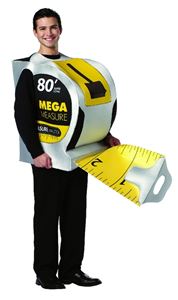
Tape Measure Uniform – $42.00
GetImage.ashx

For those times when you need to stand out and let people know there’s a Art Department professional on the job. Or, more likely what it will be saying about you is, “Yes, I am a proud member of the Art Department and I have gone completely insane from breathing Spray77 and Zip Kicker fumes, living on stale coffee, doing endless revisions and dealing with constant software issues. So just stay away from me and no one will get hurt.”


Really, Really Last Minute Gifts

When you realize you’ve really screwed up and forgotten someone and have no time to run to the store, much less order anything, you can always gift a good app.

Log onto the Apple or Android store and gift your so-important-you-forgot-about-them friend one of these apps and your reputation will be saved:

I own and can recommend all these apps.

BuildCalc – construction calculator – $19.99

Magic Plan – indoor mapping, survey tool – free, pay per use

Photo Measures – saving and sharing measurements – $6.99

Artemis – professional director’s finder – $29.99 *

pCAM – camera info calculator – $29.95 *

Sun Surveyor – sun and moon calculator – $6.99

Stereo Calc – 3D stereo film calculator – $39.99 *

Moviola Pro Camera Guide – extensive database of camera info – $3.99 *

I.D. Wood – samples and data for 200 kinds of wood – $4.99

* iOS versions only


Exhibition Of German Expressionist Film Artwork Now At LACMA

IMG_6069

At the Los Angeles County Museum Of Art now until April is a special exhibition of artwork and posters from the German Expressionist period of the silent film era, 1919 to the mid 1930’s. Produced in association with  La Cinémathèque Française and the Academy Of Motion Picture Arts And Sciences, the show features over 150 pieces of artwork from classic films of the German UFA studio.

Along with many posters are a large number of original set and costume design drawings which are seen together for the first time here. Most of which have not been on display here before and others only seen as small images in publications.
Of course artwork from the most well-known films are there; The Cabinet Of Dr. Caligari, Metropolis, The Nibelungen, but there are many others from more obscure films as well including Robert Hearlth’s original schematic of the forced perspective backings from Der Letzte Mann which were such a sensation.

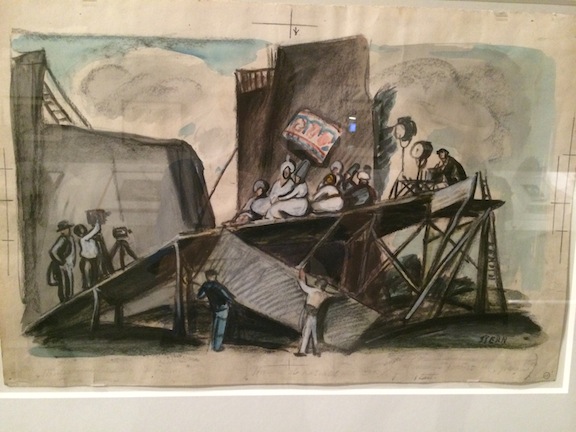
One of Ernst Stern's drawings for Waxworks, which indicates the set design, platforming, camera position and lighting.

One of Ernst Stern’s drawings for Waxworks, which indicates the set design, platforming, camera position and lighting.

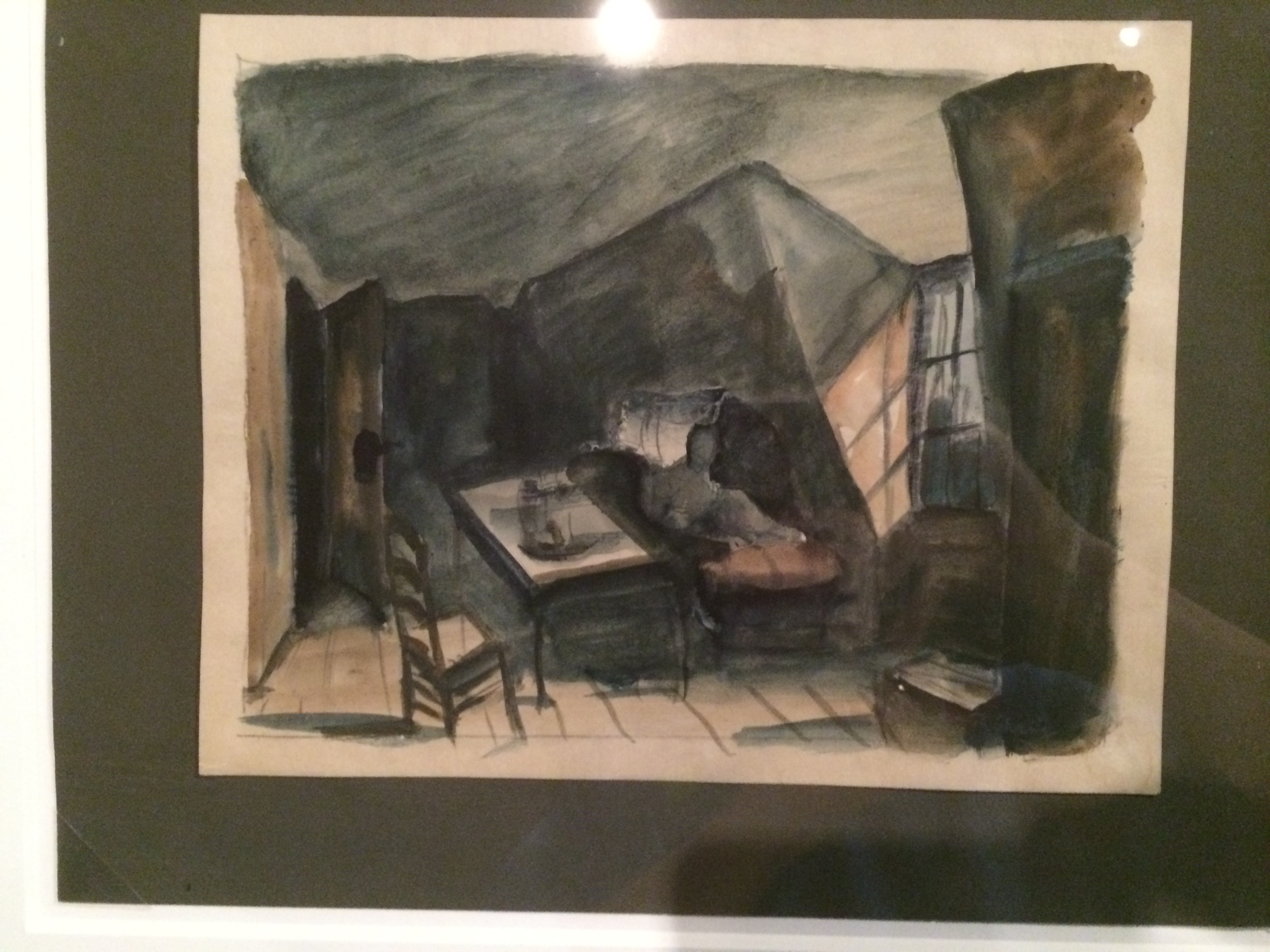
A watercolor and charcoal drawing for one of the sets for Dr. Caligari by Walter Röhrig

A watercolor and charcoal drawing for one of the sets for Dr. Caligari by Walter Röhrig

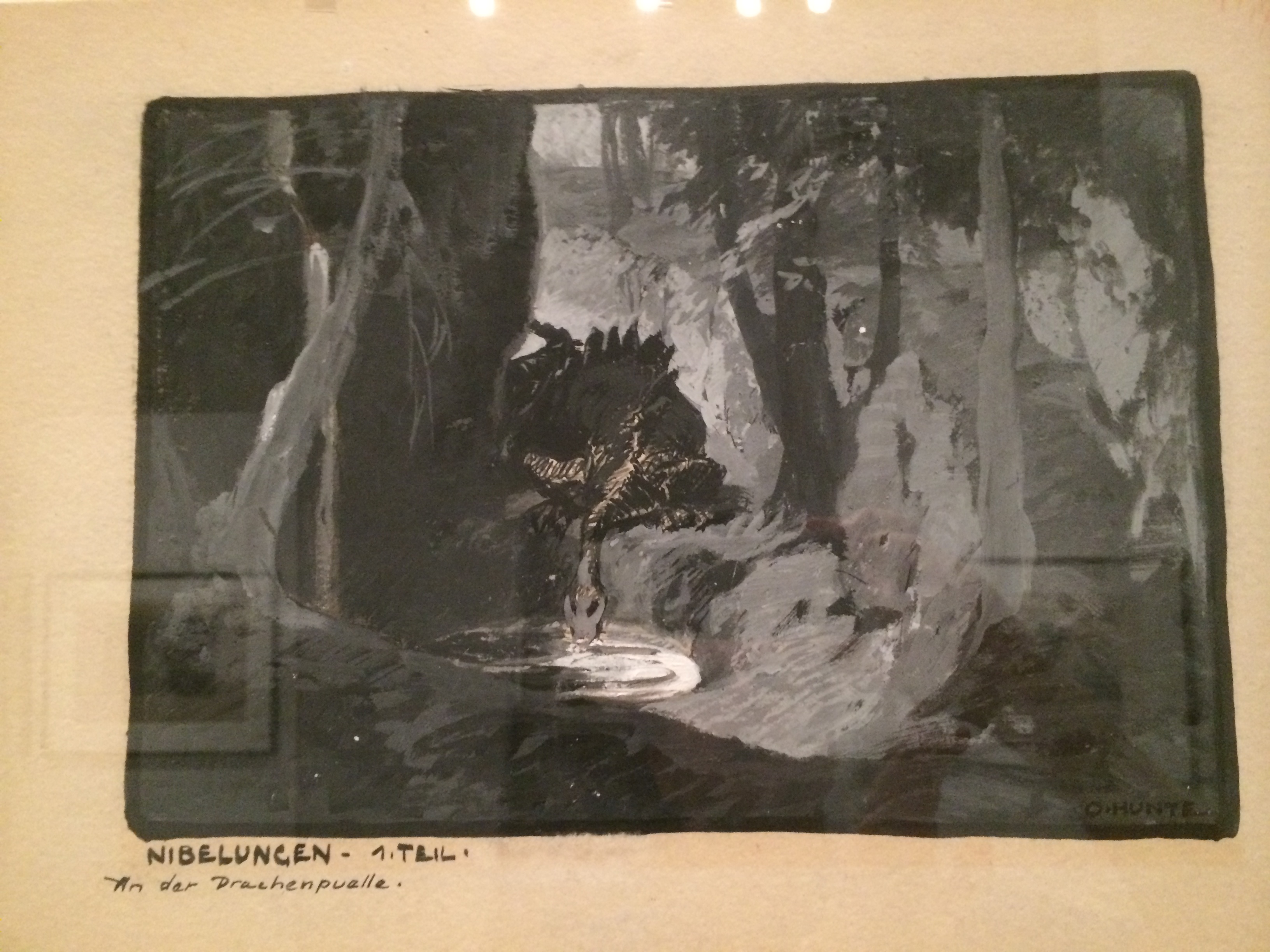
It was common during this period of German cinema for Art Directors to work in teams of two or three people, dividing the design duties among themselves as matched their individual abilities. A perfect example of this is the work of Otto Hunte and Erich Kettelhut on Fritz Lang’s The Nibelungen. Here is a drawing by Hunte of the dragon by the waterfall.

Gouache painting of the dragon for Die Nibelungen by Otto Hunte.

Gouache painting of the dragon for Die Nibelungen by Otto Hunte.

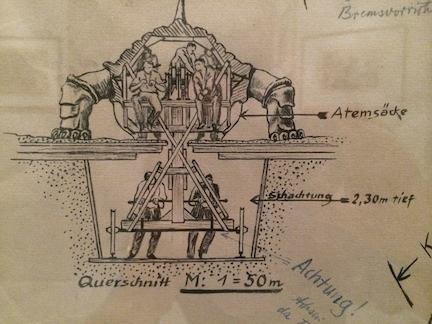
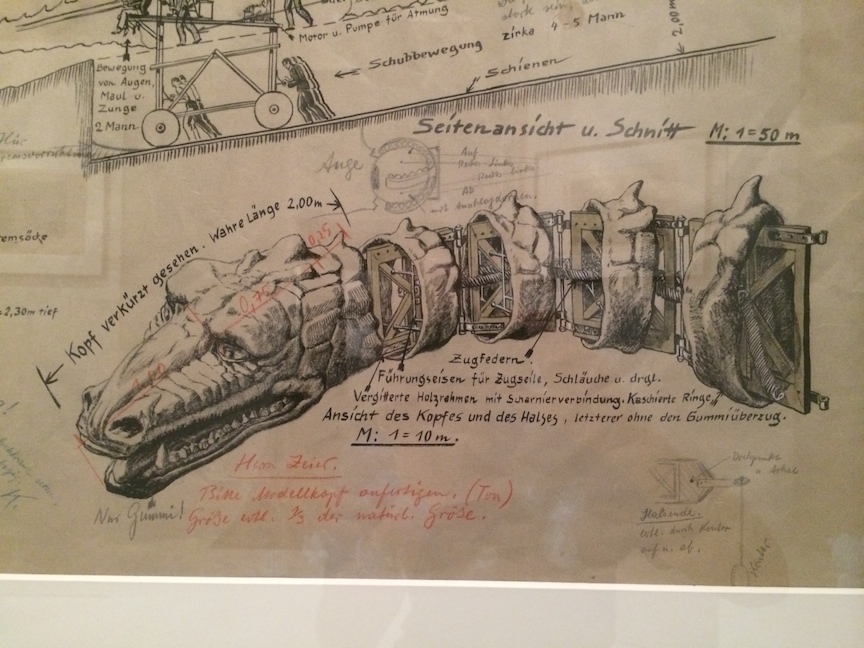
Being the more technically trained, Kettelhut elaborated on the design by drawing the technical requirements of the dragon to carry out the action called out in the script.

Technical drawing of the Dragon by Erich Kettelhut

Technical drawing of the Dragon by Erich Kettelhut

Kettelhut carefully described how the giant action prop was to be built and operated both with stage requirements as well as the on-board personnel’s responsibilities.

drawing describing how each part of the dragon was to be operated by stagehands.

Enlargement of Kettelhut’s drawing describing how each part of the dragon was to be operated by stagehands.

The size and depth of the recessed path required for the props operators.

The size and depth of the recessed path required for the props operators.

Kettelhut called out the length of the neck as well as the tension springs, framework, control cables and hoses required for the creatures fiery breath. He calls out "only rubber!" for the mouth area.

Kettelhut called out the length of the neck as well as the eye detail, tension springs, framework, control cables and hoses required for the creatures fiery breath. He calls out “only rubber!” for the mouth area.


Here is the scene from the film where Siegfried finds and kills the dragon. The effect is quite crude by our modern film standards but must have been thrilling for a public new to such spectacles. Imagine the lot of the half dozen stagehands stuck inside the big, airless prop as it bellows smoke from inside it. Notice the large forest and mountain sets created for the film, truly epic efforts for the time.

The World’s Oldest Film Scenery?

The title ends in a question mark because I’m not sure I have a definitive answer yet on my search for the the oldest existing scenery from a film. So, I’m asking everyone out there to help me with this quest.

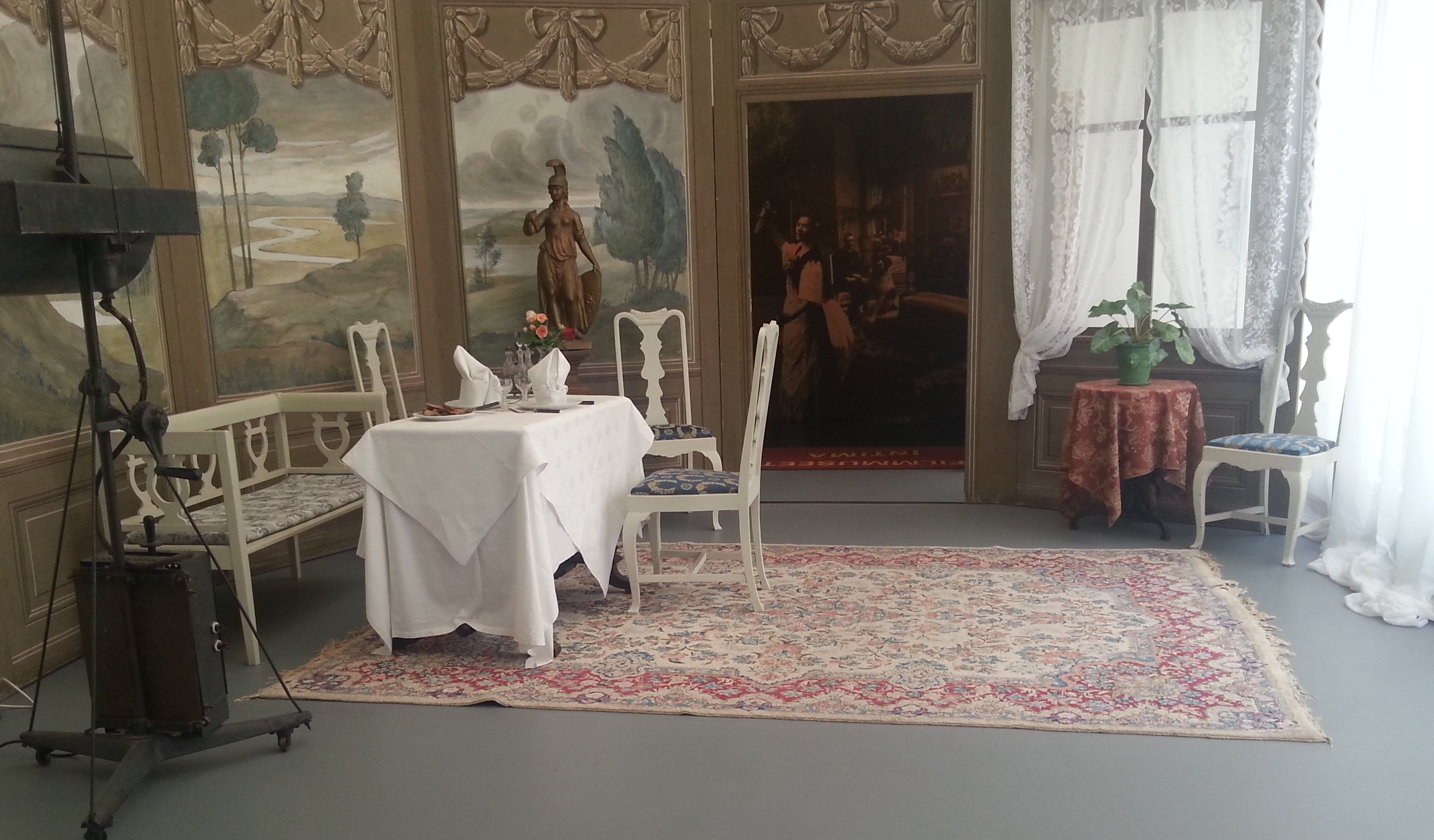
The stage of the oldest intact film studio in Sweden, and maybe the world. photo by Reinhold Fryksmo

The stage of the oldest intact film studio in Sweden,  and maybe the world. photo by Reinhold Fryksmo


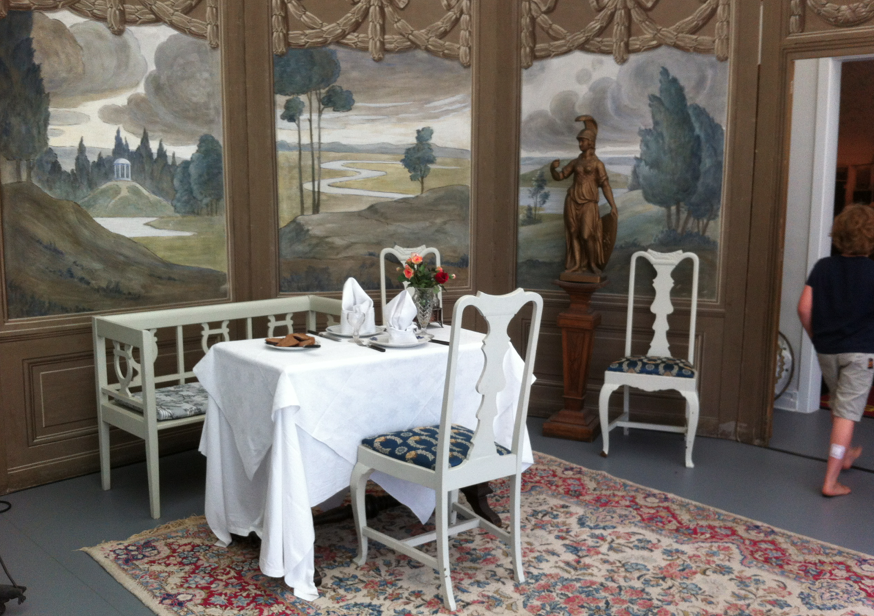
Let’s use this as a starting point: in Kristianstad, Sweden there is what is reported to be the oldest intact film studio from the silent period. Inside the studio museum (Kristianstad Filmmuseet) is a display in what was the original glass-walled studio space. It is dressed as a set from the 1909 film, Fänrik Ståls Sägner, one of three films made at the Kristianstad Biograf-Teater that year. The scenery appeared throughout the film apparently as the same space was used for a number of different scenes. The main element is a multi-panel theatrical style flat painted with a Trompe-l’œil design. If this is truly the original set piece then this is in excellent condition for a 105 year-old flat.

A closer look at the flats. photo by Lotten Bergman

A closer look at the flats. photo by Lotten Bergman

So is this the oldest film scenery in existence? I’d love to hear from other Art Department people out there from around the world with older examples.

Painted Backings – Film’s Best Kept Secret

“In 1903, Pathé (the first Pathé studio in Vincennes) had two cameramen [who were] paid 55 francs a week. The designers/painters, much better paid, began at 90 francs a week. A week then was 60 hours and payment was made every Saturday in gold.”

Gaston Dusmenil, Bulletin de l’ A.F.I.T.E.C., no. 16  (1967)

“The scenery [ in early 1900‘s France ] was painted flat, like stage scenery. The canvas (about 20 x 30 feet) was tacked to the floor, and after applying a coat of glue size and whiting, the designer drew the design in charcoal. For complicated architectural sets a small sketch was made and squared for enlargement. Since the size paint was used hot, a scale of grays running from black to white was prepared in advance in small flameproof buckets. The scene painter worked standing, walking on the canvas (in rope shoes or socks) and using very long-handles brushes: straight lines were drawn with the aid of a long flat ruler, similarly attached to a handle. To judge the whole, in order to accentuate effects if needed or to remove unnecessary details, the artist had to mount a ladder. The completed canvases were attached either to wooden frames to form flats, or else, to vertical poles so they could be rolled up.”

Léon Barsacq, Caligari’s Cabinet and Other Grand Illusions

Mèliés' Montreuil Studio

Mèliés’ Montreuil Studio

Painted backings have been a staple of filmwork since the very beginning. Georges Méliès was the first to recognixe the possiblilites of incorporating painted backings in his films which he realized could be a vehicle for creating a dramatic narrative and not just for recording real-life as the first short films had.

Even today, with the current trend of green screens and digital effects, audiences are often unaware that the view outside the windows of a set are actually hand-painted backings. While photographic backings, basically photographic images greatly enlarged and printed on heavy mylar or polyester fabric, are the norm in backings these days, the painted backing still has not only a definite place but even distinct advantages over their photographic competitor.
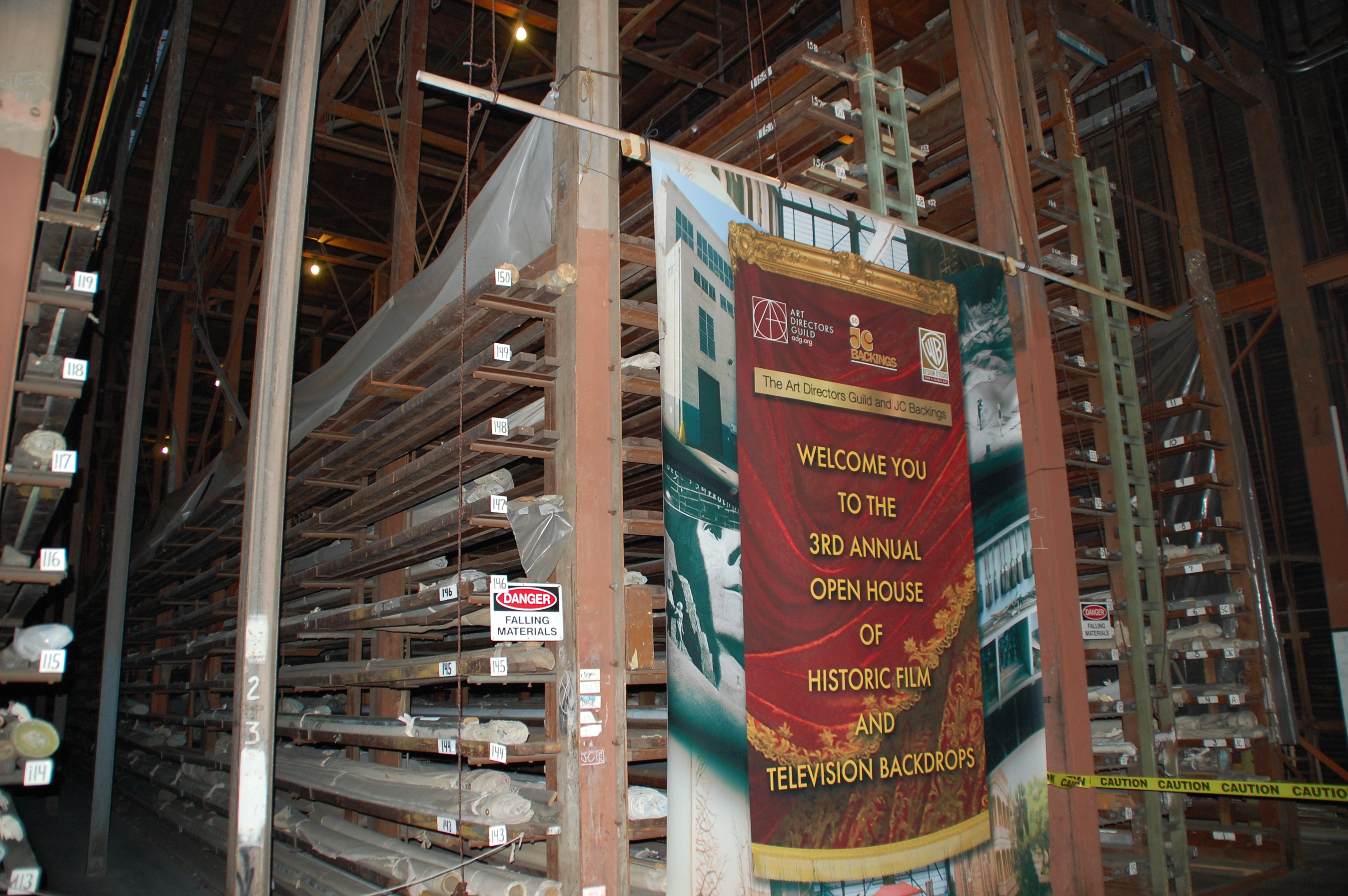
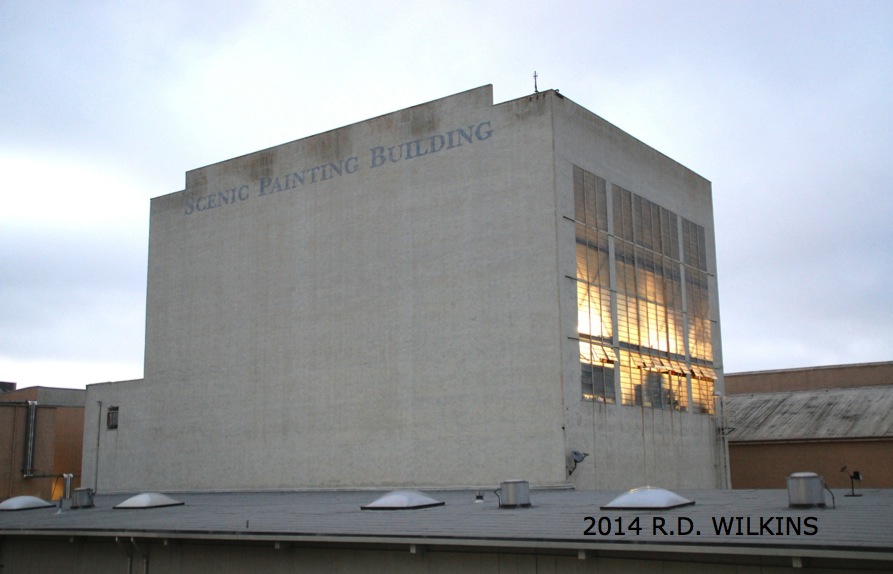
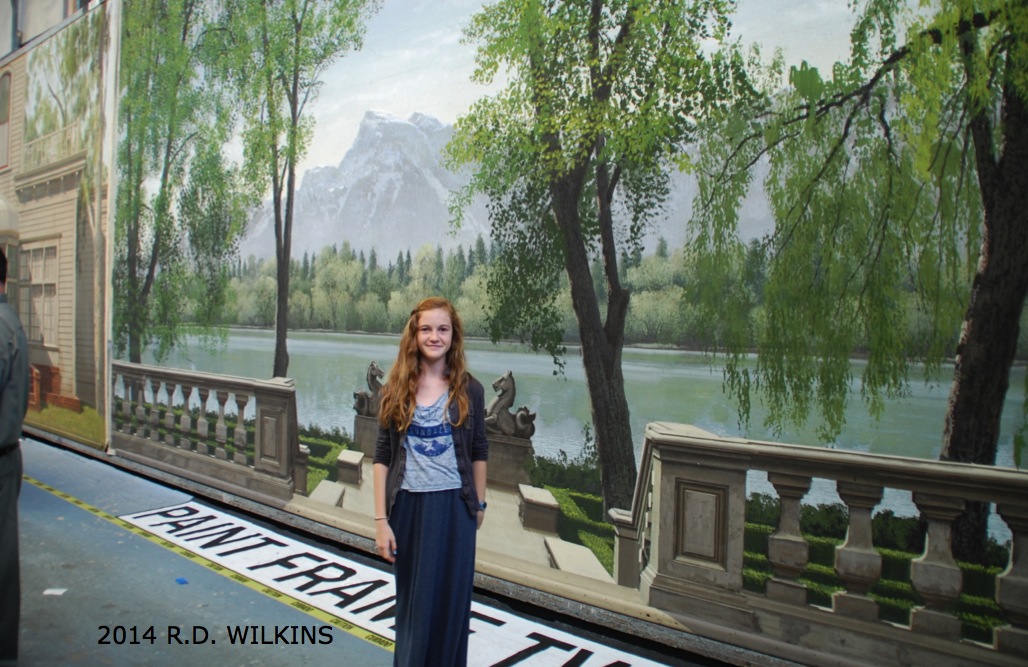
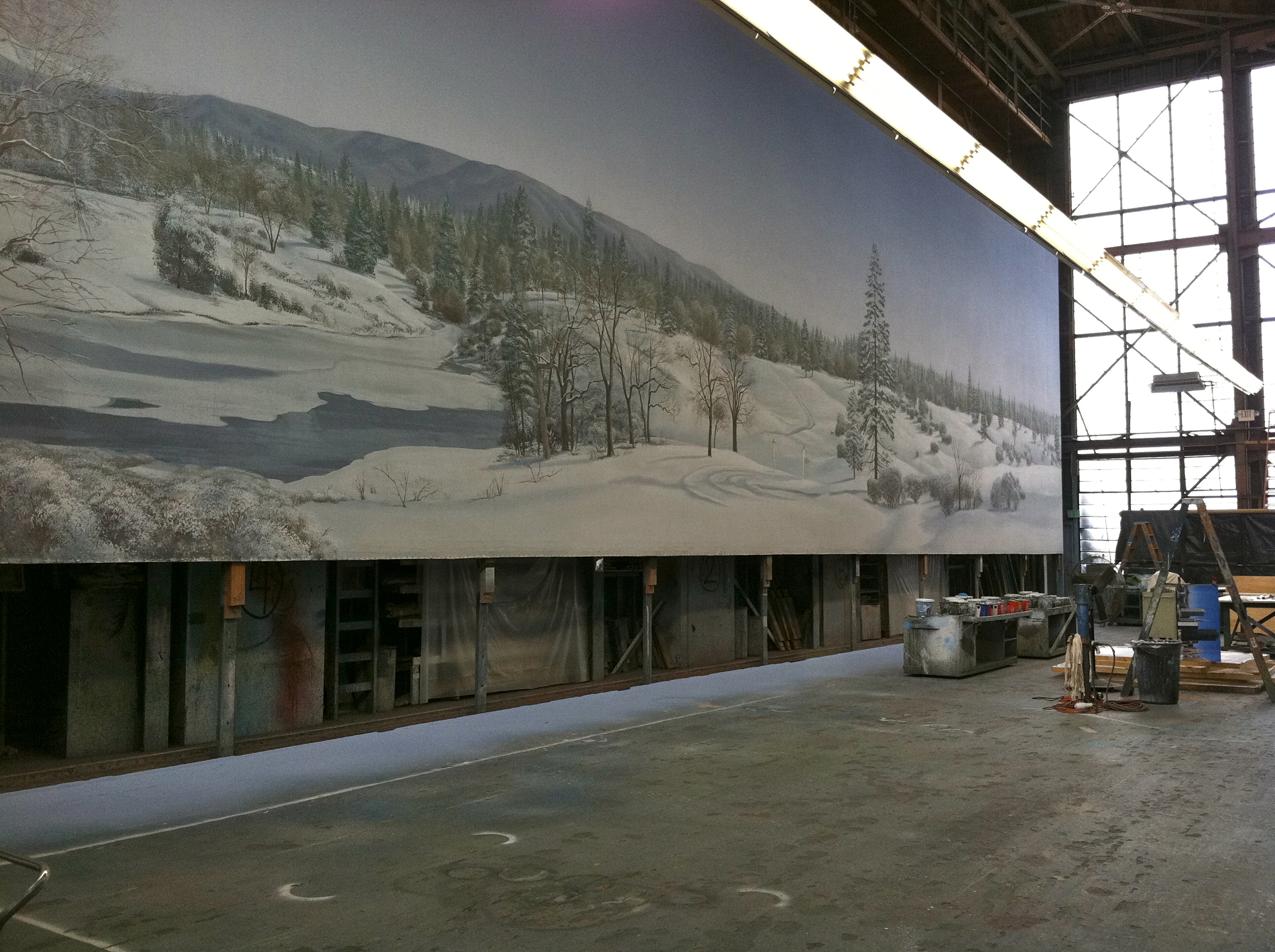
J. C. Backings, who make their home in the historic Scenic Painting Building on the old MGM lot in Culver City (now Sony Studio) recently hosted a Historic Backings event along with the Art Directors Guild here in Los Angeles. They pulled a number of backings from their collection of over 5000 backings, along with several from the Warner Bros. collection and displayed them on the six paint frames where the backings were painted originally.

The storage racks for backings at J.C. Backings

The storage racks for backings at J.C. Backings

Along with the backings were displayed a collection of smaller scale studies, paint notes, research photographs and examples of the backing design process as well as numerous photos of backings from their archives.

Usually only seen in partial focus and in the background, it’s wonderful how realistic most of these backings are even when seen up close and out of context.
The Scenic Painting Building on the Sony Lot (formerly MGM)

The Scenic Painting Building on the Sony Lot (formerly MGM)

Backing from The Sound Of Music

Backing from The Sound Of Music

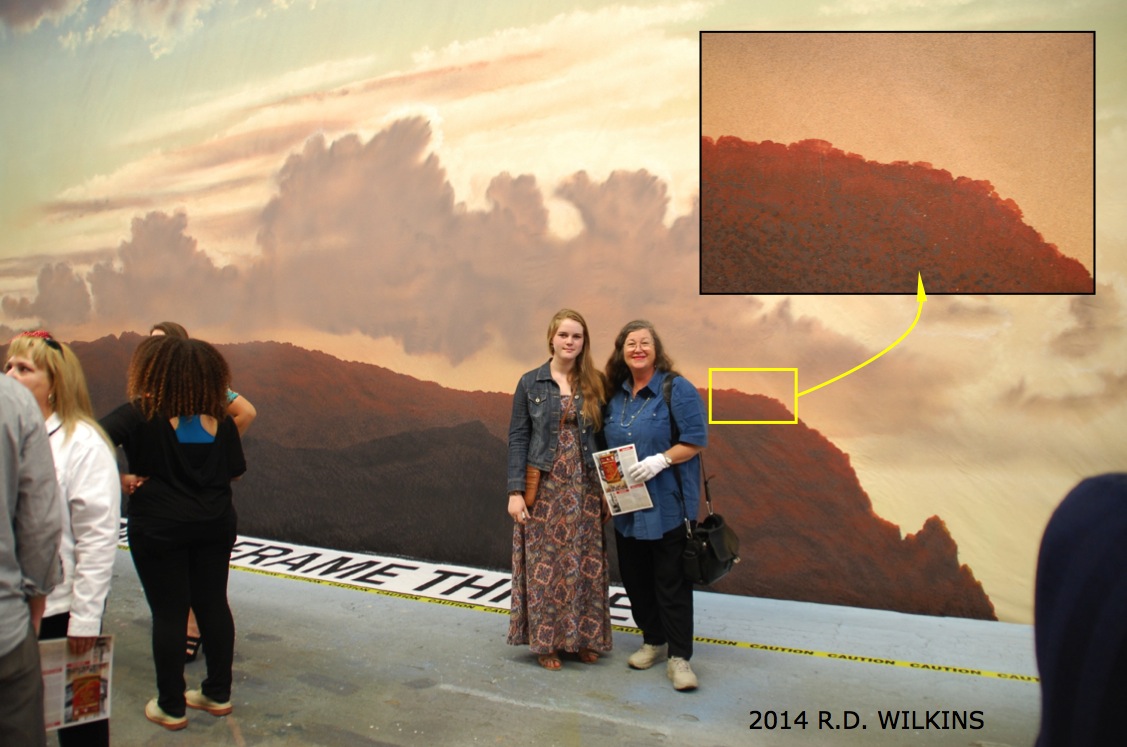
Backing from South Pacific. Notice the inset close-up of the brush work

Backing from South Pacific. Notice the inset close-up of the brush work

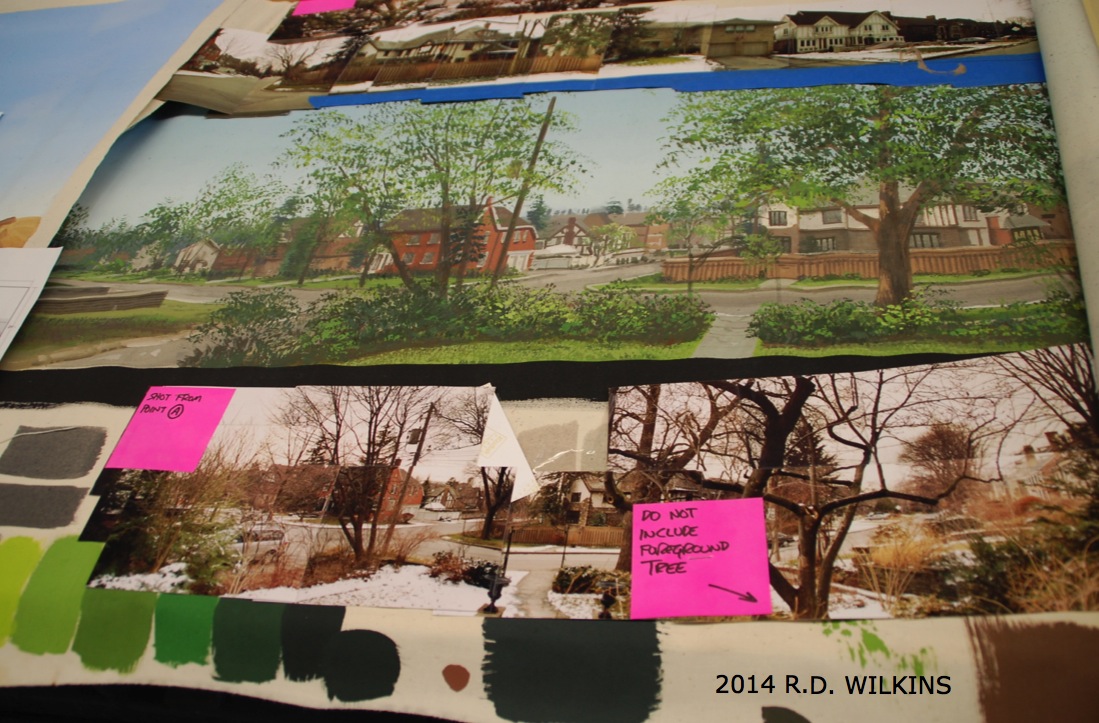
Sample of photo reference for a backing along with notes and a small preliminary paint study for the final backing

Sample of photo reference for a backing along with notes and a small preliminary paint study for the final backing

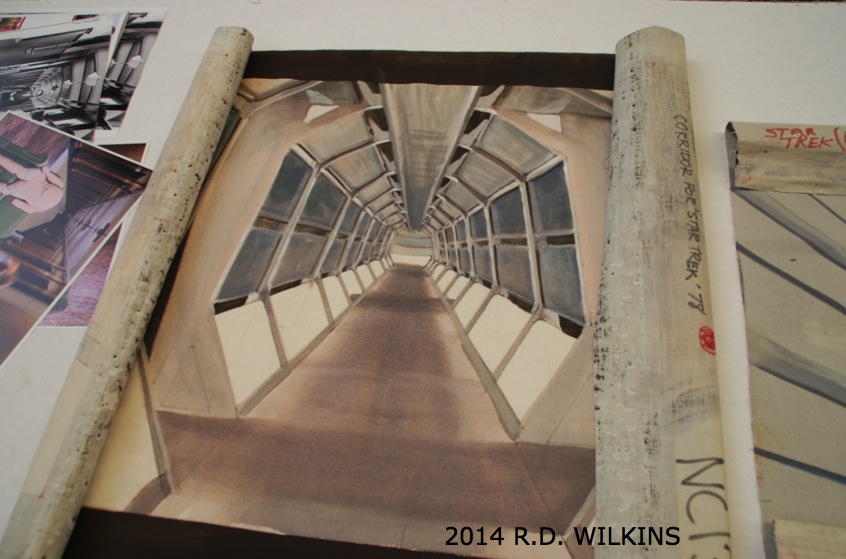
small painted comp for a backing for a corridor of the first Star Trek film in 1978

small painted comp for a backing for a corridor of the first Star Trek film in 1978

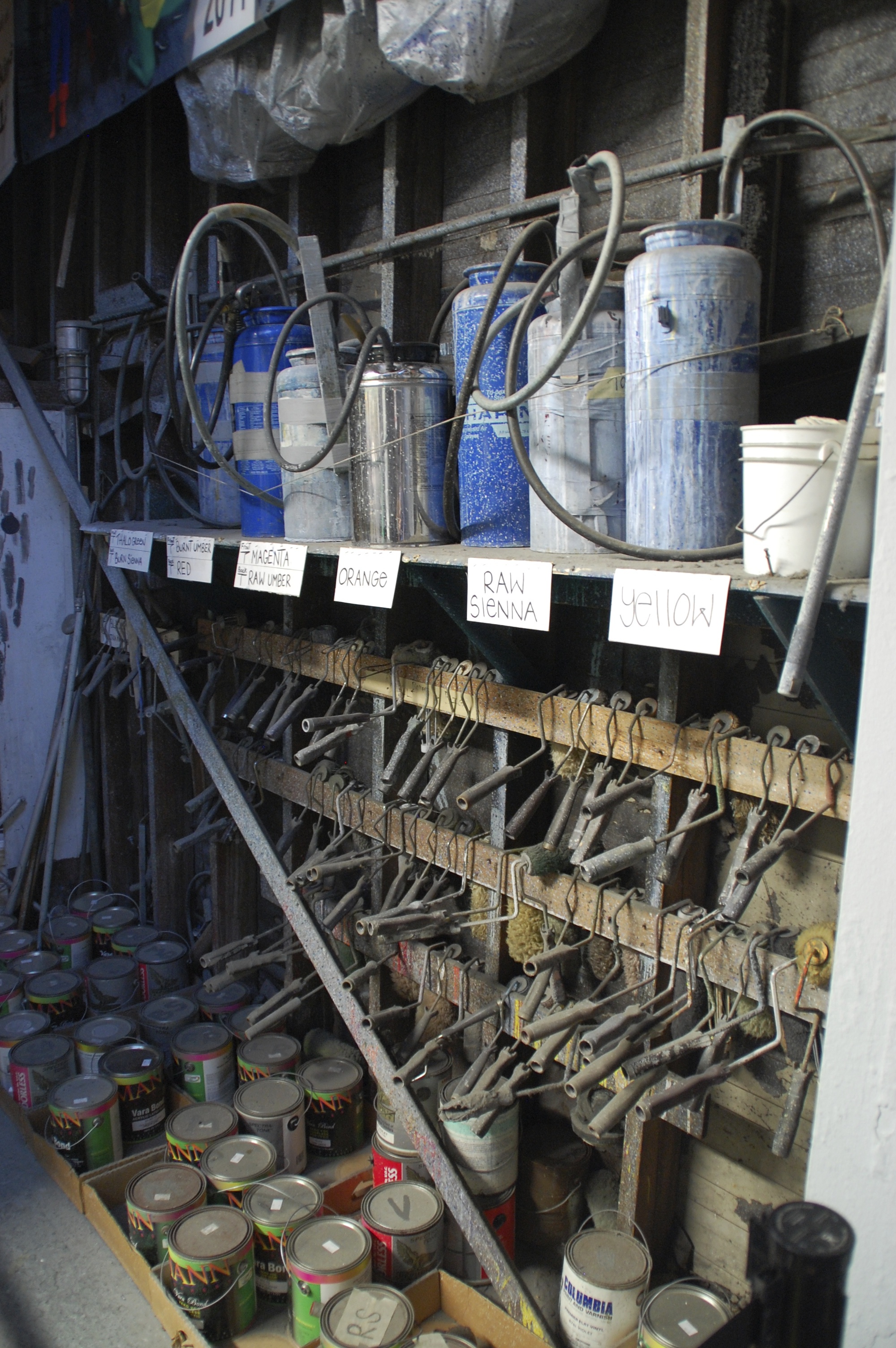
Paint rack with Hudson sprayers and roller mandles

Paint rack with Hudson sprayers and roller mandles

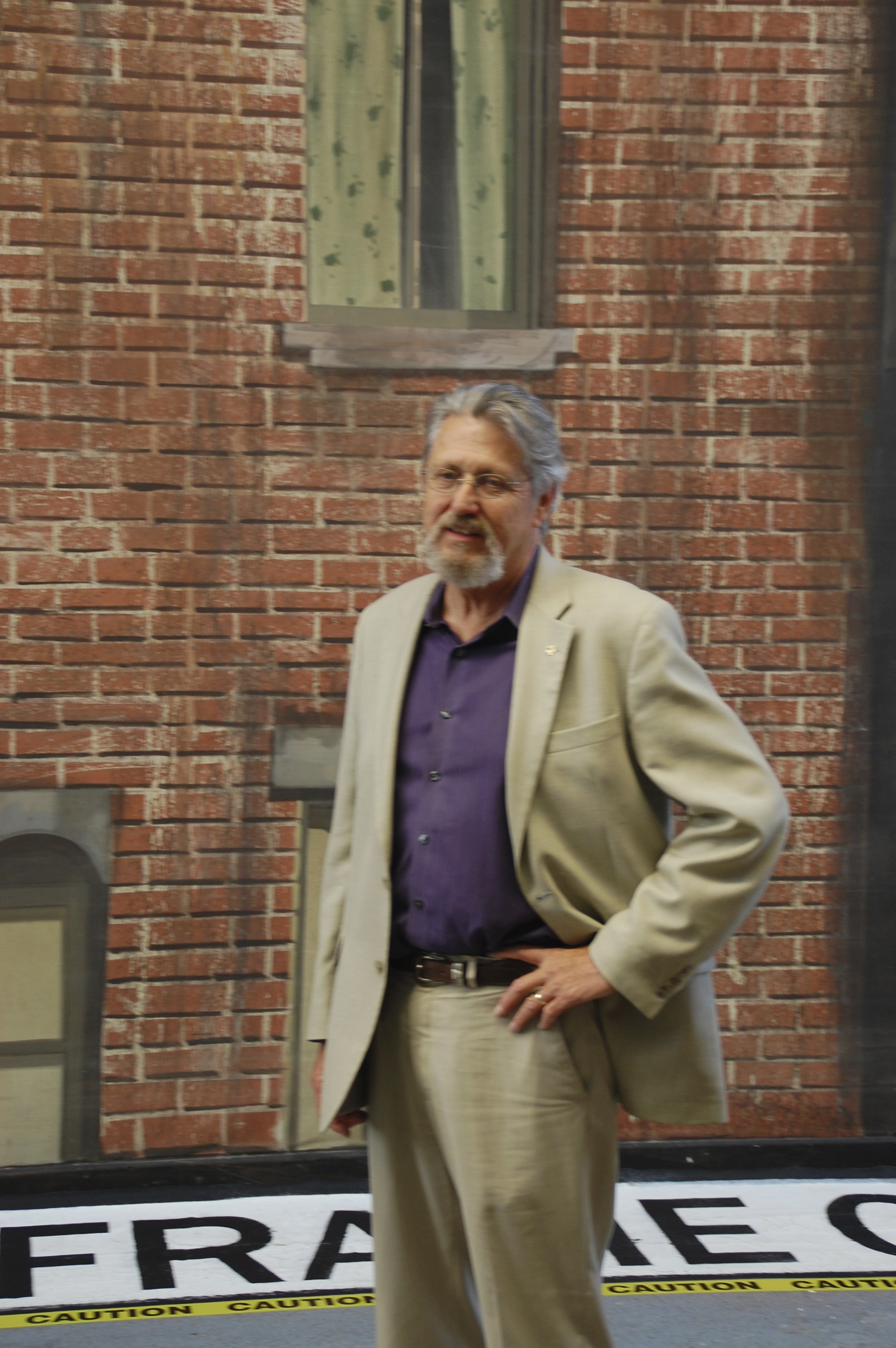
Art Directors Guild's Associate Executive Director John Moffit in front of one of the many backings he painted while Head of the Scenic Department at Warner Bros. Studio

Art Directors Guild’s Associate Executive Director John Moffit in front of one of the many backings he painted while Head of the Scenic Department at Warner Bros. Studio

Large backing in progress on the large paint frame

Large backing in progress on the large paint frame

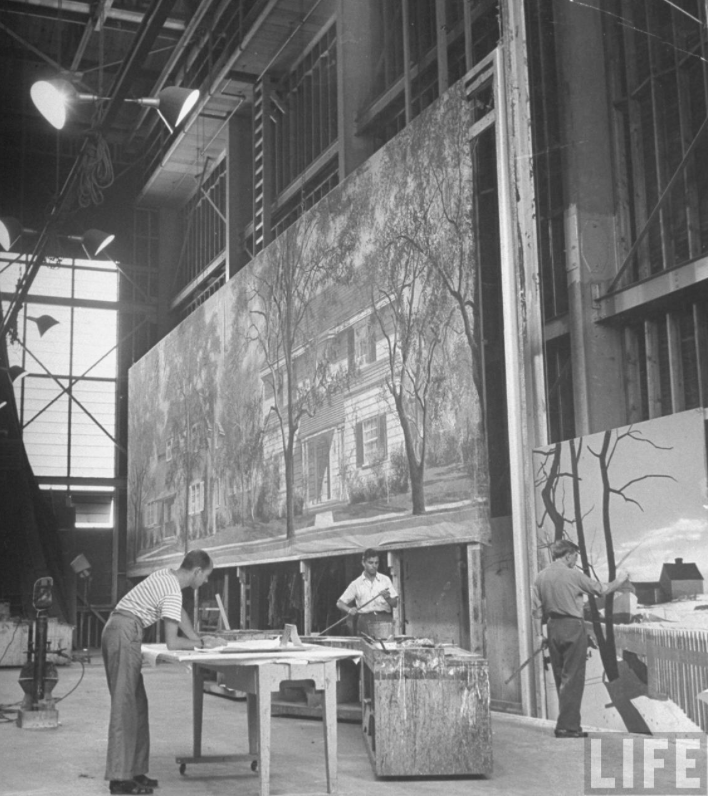
Still from a Life Magazine article of the same space when it was the MGM scenic shop in the 1950's.

Still from a Life Magazine article of the same space when it was the MGM scenic shop in the 1950’s.

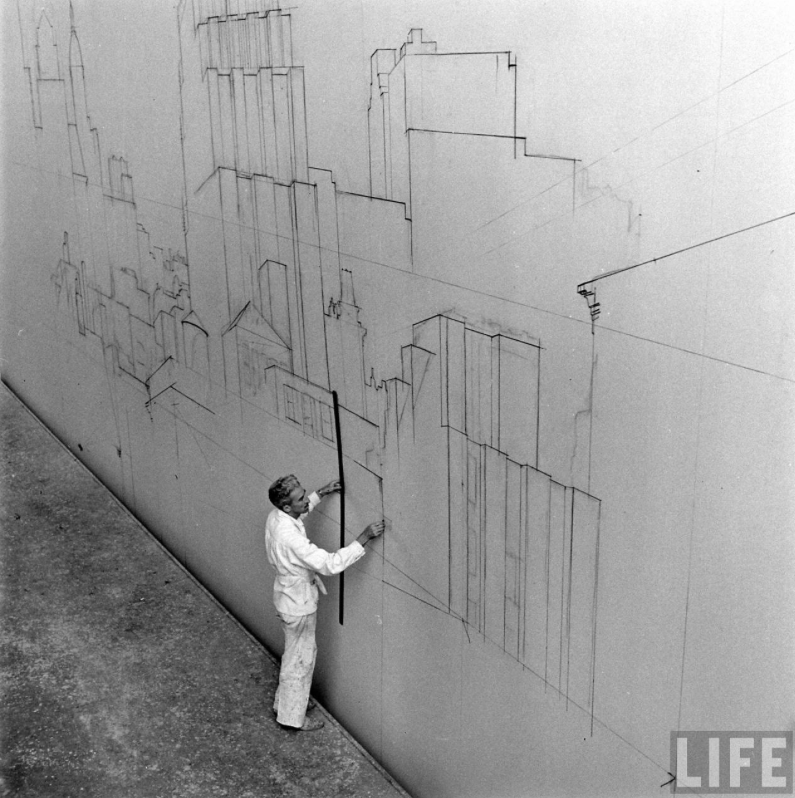
1950's photo of a backing layout in progress.

1950’s photo of a backing layout in progress.

And finally, here’s a time-lapse video of a street scene backing being painted by scenic Donald MacDonald at J.C. Backings. Note how the canvas is back-painted so that it can be rear lit for a night shot.


Comparing Cinema Lenses To Still Camera Lenses

A lot of people take shots of sets and wonder how the focal length of their still camera lens compares to cinema lenses. Even if the capture format is 35mm film or a digital camera with a 35mm size sensor, the angles of view are not the same as with a 35mm still camera.

The reason is that the the film runs horizontally through a still camera instead of vertically as through a cinema camera, resulting in a larger frame in the still camera which in turn results in a wider angle of view with a similar focal length lens.

The lens angle chart below is similar to the traditional AOV acetates used in Art Departments for decades but this one has the equivalents for still lens focal lengths next to the cinema lens angles. (You can print out a pdf of this below, just have it printed on clear acetate.) Beside each cine focal length you’ll see the equivalent focal length with a full frame DSLR. If you are using a camera with a crop frame factor this will of course be closer to the cine focal length. In fact if you shoot with the Nikon D40 or similar, it will be almost identical in focal length numbers to the cine lenses.

Angle Of View Comparison Chart

On the chart I’ve drawn a full size outline of each sensor/frame size so that you can see the difference between the two mediums. You can use this chart on any size scale plan and it will give you a very close approximation to what you’ll see with a given lens. If you want to use it on elevations you’ll need to divide the angle by 1.33 to get the vertical angle.

For those of you who use iPhones for stills, you can download a AOV chart for the iPhone below, print it on acetate and compare in to the 35mm lenses.


Cinema_Super 35 AOV Comparison

iPhone Angle Of View

Your Next Phone May Be A Real-time 3D Scanner

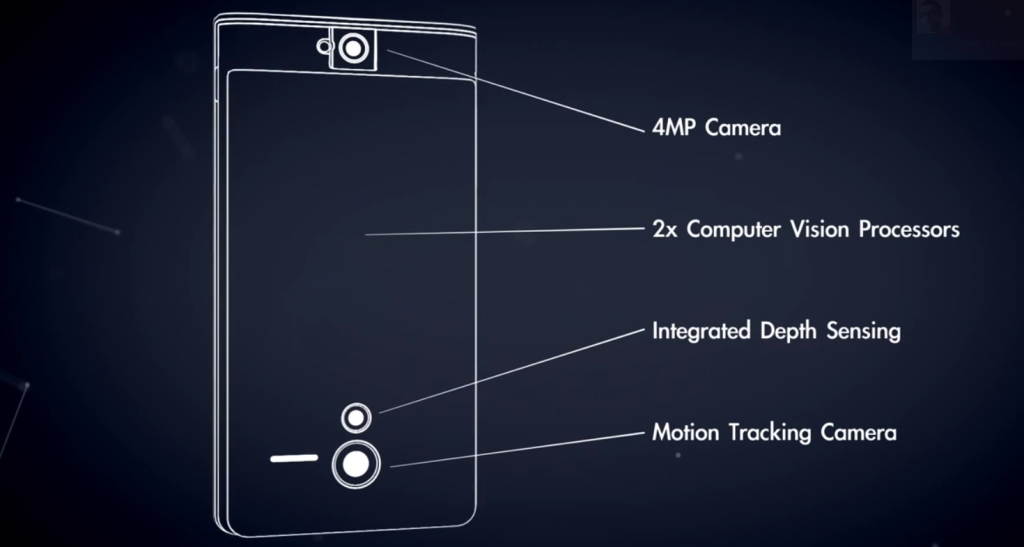
In February Google launched what they call “Project Tango”. They have developed a smartphone which is also a 3D scanner that can map the surrounding area and build a visual map of it. Processing over 3 million reference points a second, the device can build a virtual, scalable model of a room in the time it takes to walk through it.

Schematic of how the Tango device works

Schematic of how the Tango device works

They have currently hand-picked 200 developers to create applications for the device which as of now only runs on Android devices. Imagine what this would do to those never-ending time-consuming location surveys. Would you ditch your iPhone if you could have an Android phone that did this?
 

Can’t wait that long? If you’ve got $4500 and want the latest in room scanners, go over to Matterport and watch their demonstration video of their room capture camera system.


What Lens Is It? Comparing Apple Device Cameras To 35mm Lenses

A lot of times when you’re using your smart phone camera to take a shot of a set or location it would be nice to know what the equivalent view would be with a 35mm cinema / video lens.

I ran the numbers for most Apple devices and came up with the following equivalent focal lengths for both 35mm still cameras (full frame) and Super 35mm size sensors. Remember that although both formats are based on 35mm film stock, the frame for a still camera is a 1.5 aspect ratio with a frame width of about 1.417 inches. A Super 35mm frame is a 1.35 aspect ratio and the frame width is .980 inches.

Why only Apple? Well, the company readily makes their devices lens and sensor data available and it was easy to calculate. In the next post I’ll show you how to measure for your devices’ angle of view if the exact focal length isn’t published.

Please note in the following table the focal lengths for the given device have been rounded up to the nearest whole number so the equivalent lengths given are approximate.

Apple device lens comparison chart

“Hand Hewn” vs. Machine Made – Part 2

In the first part of this article I mentioned that traditional hand tools could create a finish superior to their modern day counterparts. Rather than just expect you to take my word for it, I’ll show you the proof.

Traditionally the way to surface wood once it was cut to approximate size with a saw is by using various types of  hand planes.

modern woodworking hand planes

modern woodworking hand planes by Lie-Nielsen

Used for thousands of years the plane is believed to have been designed by the Romans. Basically it was a base of wood or metal which used a wedge to hold a piece of steel with a single-bevel cutting edge at a set angle to the cutting surface. Modern planes have a more refined system for controlling the cut but the basic layout of the tool is still the same.

For bulk planing it’s hard to beat a modern powered thickness planer but for some operations like fitting doors, which requires very careful trimming, the traditional hand plane excels in a number of ways. I thought I’d do a little test and compare the quality of the surface of some wood run through a power planer as compared to a hand plane.

Lie-Neilsen block plane

Lie-Neilsen block plane

the block plane in action

the block plane in action

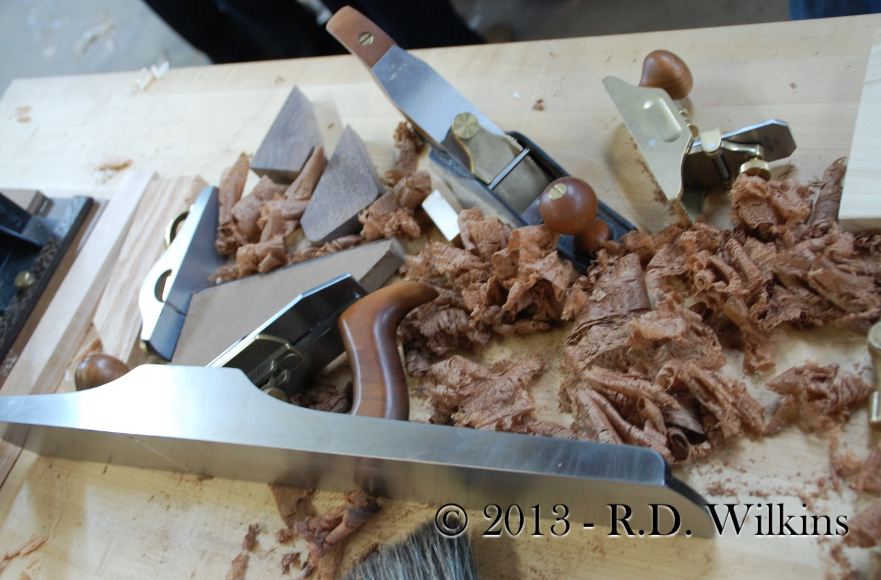
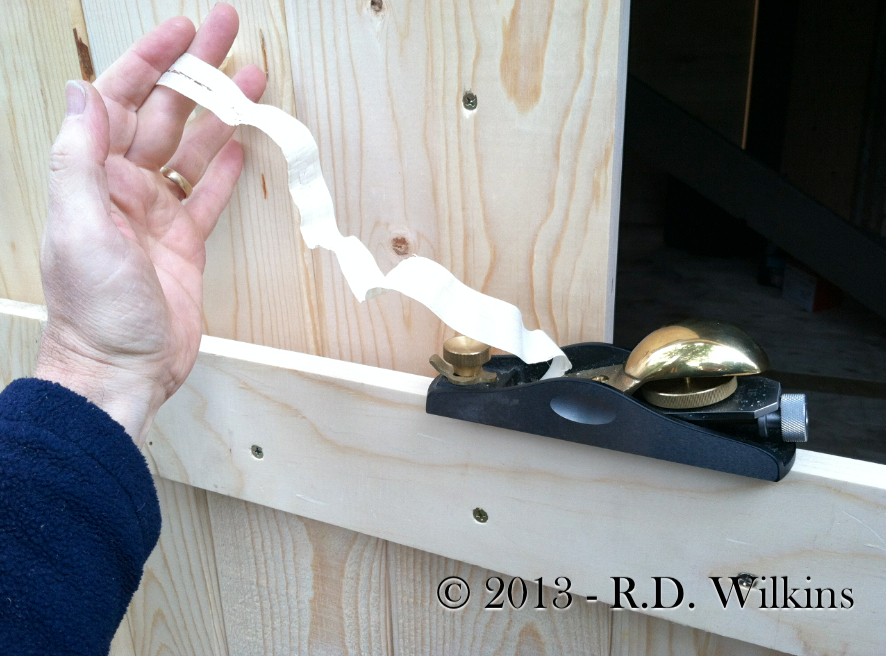
Here’s a block plane, which is great for quick jobs like fitting doors. This particular plane is an exceptionally good one made by Lie-Neilsen in Maine. The wheel on the rear allows you to adjust the depth of the cut even while planing by as little as a thousandth of an inch.

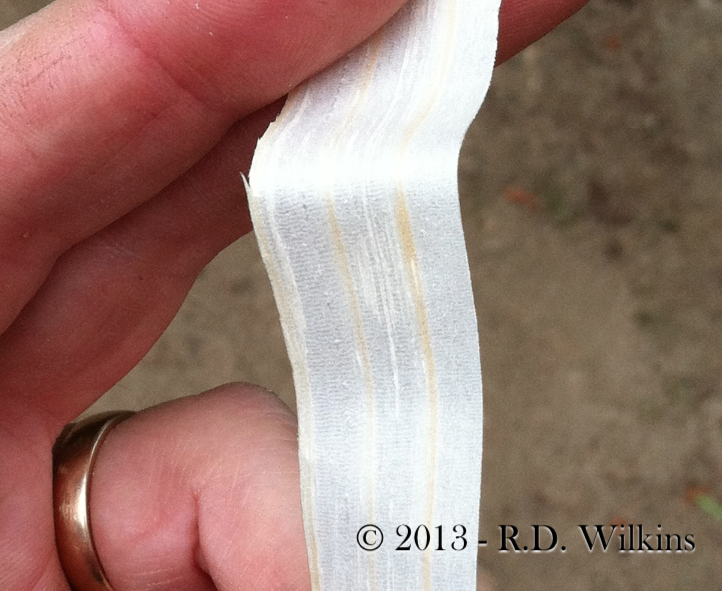
When the blade is set properly and the plane is held parallel to the wood, you get a beautiful, continuous strip of wood that comes off the work piece. Instead of sawdust from a modern power tool you get this lovely pile of curly shavings. The bottom photo is of the final plane shaving. It’s a few thou of an inch thick or about the thickness of a piece of 1000H vellum. It’s impossible to do that with a power tool.


hand plane shaving about the thickness of drafting vellum

hand plane shaving about the thickness of drafting vellum


Look closely and you can see the individual wood cells. Great, you say, but who needs wood ribbon? Stay with me, I’m getting to my point.


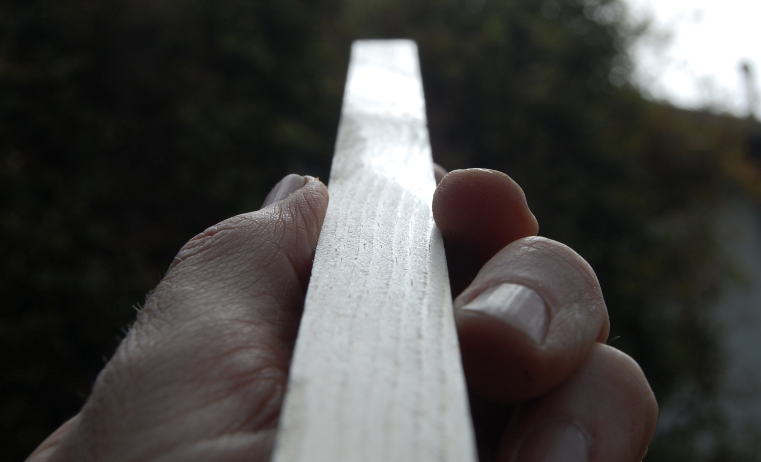
below is a piece of wood run through a power thickness planer with a new head.

Surface of wood after being run through a planer

Surface of wood after being run through a planer


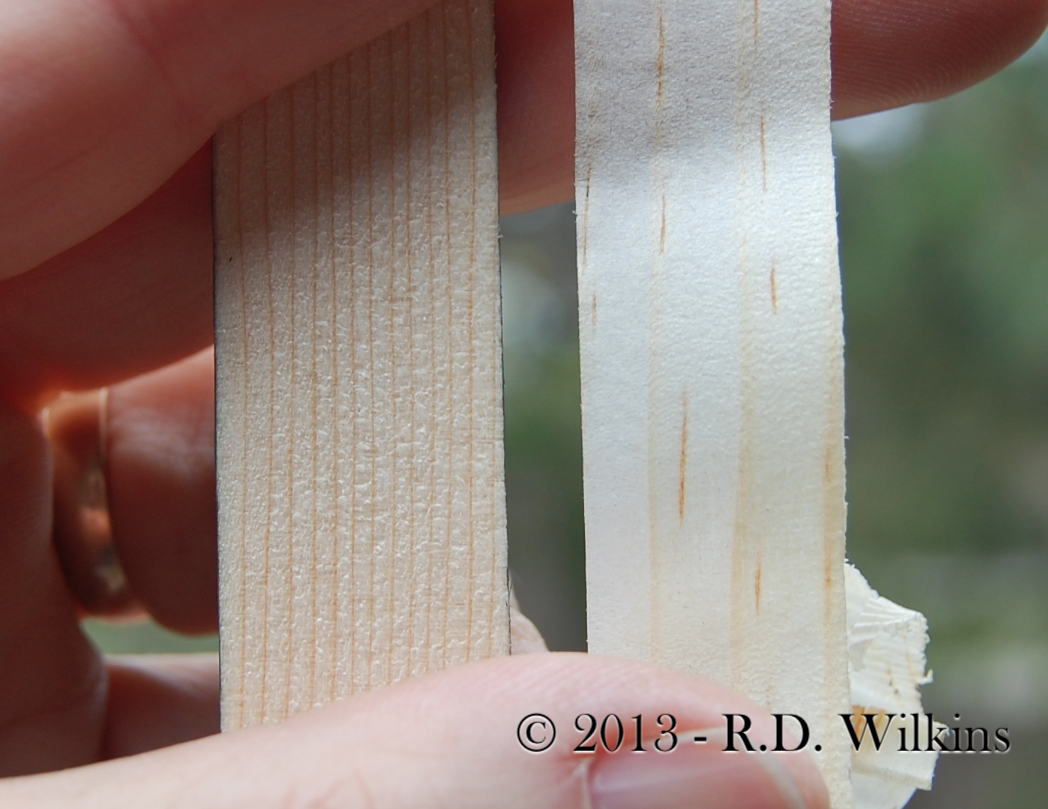
It looks pretty smooth, until you do a side-by-side comparison with the hand plane shaving. You can see below that the hand plane shaving is much smoother than the “fuzzy” appearance of the power planer sample. But why?

comparison of power planer cut (left) with a hand plane shaving (right)

comparison of power planer cut (left) with a hand plane shaving (right)

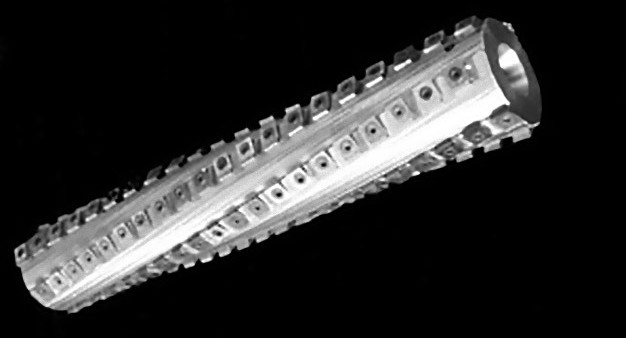
The cutting head on the thickness planer looks like this:

spiral cutter head for a thickness planer

spiral cutter head for a thickness planer

Instead of a single blade that stays in continuous contact like the hand plane, the power plane’s cutter is made up of dozens of small knives that cut at thousands of revolutions a minute, which instead of one continuous cut creates a lot of this:

power planer shavings

power planer shavings

Smoothing planes and card scrapers were used to create a finish as smooth as that created by modern tools using sandpaper. Sandpaper wouldn’t become used universally until the second half of the 19th century. Abrasive material, mainly fish skin, existed during that earlier period but was used mainly for the final polishing of a finish rather than as a way to surface wood like we do today as a replacement for planes.

One national woodworking magazine recently conducted a test, pitting a man with hand planes against another with a power sander to see which could finish a set of doors faster.The hand planes won, smoothing the pieces in less time than the sandpaper process which required sanding the pieces multiple times with different grits of sandpaper.

So why were planes replaced by sandpaper? Because you can hand a power sander to a complete novice and they will be able to get an acceptable finish with very little help. The use of hand planes requires the person to know how to use the tools as well as knowing how to sharpen and adjust them. Power tools have great advantages over hand powered tools when it comes to general output speed and during the industrial revolution they had another advantage; they allowed for the use of a fairly unskilled labor force. With power tools the real control is in the hands of the tool, not the operator. That’s why with power tools there is usually a lot of work involved in setting up or creating jigs  to gain more control over the cutting process.

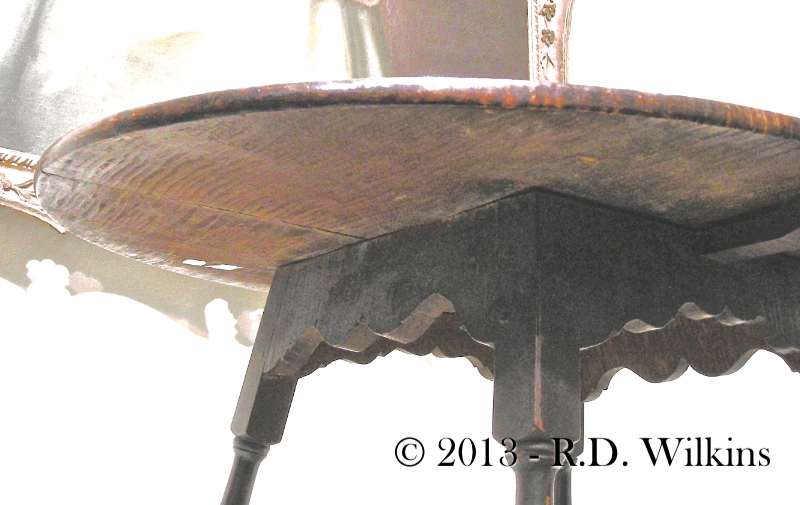
Because woodworking using had tools was labor intensive, and because prices for items like furniture was usually set by local organizations, only surfaces which were seen were finished to a highly smooth surface. here’s a photo of the underside of a table in the Chicago Art Institute. You can see the plane marks on the underside of the table top:

table top bottom


An easy way to tell if a piece of furniture is a period piece or a modern day reproduction is to run your hand along the back of the piece or the underside of a drawer. If it’s an antique it won’t be smooth.

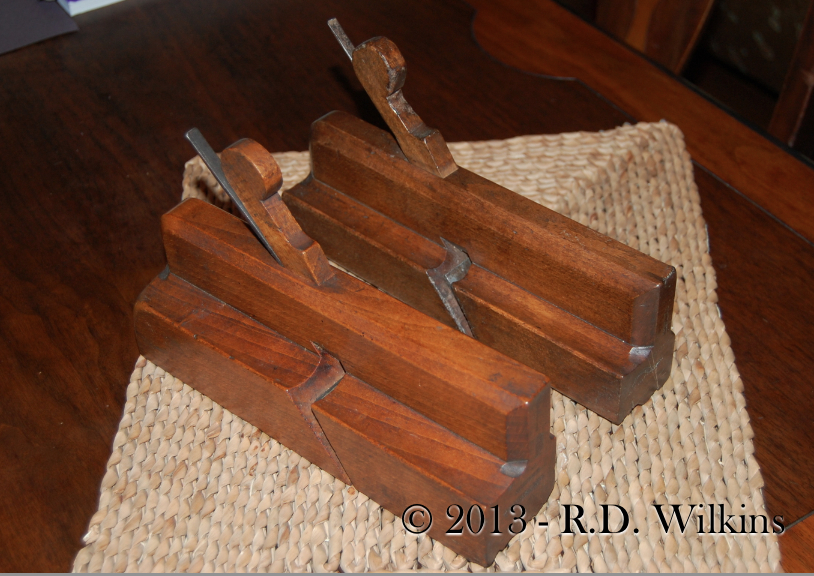
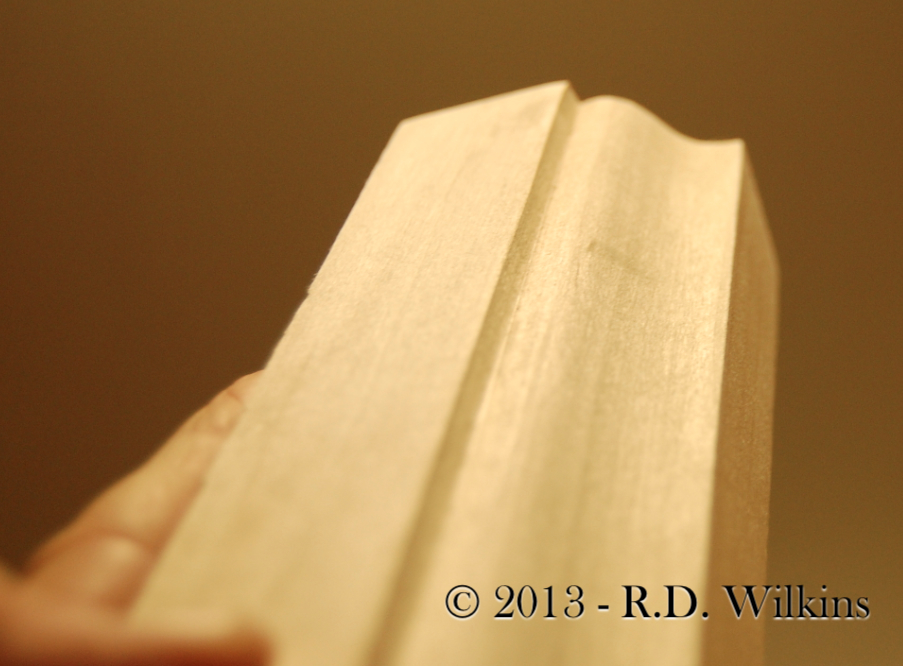
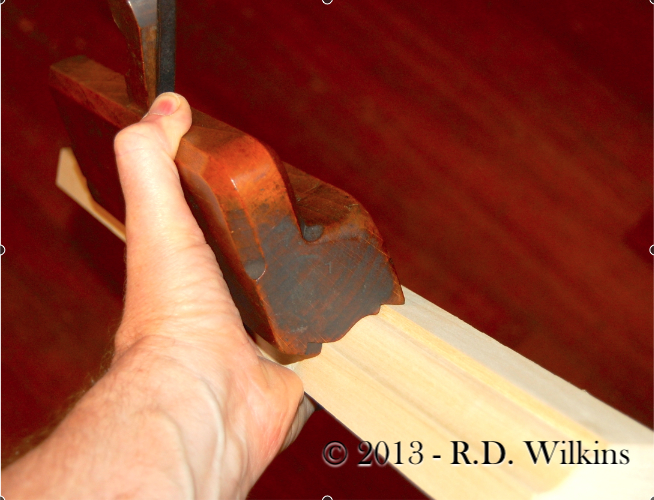
Traditional wood moldings were made much the same way but instead of a flat blade, the blade was cut in a reverse profile to the mould that was to be made. Here are two of the moulding planes from my collection. The oldest of the two, made in London over 250 years ago, still works perfectly once I tuned up the blade. You can see the results, a surface so smooth it doesn’t need to be scraped, much less sanded.

wood moulding planes

wood moulding planes


Cyma reversa cut with an 18th century moulding plane

Cyma reversa cut with an 18th century moulding plane

moulding plane1

Moulding plane and the profile it cuts


So, if the plane was developed by the Romans that should mean that woodworking before that time must have been pretty bad, right? Nope.

Take the Greeks. The Greek Trireme was as amazing ship for its time for a number of reasons.

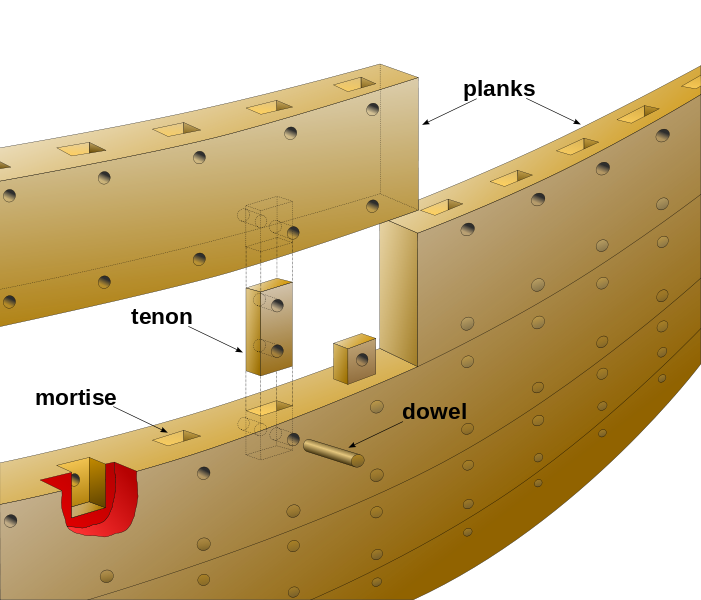
Greek_GalleysIn the ancient world ships were built in a completely different way that we think of them. Since around the 1st century ships have been built by making a framework first and then applying boards over the frame. In the ancient world ships were built hull-first., and only after that was a structural frame added for stability. The timber making up the hull was joined edge-to-edge with what is known as loose tenons. These were inserted into slots, or mortises and then pinned with dowels through holes drilled in the sides of the timbers to pull the two pieces together making a glue-less bond that didn’t require any kind of metal fasteners. The average small Greek ship had about 8000 of these tenons.

Greek ship construction - illustration by Eric Gaba

Greek ship construction – illustration by Eric Gaba


More modern wood ships had planks nailed to a wooden frame and then tarred rope, or caulking was hammered into the cracks between them to make them watertight. There is no indication the Greeks used any caulking in their ships, which means they were skilled enough with their tools, adzes and chisels, to make the joint between the edges of the planks tight enough that once the wood was exposed to water, the planks would swell together creating a watertight vessel. That’s some pretty amazing woodworking.

Of course this also means that not only was Noah a wiz with a mortise chisel, since a ship the size of the Ark must have contained some 100,000 tenons, but every modern recreation of it I’ve seen is completely wrong.


‘Hand-Hewn’ vs. Machine Made: Comparing Historic Tool Finishes To Modern Methods – Part 1

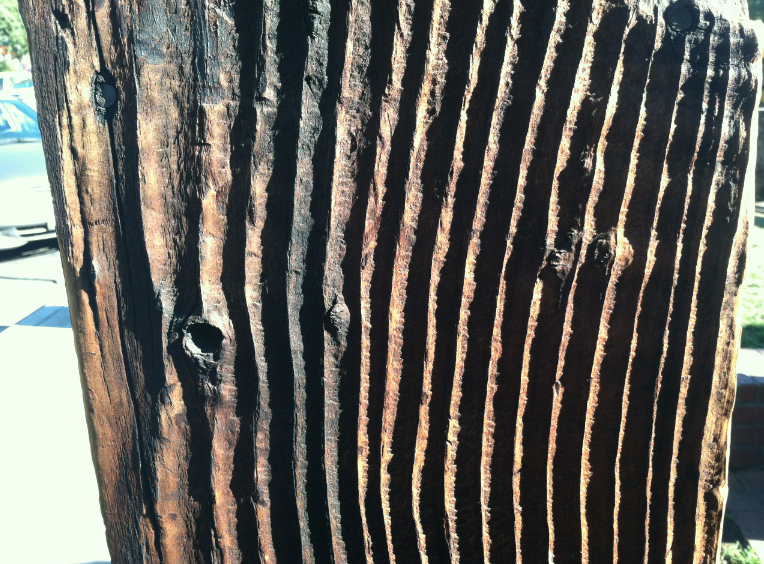
Creating period wood finishes for film and television scenery always involves a certain amount of subjective and creative interpretation. Usually the wood surfaces are finished to a level having more to do with the time period’s distance from modern times more than how old the set would look in relation to the time of the story. So usually anything set in ancient Roman times looks like it’s been through several hundred sandstorms, attacked with a grinder and sand blasted until the early growth rings are worn away from the late growth rings. There were certainly buildings that were very old at that time but there were plenty that looked much newer than the photo below.

weathered wood showing sunken early growth rings

weathered wood showing sunken early growth rings

I was working on a period film several years ago and I noticed that one of the other designers had called out the wood surfaces of their set to be finished as ‘hand-hewn’. I knew the surfaces would have actually been surfaced to a finer finish than a rough hewn beam and I asked why it needed to be so rough. They answered that being pre-machine age, other than furniture which would have required lots of sandpaper, they wouldn’t have had the ability to give the wood a smooth finish. I said that not only was that not true,  in many ways hand tools gave a superior finish to the tools of the machine age, and they had something better than sandpaper.  They laughed until they realized I wasn’t kidding.

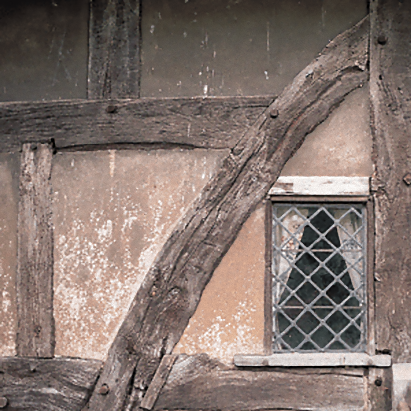
Let’s take timber framing. When most people think of a timber frame building they tend to think of the wood looking like this:

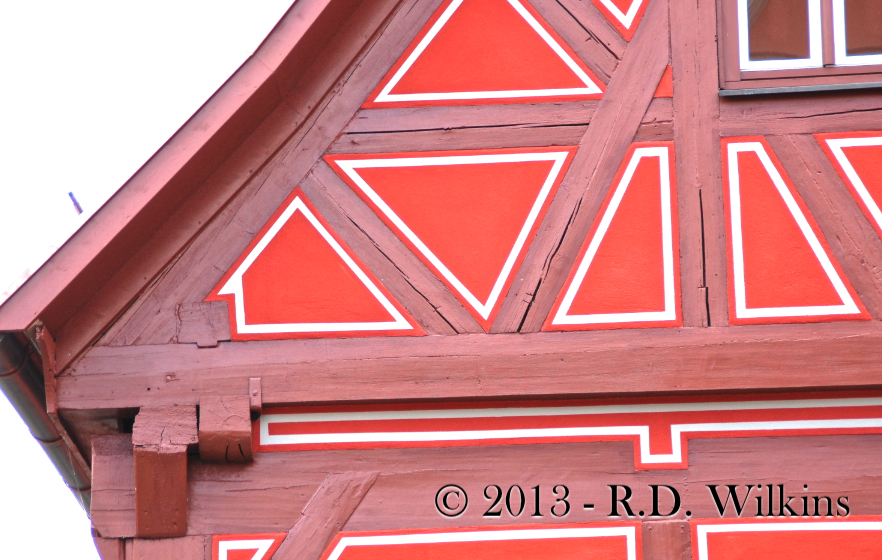
fachwerk3

16th century German timber frame or Fachwerk house.

The wood didn’t look anything like this when it was built. The faces of the wood probably looked more like this (minus the checking or cracks):

restored German Fachwerk building from the mid 1600's.

restored German Fachwerk building from the mid 1600’s.


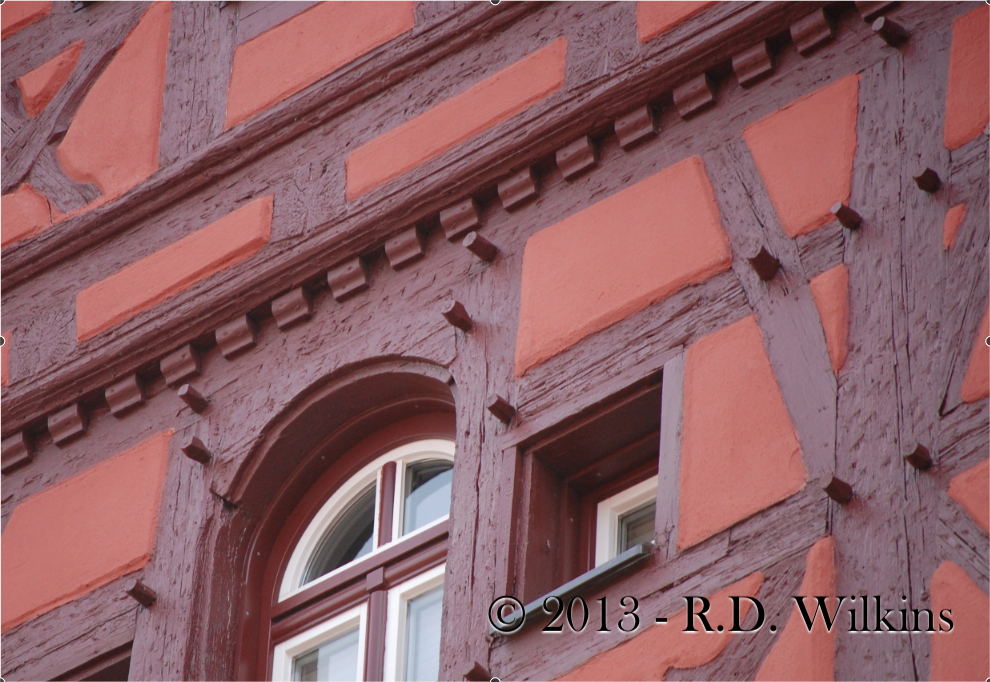
Partly because of this trend toward artistic license, and not understanding period construction which leads to misinterpreting the photographic research available (such as the photo below), wood buildings get designed and built with anachronistic finishes.


fachwerk2

The timbers of this fachwerk building were originally as smooth as those in the previous example. Many years later the faces were scored to act as a grip for the
plaster stucco-like finish that was applied at one time to ‘modernize’ it, much like some old interior brick walls were scored to accept plaster.


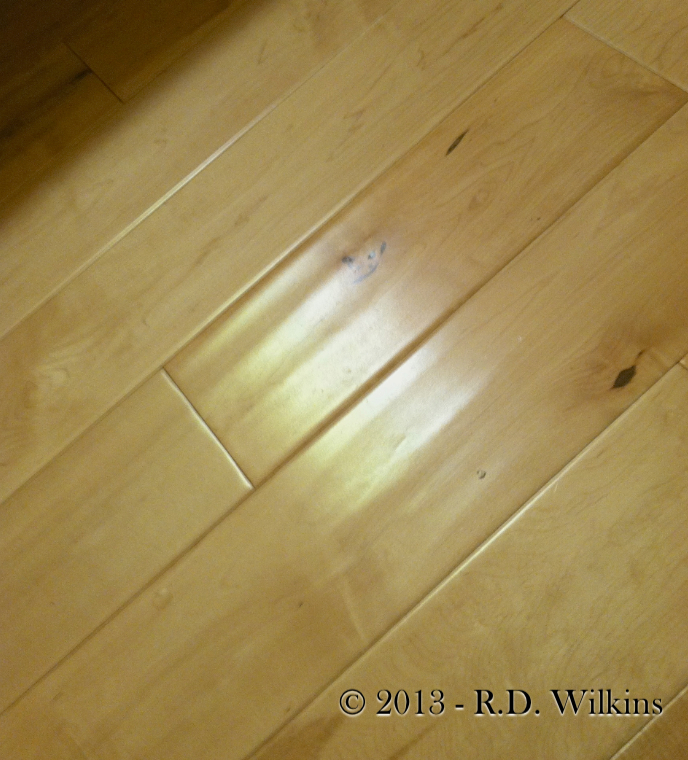
Even the building industry can take some of the blame. Here’s a photo of a popular flooring with a simulated jack plane finish. The plane had a curved blade that was used to quickly take a plank down before being planed smooth to its final thickness. A board with tool marks like this would not likely have been used in a decent dwelling.

fake jack plane tool marks


Today it’s hard to imagine doing all the work involved in processing wood from logs to a finished form without power machinery. How could a hand tool created a finish smoother than a modern tool, much less sandpaper? first of all, the way the tools work today is much different than the way period tools work. And, because it was  a much more labor-intensive process, they didn’t finish surfaces that wouldn’t be seen.

Let’s start with the big stuff. The process of taking logs from a tree to a piece of framing timber in the European tradition in the 16th and 17th centuries involved a number of types of hatchets.

Here’s a video by Christopher Schwarz on the use of hewing axes by Plimoth Plantation’s master joiner, Peter Follansbee:


By the 18th century the process involved not only the hewing axes and saws but an adze to square the sides followed by a broadax to smooth the sides, and possibly a drawknife to remove the axe and adze marks.

Here is a great little video by Ken Koons explaining the process:


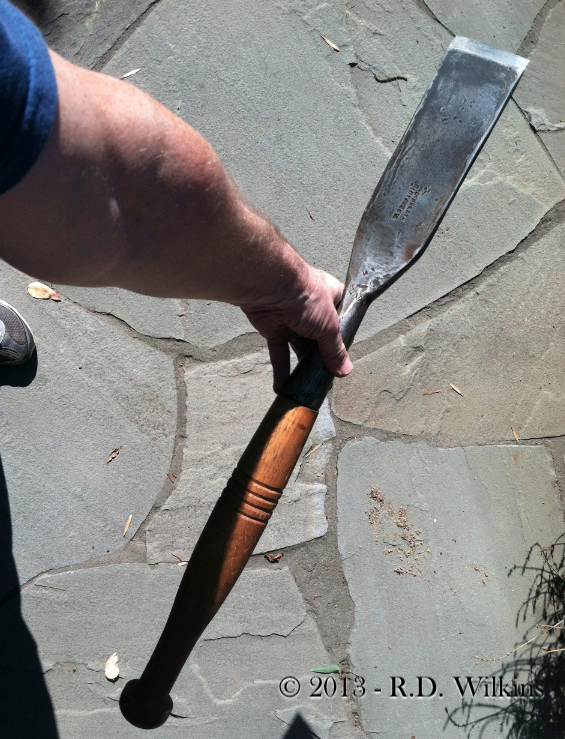
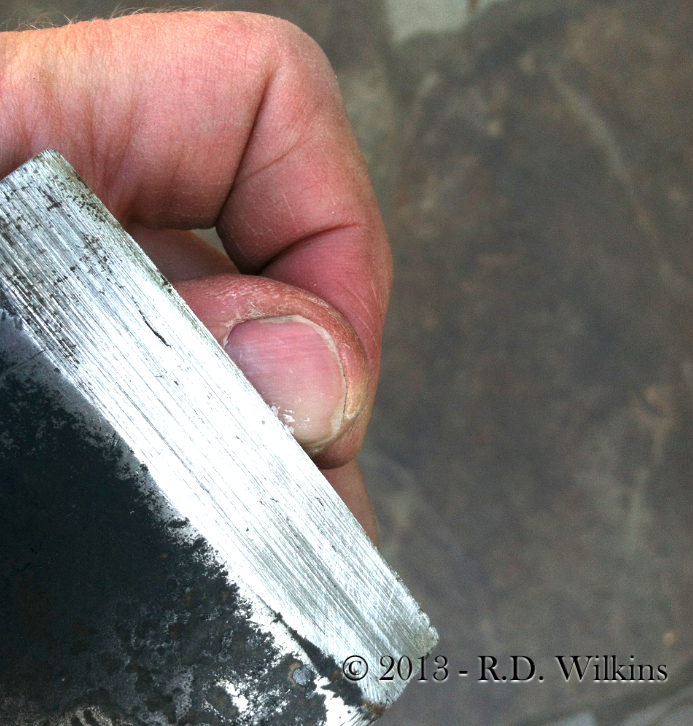
Once the mortises and tenons were cut they were cleaned up and smoothed using chisels and slicks, which were basically large chisels meant to be pushed by hand rather than hit with a mallet. The photo below is of the largest slick in my collection. Made in the late 1860’s in Ohio, it has a 3 inch wide blade. This big blade is certainly closer to a chisel than an axe as you can see from the closeup of the blade as it shaves off a sliver of my thumbnail. The blade will leave a very smooth surface.


A three inch wide framing slick from the mid 1800's

A three inch wide framing slick from the mid 1800’s

framing slick2


Here is a short video by John Neeman of a framing slick in use, you can see how quickly and cleanly it cuts a tenon.


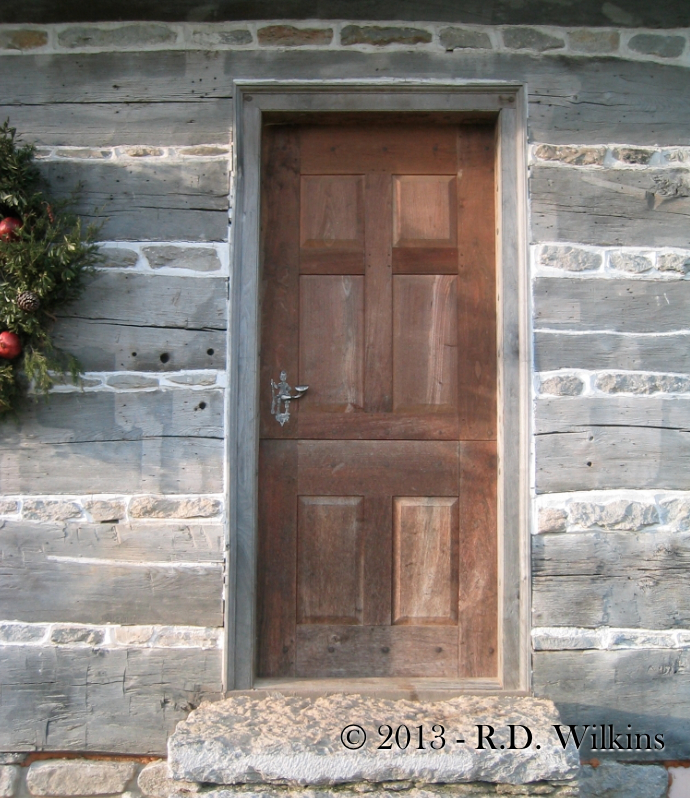
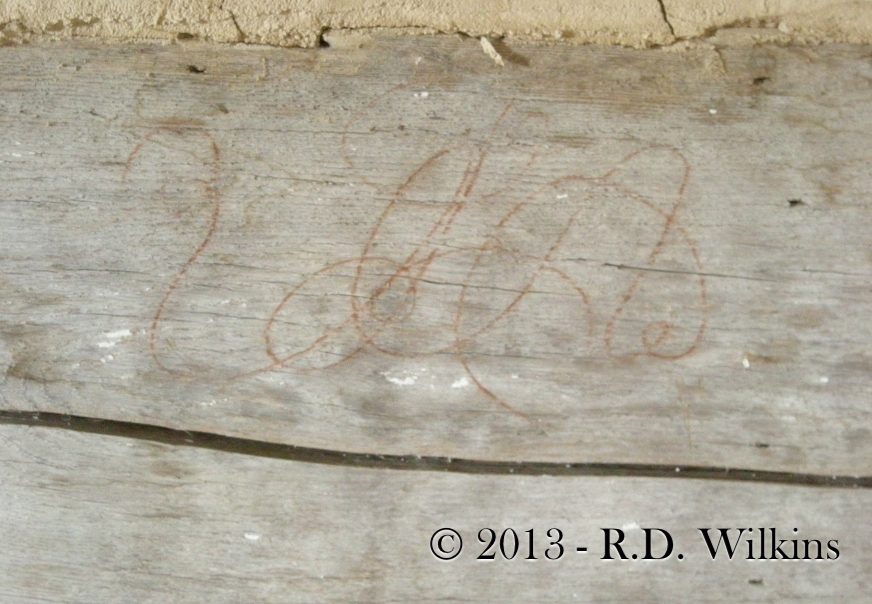
Cut timber surfaces were as smooth as their maker wanted, or needed them to be. Here are two photos of the Daniel Trabue cabin near Lexington, KY. The cabin was restored some years ago and returned to it’s 1797 appearance. The clapboard which had been applied later had protected most of the logs from decay. Notice the tool marks on the exterior logs. Now look at the second picture of an interior wall on the second floor. Here the German maker has signed his name with an 18th century cipher. Notice how clear the signature is. It was made with a traditional crayon made of beeswax and powdered vermillion used for marking out work while building. The crayon was found during the restoration, tucked above the front door lintel. The clarity is only possible because the wood surface is so smooth.

front door of the Daniel Trabue cabin

front door of the Daniel Trabue cabin

18th century cipher of the cabin's builder

18th century cipher of the cabin’s builder


Next week, in Part 2 of this post I’ll talk about and show you how traditional hand tools can actually create a finish that’s superior to their modern day counterparts and why our ancestors didn’t use, or need sandpaper to surface wood. Also, you’ll learn why every recreation of Noah’s Ark you’ve ever seen is dead wrong.

Obsessed With Film

Quote

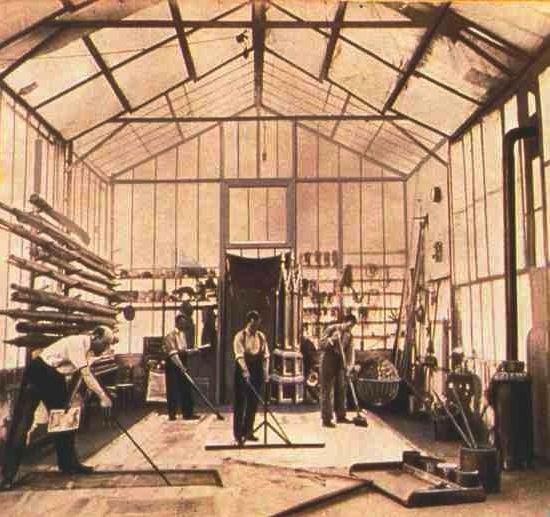
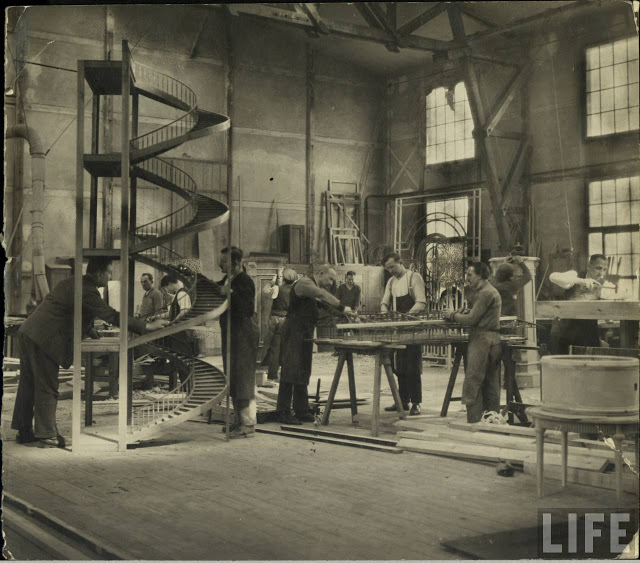
Carpenters building scenery at the UFA Studios in Berlin, 1928. (Photo by E. O. Hoppe

Carpenters building scenery at the UFA Studios in Berlin, 1928. (Photo by E. O. Hoppe

“I have to admit in all modesty that it would never have been possible to make these films if superb set designers, film directors, cameramen, and architects had not been available. I am realizing more than ever that Ufa’s success came about because it was possible to create teams. Film is an art species, or an art-related species that cannot be accomplished by a single man but only by artists in close daily cooperation. It can only be accomplished by people who are obsessed by film.”

Erich Pommer, Producer – Metropolis, The Cabinet Of Dr. Caligari, Dr. Mabuse, Die Niebelungen, Tartuffe, Faust, The Blue Angel, Liliom